Use less text on mobile!
EXACTLY WHAT YOU NEED
EVERYTHING CUSTOMIZABLE
Use less text on mobile!
FEEL THE LUXURY
CONTACT US TO GET A QUOTE AS YOU NEED
EXACTLY WHAT YOU NEED
EVERYTHING CUSTOMIZABLE
CONTACT US & GET YOUR QUOTE
FEEL THE LUXURY
بواسطة Xactz Packaging
28 يوليو 2026
أضف تعليقًا
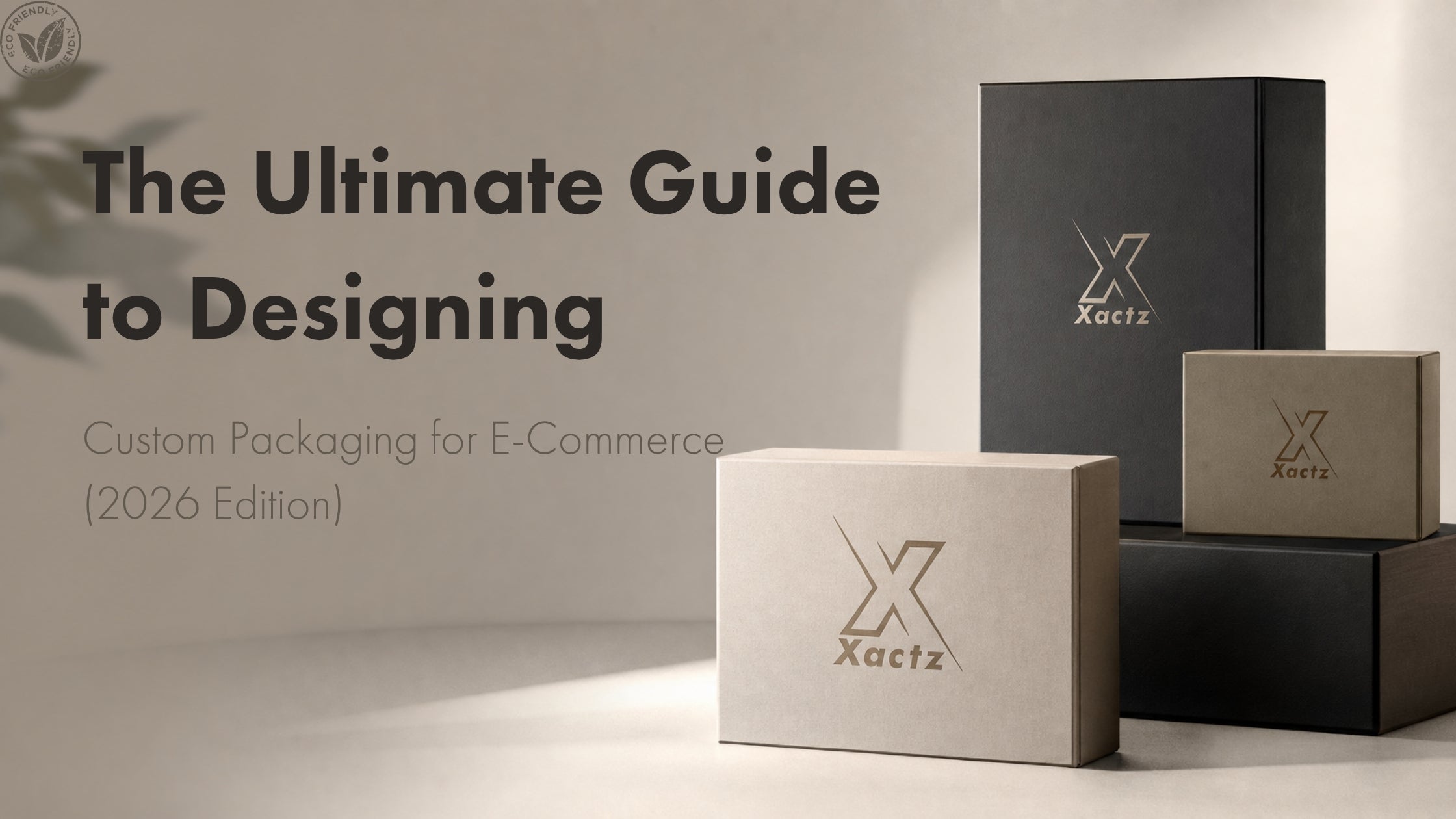
Most brand managers treat custom packaging as the last step in a product launch. The product is finalized, the brand guidelines are approved, and then someone is asked to "sort out the box." This is one of the most expensive mistakes a brand can make in e-commerce.
Custom packaging is not a design decision. It is a business decision with measurable impact on brand perception, customer loyalty, repeat purchase rate, and return costs.
The numbers confirm this at scale. The global custom packaging market was valued at $39.7 billion in 2025 and is projected to reach $59.6 billion by 2033, growing at a compound annual growth rate of 6.0%. This is not a market driven by aesthetics. It is a market driven by brands that have learned, through data, that the box is a revenue-generating asset. The custom packaging market size reflects how seriously the industry now treats packaging as a strategic investment rather than a commodity cost.
96% of consumers say packaging quality directly affects how much they trust a brand. Of those, 27% say the impact is significant, 42% say it is moderate, and 26% say it is slight. That means fewer than 5% of consumers are indifferent to the packaging their order arrives in. For an e-commerce brand spending on acquisition, creative, and fulfillment, ignoring the packaging is ignoring the final and most physical touchpoint in the entire customer journey.
52% of online shoppers say they are likely to make repeat purchases from a brand that delivers orders in premium packaging. This single statistic reframes the entire cost conversation around custom packaging. The question is not "how much does premium packaging cost?" The question is "what is the lifetime value of a repeat customer, and what is the cost of acquiring a new one?"
For B2B brand managers sourcing custom gift boxes, custom mailer boxes, or full custom packaging programs, this guide gives you the structural knowledge, the psychological framework, and the technical foundation to make packaging decisions that compound brand value rather than simply contain a product.
The first structural decision in any custom packaging program is the box type. Three formats dominate e-commerce: single-wall corrugated, rigid boxes, and double-wall corrugated. Each has a distinct cost profile, durability range, aesthetic ceiling, and optimal use case. Choosing the wrong format wastes budget. Choosing the right one multiplies the return on every other design decision you make.
Single-wall corrugated boxes consist of one layer of fluted paper sandwiched between two flat linerboards. They are the workhorse of e-commerce fulfillment. They are lightweight, cost-effective at scale, and provide adequate protection for most non-fragile products shipped in standard fulfillment environments.
Single-wall corrugated boxes usually cost less upfront because they use less material and have a lighter overall construction. For brands shipping high volumes of low-to-mid value products where the packaging is functional rather than experiential, single-wall corrugated is the correct specification. It accepts full-color digital and flexographic print, can be branded with logos and brand colors, and is curbside recyclable in most markets.
The limitation of single-wall corrugated is its aesthetic ceiling. No amount of print finishing transforms a corrugated box into a premium unboxing experience. The fluted structure is visible at cut edges, the surface texture limits print resolution, and the format communicates utility rather than luxury. For brands where the unboxing moment is a brand objective, single-wall corrugated is the wrong starting point.
Best use cases: subscription boxes, FMCG e-commerce, high-volume fulfillment, secondary outer packaging for retail distribution.
Rigid boxes, also called set-up boxes, are constructed from solid greyboard wrapped in printed paper. They do not fold flat for shipping, which means they occupy more warehouse space and cost more to ship empty. These are not limitations. They are the price of the premium signal that rigid boxes deliver.
Rigid boxes offer marketing and branding advantages that corrugated designs cannot match. The solid greyboard core, available from 1,200gsm to 2,000gsm and above, gives the box a weight and structural integrity that communicates value the moment a customer picks it up. The wrapped paper surface accepts the full range of luxury print finishes: soft-touch matte lamination, foil stamping, debossing, embossing, and spot UV. The result is a packaging format where every surface is a brand canvas.
For e-commerce brands in beauty, electronics, spirits, jewelry, watches, and premium gifting, rigid boxes are not a cost. They are a customer retention tool. Brands utilizing custom, high-end packaging experience up to a 40% increase in repeat purchase rates compared to those using standard packaging. That return makes the cost differential between rigid and corrugated irrelevant at any meaningful order volume.
Best use cases: luxury gift boxes wholesale, premium product launches, direct-to-consumer gifting, retail display packaging, subscription boxes for high-value product categories.
Double-wall corrugated boxes add a second layer of fluting between the linerboards, producing a box that is significantly more rigid and impact-resistant than single-wall. The higher durability of corrugated double-wall construction reduces damage-related costs and return rates for heavy, fragile, or high-value products that need transit protection above what single-wall provides.
Double-wall corrugated is the specification for electronics, glassware, ceramics, and any product where transit damage is a meaningful cost risk. It is more expensive than single-wall but substantially cheaper than rigid, making it the correct middle-ground specification for brands that need protection without the premium price point of a rigid box program.
Best use cases: electronics, glassware, fragile products, heavy items, B2B wholesale shipments.
Single-Wall Corrugated Cost per unit: Low. Durability: Moderate. Aesthetic ceiling: Functional. Best for: High-volume fulfillment, subscription boxes.
Double-Wall Corrugated Cost per unit: Medium. Durability: High. Aesthetic ceiling: Functional to mid-range. Best for: Fragile products, electronics, heavy goods.
Rigid Box Cost per unit: Premium. Durability: Very high. Aesthetic ceiling: Ultra-luxury. Best for: Gift boxes, premium product launches, luxury retail.
The unboxing moment is the most underinvested touchpoint in e-commerce. It is the only moment in the entire customer journey where the brand has the customer's complete, undivided physical attention. No competing notifications. No scroll. Just the customer and the box.
Thoughtful unboxing excites customers and strengthens emotional bonds, enhancing brand recall and loyalty. This is not a soft claim. It is a neurological outcome. The tactile experience of opening a well-designed package activates the same reward pathways as the product itself. The weight of the box, the resistance of the lid, the texture of the surface, and the reveal of the product are all processed as part of the product experience, not separate from it.
For B2B brand managers, this means that every finish decision on a custom gift box or custom mailer box is a brand recall decision. Here is how the four primary luxury finishes work and what each one delivers.
Soft-touch matte lamination applies a micro-textured film over the printed surface, creating a velvety, suede-like feel that is immediately associated with premium products. It is the most widely adopted luxury finish in beauty, electronics, and lifestyle packaging because it works across every brand aesthetic from minimalist to maximalist.
Soft-touch is fingerprint-resistant and scuff-resistant, which means the box arrives looking as good as it left the factory. For e-commerce brands where the packaging is photographed, shared on social media, and featured in unboxing content, soft-touch matte is the baseline specification. It photographs exceptionally well, produces deep, rich color reproduction, and creates the tactile contrast that makes foil stamping and spot UV pop.
Foil stamping applies a metallic or pigmented foil to the surface using heat and pressure. The result is a reflective, precise impression that catches light and communicates premium value before the customer has processed a single word of copy. Gold and silver foil are the classic luxury specifications. Rose gold, copper, and holographic foils are increasingly used for contemporary premium positioning.
The psychological mechanism of foil stamping is contrast. On a soft-touch matte surface, a gold foil logo creates an immediate visual hierarchy: the matte surface recedes and the foil advances. The brand mark becomes the first and dominant visual element the customer sees. This is not accidental. It is a deliberate application of visual psychology to brand recall.
For B2B buyers, foil stamping requires a one-time die tooling cost typically ranging from $80 to $200 depending on artwork complexity. This cost is amortized across the production run and is negligible at volumes above 500 units.
Embossing raises the design above the surface of the wrap paper. Debossing presses it in. Both techniques add a tactile dimension to the brand mark that no purely visual finish can replicate: the customer feels the logo as well as sees it.
The psychological impact of tactile brand marks is significant. When a customer runs their finger over a debossed logo, they are engaging with the brand through a sensory channel that is more intimate and more memorable than vision alone. This tactile memory compounds brand recall in a way that flat print cannot.
Debossing is the more contemporary specification for luxury packaging and is particularly effective on 157gsm and above wrap paper where the paper has sufficient body to hold the impression cleanly. Combined with foil stamping, a foil-deboss finish is the current benchmark for ultra-premium custom gift boxes.
Spot UV applies a high-gloss varnish to selected areas of the design, creating a contrast between the varnished and unvarnished surfaces. On a soft-touch matte laminated box, spot UV produces a striking visual effect where the selected design elements appear to emerge from the surface.
Spot UV is the most cost-effective luxury finish available. It does not require a metallic foil or a stamping die, which makes it accessible at lower minimum order quantities than foil stamping. For brands entering the premium packaging market for the first time, spot UV on soft-touch matte is the highest-return starting specification.
Brands that invest in the combination of soft-touch matte lamination, foil stamping, and debossing on rigid box packaging consistently report measurable outcomes across three metrics.
Repeat purchase rate increases because the packaging creates a physical artifact the customer keeps. A rigid box with a luxury finish is not discarded. It is repurposed as storage, displayed on a shelf, or gifted to someone else, extending the brand's physical presence in the customer's environment long after the product has been used.
Social sharing increases because the unboxing moment becomes content-worthy. An estimated 165,000 unboxing videos are watched every hour on YouTube. Packaging that creates a genuine moment of delight is packaging that generates organic reach at zero additional cost.
Return rates decrease because premium packaging signals product quality before the product is seen. A customer who receives a beautifully packaged product has their quality expectations set by the packaging itself, which reduces the psychological gap between expectation and reality that drives returns.
A die-line is the flat, two-dimensional template that defines every cut, fold, and score line of a packaging structure. It is the blueprint that your manufacturer uses to produce your box. A correctly set up die-line means your artwork prints exactly where you intend it to. An incorrectly set up die-line means misprints, misaligned graphics, cut-through artwork, and reprints at full cost.
For brand managers and designers new to custom packaging, die-line setup is the most technically demanding part of the process and the source of the most expensive mistakes. Here is what you need to know before you submit artwork.
Every die-line has three critical zones that your artwork must respect.
The safe zone is the innermost boundary. All text, logos, and critical design elements must sit inside the safe zone. Anything outside the safe zone risks being cut off or folded over during production. As a general rule, keep all critical artwork at least 3mm inside the cut line.
The bleed area extends beyond the cut line, typically by 3mm to 5mm depending on the manufacturer's specification. Any background color or design element that runs to the edge of the box must extend into the bleed area. If your background stops at the cut line, you will get a white edge on the finished box.
The cut line is the exact boundary where the die will cut the flat sheet. Nothing critical should sit on or near the cut line.
Placing text too close to fold lines is the most common mistake in die-line setup. Fold lines are not precise to the millimeter in production. A word or logo that sits directly on a fold line will be partially on one panel and partially on another in the finished box. Keep all text at least 5mm away from any fold or score line.
Using RGB color mode instead of CMYK is a mistake that produces significant color shift between screen and print. All artwork submitted for packaging production must be in CMYK color mode. If your brand colors are specified in Pantone, provide the Pantone reference and request a color proof before approving production.
Submitting low-resolution artwork is a mistake that cannot be corrected in production. All artwork for packaging must be supplied at a minimum of 300 DPI at the final print size. Artwork supplied at 72 DPI from a website or screen export will print with visible pixelation on the finished box.
Ignoring the grain direction of the wrap paper is a mistake that causes warping and poor corner wrapping on rigid boxes. The grain of the wrap paper must run parallel to the longest dimension of the box. Your manufacturer should specify the required grain direction in their die-line template.
Adobe Illustrator is the industry standard for die-line setup. It handles vector artwork natively, supports CMYK color mode, and allows precise placement of artwork relative to die-line layers. Most packaging manufacturers provide die-line templates as Adobe Illustrator files.
Esko Studio and ArtiosCAD are professional packaging design tools used by structural packaging engineers. For brand managers working on complex structural formats or high-volume programs, these tools provide 3D visualization of the finished box from the flat die-line, which eliminates most setup errors before production.
For beginners, Canva and Adobe Express now offer basic packaging templates, but these tools are not recommended for production-ready artwork. They do not support CMYK output, do not handle bleed correctly, and do not produce the file formats required by most packaging manufacturers.
No die-line setup process is complete without a physical sample approval. Before committing to a full production run, always request a printed and finished sample built to your exact specification. Check every panel for color accuracy, check every fold line for artwork alignment, check every corner for wrap paper quality, and check the closure mechanism for smooth operation.
At Xactz, sample turnaround is 1 to 3 business days. Every production run begins with a sample approval stage, and no full production order proceeds without written client sign-off on the physical sample.
Custom packaging for e-commerce in 2026 is not a commodity purchase. It is a brand investment with measurable returns across customer retention, repeat purchase rate, social sharing, and return reduction.
The brands that win in custom packaging are the brands that approach it with a specification mindset rather than a budget mindset. They know their box type before they brief their designer. They know their lamination before they choose their finish. They know their die-line requirements before they submit artwork. And they know their manufacturer's quality standards before they place an order.
The five decisions that define every successful custom packaging program are these.
Choose the right box type for your product category and price point. Single-wall corrugated for high-volume functional fulfillment. Rigid boxes for premium product launches and luxury gifting. Double-wall corrugated for fragile or heavy products that need transit protection.
Specify your finishes before you design. Soft-touch matte lamination as the baseline for any premium application. Foil stamping for brand marks where visual authority matters. Debossing for tactile brand recall. Spot UV for cost-effective luxury on secondary graphic elements.
Set up your die-line correctly the first time. Use Adobe Illustrator. Work in CMYK. Respect the safe zone, the bleed, and the fold line clearances. Submit at 300 DPI minimum.
Always approve a physical sample before full production. No digital proof replaces the physical experience of holding the finished box.
Source from a verified manufacturer with documented quality standards. ISO 9001:2015 certification, FSC certification, and a documented in-process QC protocol are the minimum requirements for any custom packaging program where brand consistency matters.
The box is not the last step. It is the first impression your customer has of your brand in the physical world. Design it accordingly.
Xactz is a verified luxury packaging manufacturer with 40,000 sqm of production facilities in Huizhou and Shenzhen. We produce custom gift boxes, custom mailer boxes, rigid boxes, folding cartons, and full custom packaging programs directly, with no trading company intermediaries and no outsourced production.
Our capabilities cover every specification in this guide: single-wall and double-wall corrugated, rigid boxes from 1,200gsm to 2,000gsm greyboard, soft-touch matte, gloss and velvet lamination, magnetic and ribbon closures, EVA foam, thermoform and paper pulp inserts, foil stamp, deboss and spot UV finishing, all produced under ISO 9001:2015 quality management with an 18-point in-house QC protocol. FSC certified (SGS-COC-332603).
Sample turnaround: 1 to 3 business days. Production lead time: 10 to 18 days. MOQ: flexible for B2B brand managers and procurement teams.
Ready to design your custom packaging?
Visit https://xactz.com/pages/get-a-factory-direct-quote to submit your specification and receive a factory-direct quote.
Browse our full range of custom gift boxes and rigid boxes at https://xactz.com/.
Read more B2B packaging sourcing guides at https://xactz.com/blogs/news.
بواسطة Xactz Packaging
16 أغسطس 2026
بواسطة Xactz Packaging
13 أغسطس 2026
بواسطة Xactz Packaging
12 أغسطس 2026
