Use less text on mobile!
EXACTLY WHAT YOU NEED
EVERYTHING CUSTOMIZABLE
Use less text on mobile!
FEEL THE LUXURY
CONTACT US TO GET A QUOTE AS YOU NEED
EXACTLY WHAT YOU NEED
EVERYTHING CUSTOMIZABLE
CONTACT US & GET YOUR QUOTE
FEEL THE LUXURY
بواسطة Xactz Packaging
13 أغسطس 2026
أضف تعليقًا
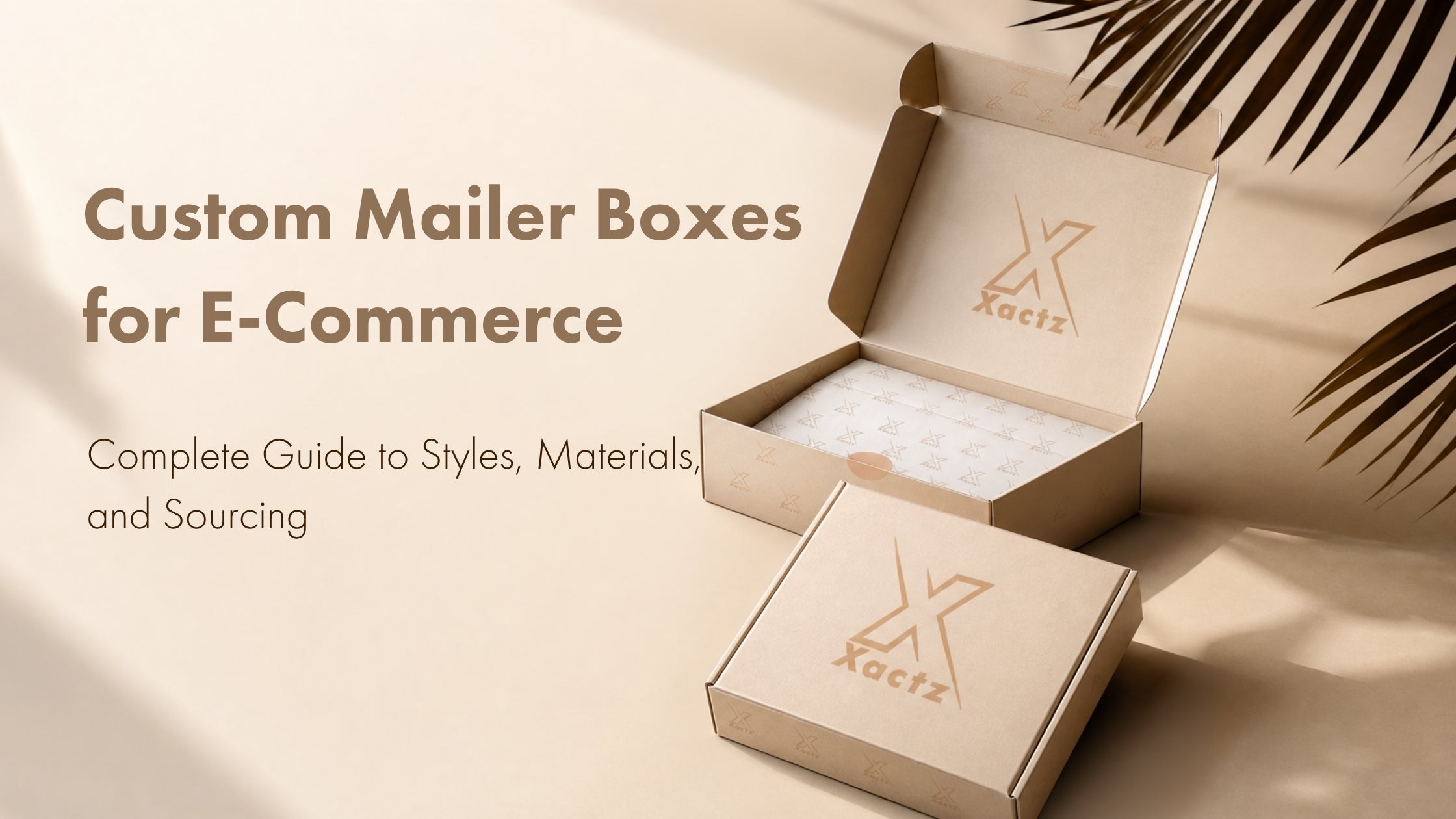
In modern e-commerce, the shipping box is no longer just a protective vessel. It is the first physical touchpoint a customer has with your brand. The moment a parcel arrives at a customer's door, the packaging communicates a brand decision. A generic brown box communicates commodity. A custom mailer box communicates investment, intention, and identity.
Custom mailer boxes have evolved from functional shipping containers into powerful marketing assets that drive brand perception, customer retention, and organic social media visibility. For DTC brands, subscription services, and premium e-commerce operators in 2026, the custom mailer box is one of the highest-return packaging investments available.
A mailer box, also referred to as a subscription box, roll-end tuck-top, or corrugated mailer, is a self-locking, paperboard-based packaging container engineered specifically for shipping goods through parcel networks. Unlike standard shipping cartons that require tape or adhesive to close, custom mailer boxes feature engineered flaps, dust-flaps, and interlocking tabs that create a secure, tool-free closure that holds through the rigors of parcel transit without additional sealing materials.
The structural distinction that separates a custom mailer box from a standard corrugated shipper is the opening experience. A standard shipper is torn open. A custom mailer box opens. That distinction is the entire brand opportunity.
The global e-commerce packaging market was valued at USD 67.5 billion in 2026 and is projected to reach USD 136.8 billion by 2034, driven by accelerating DTC brand growth, subscription commerce expansion, and rising consumer expectations for premium unboxing experiences across every product category. Custom mailer boxes are the primary packaging format capturing that growth.
Custom mailer boxes deliver operational, commercial, and brand benefits that standard shipping cartons cannot replicate. Understanding each benefit allows brand managers and procurement teams to build the business case for custom mailer investment across the full supply chain.
Tool-Free Assembly
Custom mailer boxes are engineered for rapid, tool-free assembly at fulfillment centers. The interlocking flap and tab system creates a secure closure without adhesive tape, reducing fulfillment labor time per unit and eliminating the consumable cost of tape across high-volume operations. For subscription commerce brands processing thousands of units per fulfillment cycle, the labor and consumable savings compound significantly over the course of a year.
Unboxing Experience
A custom mailer box opens like a presentation box, providing immediate product visibility and a considered reveal mechanic that a standard shipper cannot deliver. The interior of the box lid is a fully printable brand canvas. The moment the box opens, the customer sees brand color, messaging, or pattern before they see the product. That sequence is the unboxing experience, and it is the primary driver of the social media sharing behavior that generates organic brand reach at zero media cost.
Research consistently shows that customers who receive premium unboxing experiences are significantly more likely to share the experience on social media, leave positive reviews, and make repeat purchases. For DTC brands where customer acquisition cost is the primary growth constraint, the custom mailer box is a retention and referral tool as much as it is a packaging specification.
Structural Durability
Double-walled corrugated construction provides superior crush resistance, puncture resistance, and stacking strength compared to single-wall alternatives. For e-commerce brands shipping fragile, high-value, or irregularly shaped products through parcel networks where packages are routinely stacked, dropped, and compressed, the structural performance of the corrugated mailer box is a direct determinant of damage rates, return rates, and customer satisfaction scores.
The flute is the corrugated medium, the wave-shaped layer of paperboard sandwiched between the flat liner sheets that gives corrugated packaging its structural strength. Flute selection determines the strength, weight, foldability, and print quality of the finished mailer box. Choosing the wrong flute for the product weight, transit requirements, and print specification is one of the most common and most costly custom mailer box specification errors.
E-Flute: 1.5 mm
E-flute is the standard specification for custom mailer boxes in premium e-commerce, subscription commerce, and retail-ready packaging applications. At 1.5 mm caliper, E-flute provides an exceptionally smooth, flat outer surface that delivers outstanding print quality across digital, flexographic, and litho-lamination printing processes. It is lightweight, folds cleanly along precision die-cut score lines, and provides sufficient crush resistance for lightweight to medium-weight retail goods shipped through standard parcel networks.
E-flute is the correct specification for cosmetics, apparel, accessories, books, stationery, food and beverage, and any product category where print quality and brand presentation are the primary packaging priorities alongside structural adequacy for the product weight.
B-Flute: 3.0 mm
B-flute provides greater cushioning and stacking strength than E-flute at the cost of a slightly less smooth print surface. At 3.0 mm caliper, B-flute is the correct specification for medium-to-heavy goods, glassware, ceramics, electronics, and any product category where drop-test performance and stacking strength are the primary structural requirements. B-flute is the most widely used flute specification in standard e-commerce shipping across all product categories globally.
F-Flute: 0.8 mm
F-flute is the finest corrugated flute available, delivering an exceptionally smooth surface with outstanding print quality at the thinnest possible caliper. At 0.8 mm, F-flute is the correct specification for luxury micro-packaging, premium cosmetic inserts, high-end retail packaging, and any application where the packaging must be as thin and lightweight as possible while maintaining the structural benefits of corrugated construction over folding carton. F-flute is increasingly specified by luxury DTC brands seeking the print quality of a rigid box at the weight and cost of a corrugated mailer.
EB-Flute: 4.5 mm
EB-flute combines E-flute and B-flute in a double-wall construction, delivering the highest crush resistance and stacking strength available in a standard corrugated mailer format. At 4.5 mm caliper, EB-flute is the correct specification for heavy-duty e-commerce applications including electronics, appliances, wine and spirits, and any product category where the combined weight and fragility of the contents demands maximum structural protection throughout the parcel transit cycle.
The structural style of a custom mailer box determines the opening experience, the closure security, the assembly speed, and the suitability for automated fulfillment. Selecting the correct structural style for the operational context is as important as selecting the correct flute specification.
Roll-End Tuck-Top (RETT)
The Roll-End Tuck-Top is the industry standard custom mailer box format and the most widely specified structure in e-commerce packaging globally. The RETT features a roll-end base that provides double-wall protection at the base and sides, and a tuck-top lid that folds closed and locks without tape or adhesive. The double-wall construction at the base and lower sides provides superior crush resistance during transit and stacking. The tuck-top lid opens cleanly to reveal the full interior of the box in a single motion, delivering the unboxing reveal that drives social sharing behavior.
The RETT is the correct specification for the majority of e-commerce, subscription, and DTC packaging applications. It is compatible with manual and semi-automated fulfillment and is the most cost-efficient custom mailer structure at all volume levels.
Roll-End Tuck-Front (RETF)
The Roll-End Tuck-Front is a variant of the RETT in which the tuck closure is positioned at the front of the box rather than the top, with locking wings that engage the side panels to create a more secure closure during automated shipping and high-speed fulfillment operations. The RETF is the correct specification for brands operating high-volume automated fulfillment lines where the tuck-front locking mechanism provides greater closure security at machine speeds than the standard tuck-top format.
One-Piece Folder (OPF)
The One-Piece Folder is a flat, single-panel structure that wraps around thin, flat items and closes with overlapping flaps. It is the correct specification for books, vinyl records, art prints, flat apparel, documents, and any thin, rigid item that does not require a three-dimensional box structure for protection or presentation. The OPF is the most material-efficient and lowest-cost custom mailer structure available and is the standard format for media mail and flat-item e-commerce shipping.
The outer liner of a custom mailer box is the print surface and the primary visual brand carrier. Substrate selection determines the print quality, the brand aesthetic, the sustainability credentials, and the surface finish compatibility of the finished box.
Kraft (Unbleached Brown)
Kraft liner is manufactured from unbleached wood pulp, retaining the natural brown color of the raw fiber. It communicates a natural, sustainability-forward brand aesthetic that resonates strongly with eco-conscious consumers across food, wellness, beauty, and lifestyle categories. Kraft liner is compatible with one and two-color flexographic printing and with full-color digital printing. It is the most sustainable liner option available and is fully recyclable and repulpable in standard paper recycling streams.
Standard White (Bleached)
White-top liner is manufactured from bleached wood pulp or coated recycled fiber, providing a clean, bright white print surface that is compatible with full-color printing across all printing processes. It is the most versatile substrate for custom mailer boxes and the correct specification for brands requiring vibrant, high-definition full-color exterior graphics across the full exterior surface of the box.
Mottled White and Kemi Kraft
Mottled white and Kemi Kraft liners are premium coated substrates that deliver a smoother, more consistent print surface than standard white or kraft liner, enabling higher-definition print reproduction and more accurate color matching for premium brand applications. These substrates are the correct specification for luxury e-commerce brands, premium subscription services, and any application where the print quality of the mailer box must match the visual standards of the brand's retail or digital presence.
Print method selection for custom mailer boxes is determined by order volume, design complexity, color count, and per-unit cost targets. Each printing process has a distinct optimal volume range and quality profile.
Digital Printing
Digital printing applies ink directly to the corrugated substrate using inkjet or laser technology without printing plates or setup tooling. It is the correct specification for low-to-medium volume runs from 50 to 2,000 units, for designs with photographic complexity or high color counts, and for brands that require short lead times, variable data printing, or frequent design changes. Digital printing delivers the highest per-unit cost at high volumes but the lowest setup cost and fastest turnaround at low volumes.
Flexographic Printing
Flexographic printing uses flexible rubber or photopolymer printing plates to apply water-based inks to the corrugated substrate at high speed. It is the correct specification for medium-to-large volume runs from 1,000 to 100,000 units and above, delivering the lowest per-unit cost at high volumes with good color consistency and adequate print quality for bold graphic designs with solid color fills and simple typography. Flexographic printing has higher setup costs than digital due to plate manufacturing but delivers significantly lower per-unit costs at volume.
Litho-Lamination
Litho-lamination prints a high-resolution lithographic sheet on a separate press and laminates it to the corrugated substrate, delivering offset-quality print reproduction on a corrugated structure. It is the correct specification for luxury e-commerce brands, premium subscription services, and any application requiring photographic-quality print reproduction, fine typography, or complex gradient artwork on a corrugated mailer box. Litho-lamination has the highest setup cost and longest lead time of the three processes but delivers print quality that is indistinguishable from a rigid box at a fraction of the structural cost.
The unboxing experience is the moment the customer opens the box and encounters the brand for the first time in three dimensions. Every element visible during the opening sequence is a brand touchpoint, and each one can be specified to reinforce the brand identity, communicate brand values, and create the emotional response that drives sharing, retention, and loyalty.
Interior Printing
The interior of a custom mailer box is a fully printable brand canvas that the customer sees the moment the lid opens. Interior printing adds brand color, pattern, messaging, or illustration to the inside surfaces of the box, transforming the opening moment from a functional action into a brand experience. Interior printing is one of the highest-impact, lowest-cost brand differentiation options available in custom mailer box specification.
Custom Protective Inserts
Die-cut cardboard inserts manufactured from FSC-certified or PCR board provide product protection and presentation structure within the mailer box at zero tooling cost and with full recyclability. Thermoformed molded pulp inserts deliver precise product contouring, premium tactile presentation, and full recyclability for brands building EU PPWR compliant packaging systems. Foam inserts provide maximum shock absorption for fragile or high-value products where drop-test performance is the primary specification criterion.
Surface Finishes
Water-based soft-touch coating applied to the exterior of a custom mailer box delivers the velvety, low-glare surface finish that defines quiet luxury packaging in 2026 and is fully recyclable and EU PPWR compliant. Hot foil stamping in gold, silver, rose gold, or holographic applies a premium metallic brand signal to the exterior surface that photographs exceptionally well for e-commerce and social media. Spot UV varnish applies a high-gloss coating to selected design elements, creating a contrast between matte and gloss surfaces that reads as premium and adds tactile interest to the exterior.
Specifying the correct custom mailer box structure, flute, and substrate is necessary but not sufficient for a high-performing e-commerce packaging program. Operational and logistics optimization across four key dimensions ensures that the packaging investment delivers its full commercial return.
Optimize Dimensional Weight
DIM weight pricing by parcel carriers means that the internal volume of the mailer box directly determines the shipping cost of every unit dispatched. Designing the box dimensions tightly around the product dimensions, with sufficient clearance for the insert and void fill specification but no excess internal volume, is the single most impactful cost optimization available in e-commerce packaging. A box that is 20 mm too large in each dimension can add a meaningful freight cost premium to every unit shipped over the life of the packaging program.
Right-Sizing and Void Fill
Right-sizing the mailer box to the product eliminates the need for excessive void fill materials, reduces the weight of each shipment, and improves the unboxing experience by eliminating the frustration of opening a large box to find a small product buried in filler. Where void fill is required, specify recyclable tissue paper, shredded kraft paper, or molded pulp void fill in preference to plastic air pillows or polystyrene loose fill to maintain sustainability credentials and EU PPWR compliance.
Transit Testing
Performing ISTA or ASTM drop-test and vibration-test protocols on production-representative samples before committing to full production volume ensures that the structural specification delivers the required protection performance in the actual parcel transit environment. Transit testing is particularly important for fragile products, heavy products, and products being shipped internationally through multi-leg parcel networks where the cumulative handling stress is significantly higher than domestic single-leg shipments.
Tamper Seals and Easy Returns
Integrating a self-adhesive tamper seal strip into the mailer box closure provides visible evidence of tampering for high-value shipments and eliminates the need for tape at the fulfillment stage. Including a second peel-and-seal strip on the interior of the lid enables the customer to reseal the box for a return shipment without additional packaging materials, reducing the friction of the returns process and improving the customer experience at one of the highest-risk touchpoints in the e-commerce journey.
Xactz designs and manufactures custom mailer boxes factory-direct, working directly with brand managers, packaging designers, and e-commerce operators to develop custom mailer box programs that deliver premium brand impact, operational efficiency, and optimized landed cost.
Our factory-direct service includes custom dieline development and structural prototyping, FSC-certified and PCR substrate specifications, full printing options across digital, flexographic, and litho-lamination processes, surface finish options including soft-touch matte, hot foil stamping, and spot UV varnish, custom insert engineering in molded pulp, die-cut cardboard, and foam, EU PPWR Declaration of Conformity and recyclability assessment, and dedicated production management from prototype to delivery.
To receive a fast and accurate factory-direct quote, prepare the following specifications:
Know your specifications and get a factory-direct quote from Xactz today. Visit xactz.com and contact us to start your custom mailer box project. From first dieline to final delivery, our factory-direct team is with you at every step.
بواسطة Xactz Packaging
16 أغسطس 2026
بواسطة Xactz Packaging
12 أغسطس 2026
بواسطة Xactz Packaging
11 أغسطس 2026
