Use less text on mobile!
EXACTLY WHAT YOU NEED
EVERYTHING CUSTOMIZABLE
Use less text on mobile!
FEEL THE LUXURY
CONTACT US TO GET A QUOTE AS YOU NEED
EXACTLY WHAT YOU NEED
EVERYTHING CUSTOMIZABLE
CONTACT US & GET YOUR QUOTE
FEEL THE LUXURY
By Xactz Packaging
Jul 8, 2026
Add a comment
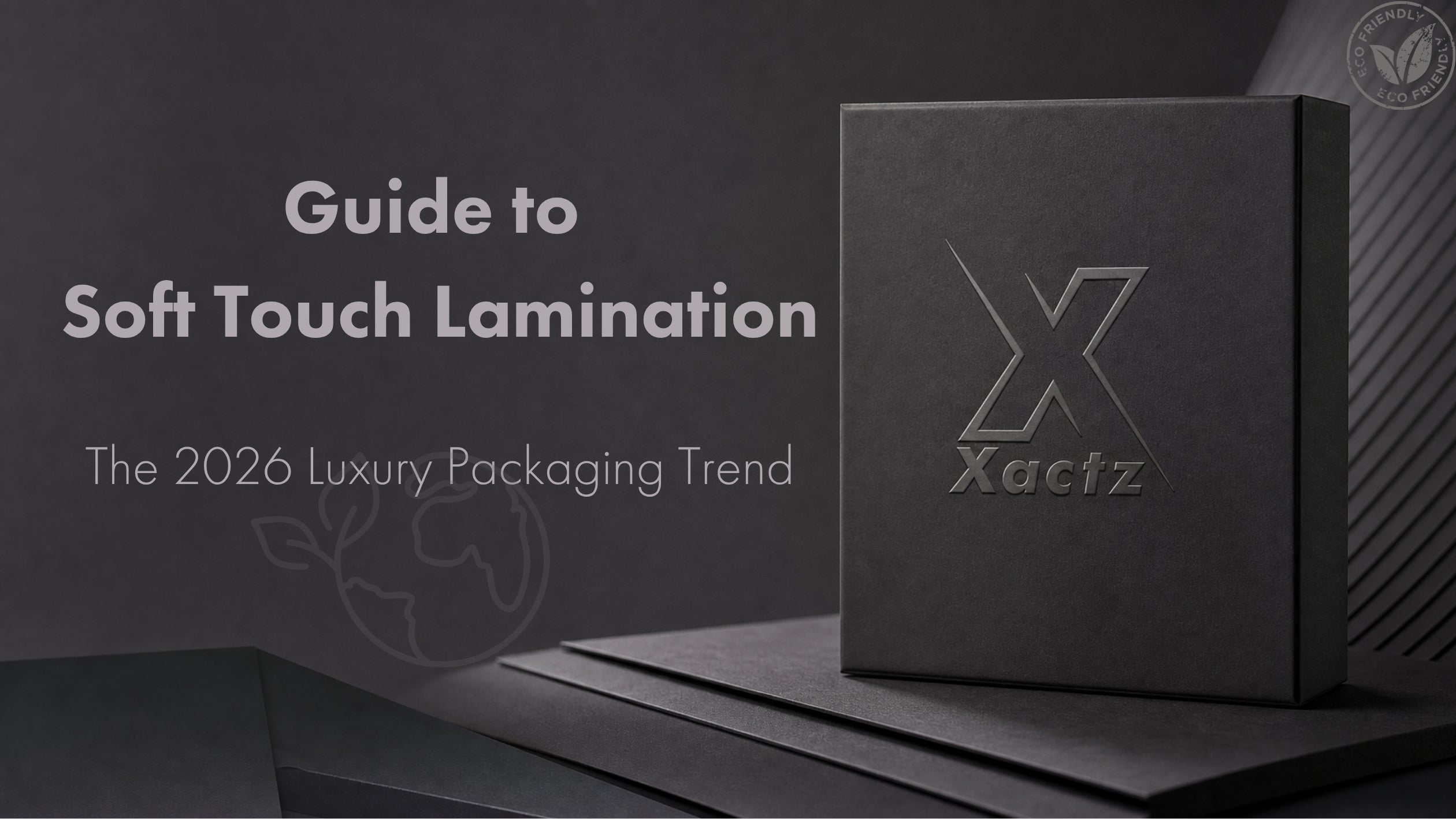
There is a finish that luxury brands across cosmetics, spirits, jewellery, fashion, and consumer electronics have been specifying at an accelerating rate for the past three years. You have touched it on a perfume box, a premium skincare carton, a high-end chocolate gift box, or a luxury rigid box and immediately registered something different. The surface felt like suede. It felt like velvet. It felt expensive in a way that gloss lamination and standard matte lamination do not.
That finish is soft touch lamination. It is also called velvet lamination, soft feel lamination, and touch feel lamination depending on the manufacturer and the market. The names all refer to the same surface finishing technology, and in 2026 it has become the single most specified surface finish in premium and luxury packaging across every major product category.
This guide explains exactly what soft touch lamination is, how it is applied, what it communicates about a brand, which packaging formats and product categories it works best for, and how it performs in combination with foil stamping, spot UV, and blind embossing to create the finish combinations that define premium packaging in 2026.
Soft touch lamination is a surface finishing process in which a thin polymer film, typically between 12 and 30 microns thick, is bonded to the outer surface of a printed substrate using heat and pressure. The film contains a specialised coating of microscopic raised particles, typically polyurethane or acrylic-based, that create a micro-texture on the surface. It is this micro-texture that produces the characteristic velvet or suede tactile sensation when the surface is touched.
The result is a surface that is simultaneously matte in appearance and tactile in feel. Under light, a soft touch laminated surface absorbs rather than reflects, giving it a depth and richness that standard matte lamination does not achieve. Under the fingertip, it has a slight drag and warmth that registers immediately as premium, in the same way that a high-thread-count fabric registers differently from a standard cotton sheet.
Soft touch lamination is applied to the outer surface of folding cartons, rigid boxes, paper bags, book covers, labels, and any other printed substrate where a premium tactile surface is required. It is compatible with all standard printing processes including offset lithography, digital printing, and flexographic printing, and it can be applied in both sheet-fed and roll-to-roll lamination processes.
The film is available in several variants. Standard soft touch film produces the classic velvet feel. Silk soft touch film produces a slightly smoother, more refined surface with a lower drag coefficient. Matte soft touch film produces a flatter, more restrained surface that is closer to an uncoated paper feel but with the durability and scuff resistance of a laminated surface. Each variant has a distinct tactile character and the choice between them should be driven by the brand aesthetic and the product category.
The application process for soft touch lamination follows the same fundamental sequence as standard lamination but requires more precise temperature and pressure control to achieve a consistent, defect-free surface.
The printed substrate, typically a sheet of coated or uncoated board, is fed into a laminating machine where the soft touch film is unwound from a roll and brought into contact with the printed surface. Heat is applied to activate the adhesive layer on the film, and pressure rollers bond the film to the substrate in a single, continuous pass. The laminated sheet is then cooled, trimmed, and passed to the next finishing process, whether that is foil stamping, spot UV, embossing, die cutting, or box assembly.
The critical quality control points in soft touch lamination are temperature consistency, pressure uniformity, and film tension. Temperature variation across the laminating roller produces uneven adhesion, which results in bubbling or delamination at the edges of the sheet. Pressure inconsistency produces surface irregularities that are visible under raking light and detectable by touch. Film tension variation produces waviness in the finished surface that is particularly visible on large flat panels such as the lid of a rigid box.
At Xactz, soft touch lamination is applied on fully automated laminating equipment with closed-loop temperature and pressure monitoring, and every laminated sheet passes through our 18-point in-house quality control system before proceeding to the next production stage. Surface consistency is verified visually and by touch across a sample of sheets from every production run.
The choice of surface finish is one of the most direct and immediate brand communication decisions in packaging design. The customer touches the packaging before they open it, before they read the brand name, and before they see the product. The tactile signal from the surface finish is the first physical brand communication the customer receives.
Soft touch lamination communicates restraint, confidence, and considered quality. The velvet-feel surface signals that the brand has invested in the physical experience of the packaging, not just in the printed design. It communicates that the brand understands the difference between a surface that looks premium and a surface that feels premium, and that it has chosen to deliver both.
In the luxury consumer goods market in 2026, the dominant aesthetic direction is quiet luxury. Brands are moving away from loud, logo-heavy, high-gloss packaging and toward surfaces that communicate quality through restraint, texture, and material choice rather than through visual noise. Soft touch lamination is the surface finish that most directly embodies this direction. It is the physical equivalent of a well-tailored suit in a neutral colour: immediately recognisable as premium to anyone who knows quality, and entirely without the need to announce itself.
Consumer research consistently shows that packaging with a premium tactile surface increases the perceived value of the product inside. In blind tests across cosmetics, spirits, and jewellery categories, products packaged in soft touch laminated boxes are consistently rated as higher quality and higher value than identical products packaged in standard matte or gloss laminated boxes. The finish is not decorative. It is commercial. It is doing measurable work on perceived value and purchase intent before the product is even seen.
Soft touch lamination performs at its highest commercial impact in packaging categories where the tactile experience of the packaging is a primary brand signal. These are the categories where the customer is most likely to handle the packaging before purchase, where gifting desirability is a key commercial driver, and where perceived value has the most direct impact on price point and purchase decision.
Luxury rigid boxes are the highest-impact application for soft touch lamination. The large flat panels of a rigid box lid and base provide the maximum surface area for the tactile finish to register, and the structural weight of a premium rigid box combined with a soft touch exterior creates a hand-feel combination that is immediately and unmistakably premium. Rigid boxes for jewellery, cosmetics, spirits, fashion accessories, and consumer electronics are the most common applications.
Folding cartons for premium cosmetics and skincare are the second highest-impact application. The skincare and cosmetics category has the highest density of soft touch lamination specification of any packaging category, driven by the direct retail shelf interaction where the customer picks up and handles the carton before purchase. A soft touch laminated skincare carton on a retail shelf communicates premium quality in the two seconds of physical handling before the customer reads a single word of copy.
Paper carrier bags and gift bags for luxury retail are a strong application for soft touch lamination, particularly for brands where the carrier bag is a visible brand signal in a retail or gifting context. A soft touch laminated paper bag communicates the same premium quality as a soft touch laminated box and extends the brand's tactile identity into the secondary packaging layer.
Book covers, premium stationery, and brand collateral including lookbooks, product catalogues, and brand books are strong applications for soft touch lamination in the B2B and brand identity context. A soft touch laminated brand book communicates the same quality and restraint as a soft touch laminated product box and extends the brand's tactile identity into every physical brand touchpoint.
Wine and spirits boxes are a growing application for soft touch lamination, driven by the premiumisation trend in the wine and spirits category and the increasing importance of gifting presentation in spirits retail. A soft touch laminated wine box or spirits gift box communicates premium quality at the moment of gifting that a standard laminated box cannot match.
The combination of soft touch lamination and foil stamping is the most commercially proven finish combination in luxury packaging in 2026. It is the combination that most directly delivers the quiet luxury aesthetic that is defining premium brand positioning across every major consumer goods category.
The mechanism is contrast. Soft touch lamination creates a matte, light-absorbing, tactile surface. Foil stamping creates a reflective, light-catching, visually precise detail. When a foil-stamped brand mark or decorative element is applied over a soft touch laminated surface, the contrast between the two finishes creates a visual and tactile hierarchy that is immediately perceived as sophisticated and premium.
The most effective foil specifications for soft touch lamination combinations in 2026 are matte gold foil, matte silver foil, and matte rose gold foil. Matte foils maintain the restrained, non-reflective aesthetic of the soft touch surface while adding a metallic warmth and depth that communicates luxury without visual noise. Gloss foils can also be used effectively over soft touch lamination, particularly for brand marks that require high visibility and strong contrast, but the matte foil combination is the more sophisticated and trend-aligned specification for 2026.
The registration precision required for foil stamping over soft touch lamination is higher than for foil stamping over standard laminated surfaces because the soft touch surface has a slightly higher coefficient of friction that can affect sheet positioning in the foil stamping press. At Xactz, foil stamping over soft touch lamination is performed on calibrated equipment with registration tolerances held to within 0.2mm across the full sheet, ensuring clean, precise foil placement on every production run.
Spot UV over soft touch lamination is the finish combination that delivers the highest visual drama of any two-finish combination in premium packaging. The contrast between the matte, light-absorbing soft touch surface and the high-gloss, light-reflecting spot UV element creates a visual effect that shifts dramatically under different lighting conditions and viewing angles.
Under direct light, the spot UV element appears as a high-gloss, almost wet surface against the matte soft touch background. Under raking or angled light, the spot UV element catches the light while the soft touch surface remains flat and absorbed, creating a three-dimensional visual effect that is impossible to replicate in print alone. This lighting-dependent visual behaviour is particularly effective for packaging that is displayed under retail lighting, photographed for e-commerce, or handled in a gifting context where the packaging is examined closely before opening.
The most effective spot UV applications over soft touch lamination are brand marks, pattern elements, and texture overlays rather than large solid areas. A spot UV brand mark on a soft touch surface reads as a premium, considered detail. A large spot UV solid area on a soft touch surface can read as visually heavy and can reduce the restrained, tactile quality that makes soft touch lamination commercially effective in the first place.
Blind embossing and debossing over soft touch lamination is the finish combination that delivers the most purely tactile brand experience in luxury packaging. Where foil stamping and spot UV add visual contrast, blind embossing and debossing add physical dimension to the soft touch surface without introducing any additional visual element.
A blind debossed brand mark on a soft touch laminated surface is felt before it is seen. The customer's fingertip registers the recessed brand mark in the velvet-feel surface as a subtle, considered detail that communicates craftsmanship and precision. Under raking light, the debossed element becomes visible as a shadow detail that adds depth to the surface without any additional colour or finish. This combination is the purest expression of the quiet luxury aesthetic in packaging: a brand mark that is present but not announced, felt but not shouted.
The depth specification for blind embossing and debossing over soft touch lamination is typically between 0.3mm and 0.8mm depending on the board weight and the complexity of the design. Deeper embossing over soft touch lamination requires a heavier board weight to prevent cracking at the emboss edges. At Xactz, blind embossing and debossing depth is specified in consultation with the client's design file and the board weight specification to ensure clean, crack-free results across the full production run.
Understanding the difference between soft touch lamination, matte lamination, and gloss lamination is essential for making the right surface finish specification for a packaging brief.
Gloss lamination applies a high-gloss, light-reflecting film to the substrate surface. It produces vivid colour reproduction, high contrast, and a visually impactful surface that performs well under retail lighting. It is durable and scuff-resistant. It communicates energy, confidence, and visual impact. It is the correct specification for packaging categories where visual shelf impact is the primary commercial driver and where the brand aesthetic is bold, colourful, and direct. It is not the correct specification for packaging where tactile premium quality and quiet luxury are the primary brand signals.
Matte lamination applies a low-sheen, light-diffusing film to the substrate surface. It produces a flat, even surface with reduced colour saturation compared to gloss lamination. It is durable and provides good scuff resistance. It communicates restraint and seriousness. It is a strong specification for premium packaging where a clean, flat surface is required and where the brand aesthetic is minimal and considered. However, it has no tactile differentiation from an unlaminated surface and does not deliver the premium hand-feel that soft touch lamination provides.
Soft touch lamination applies a micro-textured, light-absorbing film to the substrate surface. It produces a matte appearance with deeper colour absorption than standard matte lamination and a velvet or suede tactile surface that is immediately perceived as premium. It communicates restraint, quality, and considered luxury. It is the correct specification for any packaging where the tactile experience of the surface is a primary brand signal and where the brand is positioning in the premium or luxury segment.
The cost differential between soft touch lamination and standard matte lamination is typically in the range of 15 to 25 percent on the lamination process cost, which translates to a smaller percentage increase in total packaging unit cost depending on the complexity of the structure and the other finishing processes specified. For premium and luxury brand positioning, the perceived value uplift delivered by soft touch lamination consistently outperforms the cost differential by a significant margin.
Soft touch lamination affects colour appearance in ways that are important to understand before specifying a colour for a soft touch laminated packaging design.
The micro-texture of the soft touch film scatters light rather than reflecting it, which means that colours appear slightly darker and more saturated under soft touch lamination than they do under gloss lamination or on an unlaminated proof. This darkening effect is most pronounced in mid-tone colours and least pronounced in very light or very dark colours.
The practical implication is that colour proofing for soft touch laminated packaging should always be done on a soft touch laminated proof rather than a standard digital or gloss proof. Colours specified from a standard proof and then applied under soft touch lamination will appear darker in production than they did in the proof, and this discrepancy is most visible in brand colours where exact colour matching is a requirement.
Deep, saturated colours perform particularly well under soft touch lamination. Navy blue, forest green, deep burgundy, rich terracotta, and moody charcoal all gain depth and richness under the soft touch film that makes them appear more premium and more visually sophisticated than the same colours under gloss or standard matte lamination. This is one of the reasons why soft touch lamination has become the dominant surface finish in the premium jewellery, cosmetics, and spirits packaging categories, where deep saturated colour palettes are the primary aesthetic direction in 2026.
Pantone colour matching under soft touch lamination requires a soft touch laminated colour swatch reference rather than a standard Pantone coated or uncoated reference. At Xactz, we provide soft touch laminated colour drawdowns for all Pantone-matched production runs to ensure that the approved colour is matched accurately in the finished production packaging.
Sustainability is a primary specification requirement for brands selling into European and North American markets in 2026, and soft touch lamination has historically presented a sustainability challenge because the polymer film is difficult to separate from the paper substrate in standard paper recycling streams.
The packaging industry has responded to this challenge with the development of water-based soft touch coatings and recyclable soft touch film variants that are compatible with standard paper recycling processes. Water-based soft touch coatings are applied as a coating rather than a laminated film, producing a similar tactile surface with a lower environmental impact and full compatibility with paper recycling streams. Recyclable soft touch film variants use a mono-material film construction that can be separated from the paper substrate in standard recycling processes.
At Xactz, we offer both standard soft touch lamination and water-based soft touch coating options across all packaging formats. For brands with EU packaging regulation compliance requirements or sustainability commitments that require recyclable packaging, the water-based soft touch coating is the recommended specification. It delivers a tactile surface that is comparable to standard soft touch lamination in hand-feel and appearance, with full FSC certification compatibility and paper recycling stream compliance.
A precise brief produces a precise sample. When briefing a soft touch lamination packaging order, the following specifications should be included to ensure the sample accurately represents the brand's requirements.
The surface finish specification should state the soft touch film variant required, standard soft touch, silk soft touch, or matte soft touch, and whether a water-based soft touch coating is required for sustainability compliance. The colour specification should include a Pantone reference and a note that colour matching should be proofed on a soft touch laminated drawdown rather than a standard coated proof.
If foil stamping is specified in combination with soft touch lamination, the foil colour and finish should be stated, matte or gloss, and the foil placement and size should be provided in the design file with a clear indication of the registration tolerance required. If spot UV is specified, the spot UV elements should be called out in a separate layer in the design file with a clear indication of whether the spot UV is applied over or under the soft touch lamination.
If blind embossing or debossing is specified, the emboss depth and the design complexity should be stated, and the board weight should be confirmed as sufficient to support the specified emboss depth without cracking. The structural board weight for soft touch laminated rigid boxes should be specified at a minimum of 1200g, with 1500g recommended for any format where premium hand weight is a primary brand signal.
Xactz is a luxury custom packaging manufacturer based in China, ranked in the top 5% of exhibitors at Packaging Premiere and PCD Milan 2026, Packaging Innovations and Empack Birmingham 2026, and Paris Packaging Week 2026. Soft touch lamination is one of our core surface finishing capabilities, applied across rigid boxes, folding cartons, paper bags, and all other packaging formats we manufacture.
We offer standard soft touch lamination, silk soft touch lamination, matte soft touch lamination, and water-based soft touch coating across all formats and all order sizes. Every soft touch lamination run is monitored for temperature consistency, pressure uniformity, and surface quality through our 18-point in-house quality control system, and every production run includes a laminated colour drawdown for Pantone-matched orders.
Our combination finishing capabilities include soft touch lamination with matte foil stamping, soft touch lamination with spot UV, soft touch lamination with blind embossing and debossing, and multi-finish combinations across all three processes in a single production run. We manufacture with MOQ from 100 units, 1 to 3 day sample turnaround, and 10 to 18 day production turnaround, with a dedicated department for startup brands and enterprise micro-order requirements.
Our certifications include ISO 9001:2015, FSC certification (SGSHK-COC-332603), TUV Rheinland third-party factory audit verification, FDA compliance, and EU 94/62/EC. We deliver worldwide across 60+ countries.
If you are specifying soft touch lamination packaging for a new product launch, a seasonal collection, or a full brand packaging system, contact Xactz for a quote at xactz.com/pages/contact-us or visit xactz.com to explore our full surface finishing capabilities.
By Xactz Packaging
Aug 16, 2026
By Xactz Packaging
Aug 13, 2026
By Xactz Packaging
Aug 12, 2026
