Use less text on mobile!
EXACTLY WHAT YOU NEED
EVERYTHING CUSTOMIZABLE
Use less text on mobile!
FEEL THE LUXURY
CONTACT US TO GET A QUOTE AS YOU NEED
EXACTLY WHAT YOU NEED
EVERYTHING CUSTOMIZABLE
CONTACT US & GET YOUR QUOTE
FEEL THE LUXURY
By Xactz Packaging
Jul 5, 2026
Add a comment
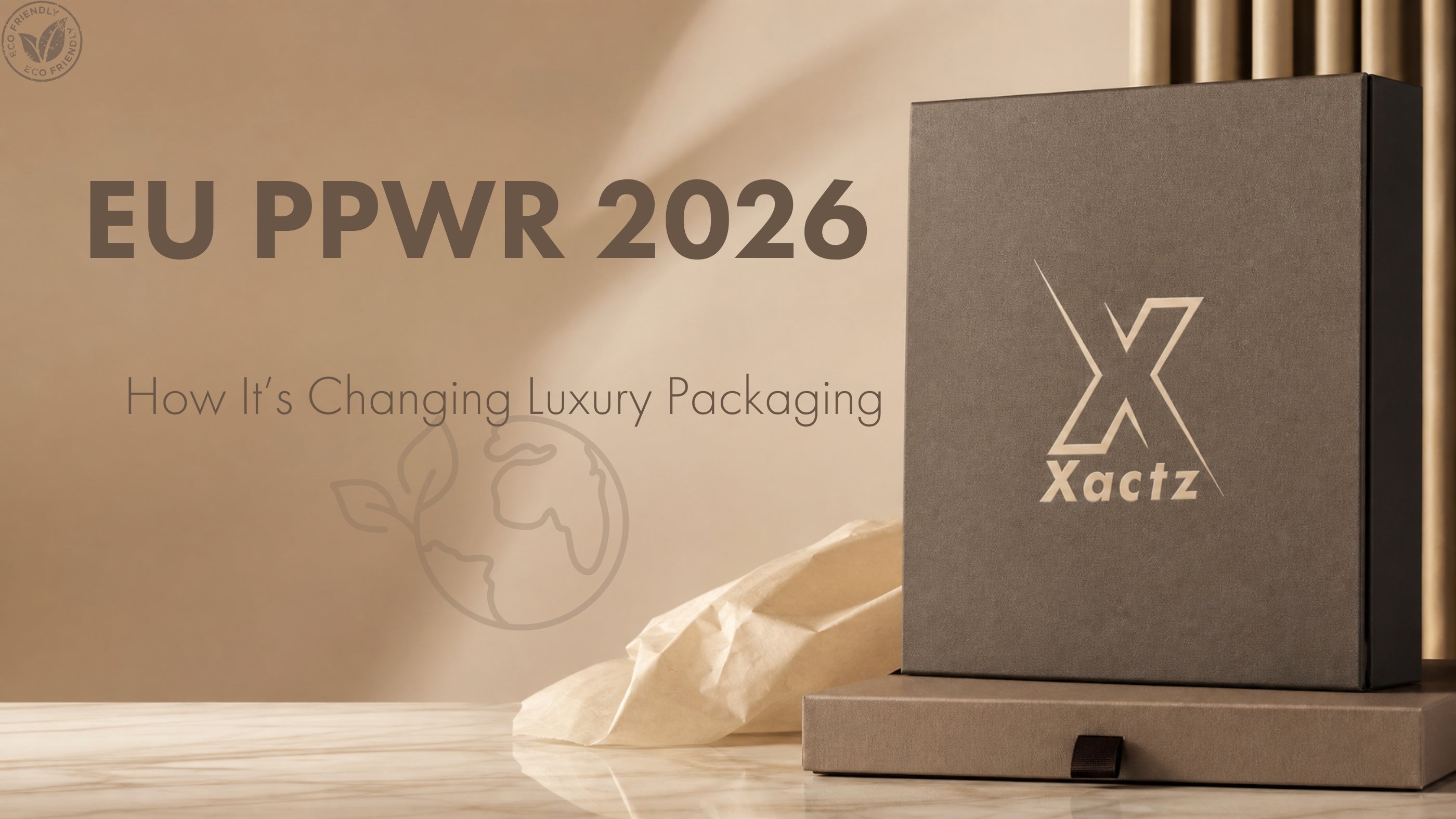
The EU Packaging and Packaging Waste Regulation, formally Regulation EU 2025/40, entered into force on February 11, 2025 and applies from August 12, 2026.
For luxury brands selling into Europe, this is not a future consideration. It is a present operational requirement. The regulation covers the entire packaging life cycle from design to waste management, and its implications for rigid box construction, lamination choices, magnetic closures, and mixed material systems are significant. Brands that have not yet audited their packaging against PPWR requirements are already behind. Brands that are waiting for further regulatory guidance before acting are taking a market access risk they cannot afford.
This guide explains exactly what PPWR requires, what it means for the specific formats and materials used in luxury packaging, and what brands must do now to remain compliant without compromising their premium positioning.
The EU Packaging and Packaging Waste Regulation is the most significant overhaul of European packaging law in over thirty years. It replaces the previous Packaging and Packaging Waste Directive of 1994 and introduces a new, binding regulatory framework that covers every aspect of packaging design, production, use, and end-of-life management across all EU member states.
Unlike the previous directive, which set targets for member states to implement through national legislation, PPWR is a regulation, meaning it applies directly and uniformly across all 27 EU member states without requiring national transposition. A brand selling luxury packaging into France, Germany, Italy, and the Netherlands is subject to a single, consistent set of requirements rather than four different national interpretations of a directive. This uniformity is one of the most significant practical changes PPWR introduces for brands operating across multiple European markets.
The regulation establishes requirements across five principal areas. Recyclability, requiring that all packaging placed on the EU market be recyclable by 2030. Recycled content, requiring minimum percentages of recycled material in packaging by defined deadlines. Packaging minimisation, prohibiting unnecessary packaging and requiring that packaging weight and volume be minimised to the extent compatible with the packaging's functional requirements. Reusability, introducing reuse targets for specific packaging categories. And labelling, requiring standardised recyclability and material composition labelling on all packaging.
PPWR formally applies from August 12, 2026. This is the date from which the regulation's requirements become enforceable across all EU member states, and from which non-compliant packaging placed on the EU market creates a legal exposure for the brand responsible.
The August 2026 date is not a soft deadline. It is the point at which the regulation transitions from a compliance preparation period to an active enforcement framework. Brands that have not completed their packaging compliance audit and begun the transition to compliant packaging formats by this date are placing non-compliant product on the EU market and accepting the associated regulatory and reputational risk.
For luxury packaging specifically, the August 2026 deadline is particularly urgent because the lead times involved in redesigning and resampling premium packaging formats are significant. A rigid box redesign that requires a new structural specification, new material sourcing, and a new golden sample approval process takes a minimum of six to ten weeks from brief to production-ready approval. Brands that have not started this process are already operating with very limited margin before the enforcement date.
The core recyclability requirement of PPWR is that all packaging placed on the EU market must be recyclable by 2030, with interim milestones requiring significant progress toward this target by 2026. Recyclability under PPWR is defined not as theoretical recyclability but as recyclability at scale, meaning that the packaging must be recyclable in the waste collection and sorting infrastructure that actually exists across EU member states, not only in specialist or industrial recycling streams.
This distinction between theoretical and at-scale recyclability is the most important practical implication of PPWR for luxury packaging. Many premium packaging formats that are technically recyclable in specialist streams do not meet the at-scale recyclability standard because the materials or material combinations they use are not processed by the mainstream municipal recycling infrastructure that the majority of EU consumers have access to.
The recycled content requirements introduce minimum percentages of post-consumer recycled material in packaging by defined deadlines. For paper and board packaging, the recycled content requirements are achievable within existing supply chains for most packaging formats. For plastic components used in luxury packaging, including magnetic closure mechanisms and some lamination films, the recycled content requirements create a more significant sourcing challenge.
The packaging minimisation requirements prohibit packaging that has more space than is functionally necessary for the product it contains, packaging that uses double walls, false bottoms, or other structural elements that increase the apparent size of the package without a functional justification, and packaging where the packaging weight is disproportionate to the product weight. These requirements have direct implications for the structural design of luxury rigid boxes, where decorative structural elements that add volume or weight without functional purpose may no longer be compliant.
The rigid box is the primary format of luxury packaging and the format most directly affected by PPWR's recyclability and minimisation requirements.
A standard rigid box is constructed from a greyboard core wrapped in a paper or board material, with a separate lid component constructed in the same way. The greyboard and paper wrap are both paper-based materials that are recyclable in mainstream municipal recycling streams across EU member states. A rigid box constructed entirely from greyboard and paper wrap, with no lamination films, no foil stamping, and no non-paper components, is fully recyclable at scale under PPWR.
The compliance challenge arises from the finishing and component additions that define luxury rigid box construction. Lamination films, foil stamping, magnetic closure components, ribbon pulls, and mixed material inserts all introduce non-paper elements into the packaging system that affect its recyclability classification under PPWR.
The minimisation requirements affect rigid box construction in a specific way. A rigid box with a double-wall construction, a false bottom that raises the product presentation height, or a structural volume significantly larger than the product it contains may be classified as non-compliant under the minimisation provisions. Luxury brands that have used oversized box formats as a premium positioning signal must review their box dimensions against the product dimensions and functional requirements to confirm compliance.
The practical implication for rigid box construction is that PPWR-compliant luxury packaging requires a structural design approach that achieves premium quality signals through material quality, finish precision, and engineering accuracy rather than through volume, weight, or material complexity. This is not a constraint on luxury packaging quality. It is a design discipline that the best luxury packaging manufacturers have always applied.
Magnetic closures are the standard closure mechanism for premium rigid boxes and one of the most important tactile premium signals in luxury packaging. The magnet component of a magnetic closure is a non-paper element embedded within the board structure of the box, and its presence affects the recyclability classification of the packaging under PPWR.
Under PPWR's at-scale recyclability standard, a rigid box with embedded magnets is classified as a mixed material packaging format. The recyclability of this format depends on whether the magnets can be separated from the paper and board components in the mainstream recycling process. In most EU municipal recycling streams, embedded magnets are separated from the paper and board during the pulping process and recovered as metal, meaning that the paper and board components of the box remain recyclable. However, the classification of magnetic closure boxes as fully recyclable at scale varies across EU member states and is subject to ongoing regulatory clarification.
The practical implication for luxury brands is that magnetic closure boxes should be reviewed against the specific recyclability classification standards applicable in each EU market where the packaging is sold. Where the recyclability classification is uncertain, the safest compliance approach is to transition to a snap-lock or friction-fit closure that eliminates the non-paper component entirely, or to use a magnetic closure system where the magnet is attached rather than embedded, allowing easy separation at end of life.
It is important to note that PPWR does not prohibit magnetic closures. It requires that packaging be recyclable at scale. Brands that can demonstrate that their magnetic closure packaging meets the at-scale recyclability standard in the markets where it is sold are compliant. The compliance requirement is documentation and verification, not necessarily redesign.
Lamination films are the finishing element most directly affected by PPWR's recyclability requirements. A lamination film applied to a paper or board substrate creates a multi-material composite that is more difficult to recycle than the unlaminated substrate alone, because the film must be separated from the paper or board during the recycling process.
Standard gloss and matte lamination films are plastic-based materials that are not recyclable in mainstream paper and board recycling streams. A rigid box with a standard plastic lamination film applied to its outer surface is classified as a mixed material packaging format under PPWR, and its recyclability at scale depends on whether the film can be separated from the board in the mainstream recycling process. In most EU municipal recycling streams, plastic-laminated board is not recyclable in the paper stream and must be directed to residual waste, meaning that it does not meet the at-scale recyclability standard.
The compliance solution for lamination is the transition to recyclable lamination films. Water-based coatings and dispersion coatings applied in place of plastic lamination films create a surface finish that is compatible with mainstream paper and board recycling streams. These coatings are available in matte, gloss, and soft-touch variants, and deliver a surface quality that is comparable to standard plastic lamination films for most luxury packaging applications.
Soft-touch matte is the most widely specified lamination finish in luxury packaging and the one most affected by this transition. A soft-touch matte finish achieved through a water-based dispersion coating rather than a plastic film delivers a comparable tactile quality to standard soft-touch lamination and is fully recyclable in mainstream paper and board recycling streams. This transition is the single most impactful compliance action available to luxury brands using soft-touch matte as their primary surface finish.
Mixed material packaging systems, where the packaging combines paper or board with plastic, metal, fabric, or other non-paper materials in a way that prevents separation at end of life, are the most challenging category under PPWR's recyclability requirements.
Common mixed material elements in luxury packaging include plastic window panels in folding cartons, fabric ribbon pulls attached to paper tray inserts, plastic foam inserts within rigid boxes, metallic foil stamping on paper surfaces, and plastic-based lamination films on board substrates. Each of these elements introduces a non-paper component into the packaging system that affects its recyclability classification.
The PPWR approach to mixed material packaging is not to prohibit it but to require that it meet the at-scale recyclability standard. For many mixed material luxury packaging formats, this means demonstrating that the non-paper components are either recyclable in their own right in mainstream recycling streams, or separable from the paper and board components without specialist equipment or effort.
Foil stamping is a specific case that requires clarification. Metallic foil stamping applies a very thin metallic layer to the paper surface that becomes part of the paper substrate at the microscopic level. The foil layer is present in quantities that are below the threshold at which it affects the recyclability of the paper substrate in mainstream recycling streams. Foil-stamped paper and board packaging is generally classified as recyclable in mainstream paper recycling streams across EU member states, meaning that foil stamping does not create a PPWR compliance issue for luxury packaging.
The mono-material packaging approach is the most straightforward path to PPWR compliance for luxury rigid box packaging. A mono-material rigid box is constructed entirely from paper and board materials, with no plastic lamination films, no non-paper closure components, and no mixed material inserts. Every component of the packaging is recyclable in mainstream paper and board recycling streams, and the packaging as a whole meets the at-scale recyclability standard across all EU member states.
A mono-material rigid box does not mean a compromise on luxury quality. The premium signal in a mono-material rigid box is delivered through material weight and quality, structural precision, surface texture, and finishing technique rather than through material complexity. A heavyweight greyboard core wrapped in a premium textured art paper, with a water-based soft-touch coating, a foil-stamped brand mark, and an embossed structural detail, is a fully PPWR-compliant packaging format that communicates luxury quality at the highest level.
The mono-material approach also simplifies the recyclability labelling requirement, because a packaging format constructed entirely from paper and board materials can be labelled with a single, unambiguous recyclability instruction rather than a complex multi-material separation guide.
For brands that have been using mixed material luxury packaging formats, the transition to a mono-material approach is an opportunity to redesign the packaging with a discipline that often produces a cleaner, more considered result than the original. The constraint of mono-material construction focuses the design on the elements that most effectively communicate luxury quality, material weight, surface texture, structural precision, and finishing detail, rather than on material complexity.
FSC certification is not a direct requirement of PPWR, but it is the most widely recognised and accepted evidence of responsible fibre sourcing for paper and board packaging materials, and it supports compliance with PPWR's broader sustainability requirements in several important ways.
PPWR requires that packaging placed on the EU market meet sustainability standards that cover the entire packaging life cycle, including the sourcing of raw materials. FSC certification provides documented evidence that the paper and board materials used in the packaging have been sourced from responsibly managed forests, meeting the due diligence requirements that PPWR places on brands for the sustainability of their packaging supply chain.
FSC certification also supports compliance with EU deforestation regulation requirements that apply alongside PPWR, requiring that products placed on the EU market have not contributed to deforestation or forest degradation. For paper and board packaging, FSC certification is the most straightforward way to demonstrate compliance with these requirements.
For luxury brands, FSC certification on their packaging materials is increasingly a customer expectation as well as a regulatory requirement. The premium consumer demographic in Europe is among the most environmentally aware consumer segments globally, and FSC certification on luxury packaging communicates that the brand's sustainability commitments extend to every element of the product experience, not only to the formulation or the product itself.
PPWR introduces standardised recyclability labelling requirements for all packaging placed on the EU market. From the application date, packaging must carry a label that communicates the recyclability of the packaging to the consumer in a standardised format that is consistent across all EU member states.
The standardised labelling system replaces the variety of national and voluntary recyclability labelling schemes currently in use across EU member states, including the Green Dot scheme, the Tidyman symbol, and various national recycling instruction systems. Under PPWR, all packaging must carry a label that indicates whether the packaging is recyclable, the material composition of the packaging, and the appropriate disposal instruction for the consumer.
For luxury packaging, the recyclability labelling requirement creates a design challenge. Premium packaging typically minimises visible compliance labelling to maintain a clean, uncluttered surface aesthetic. PPWR's standardised labelling requirement must be met, but the regulation does not prescribe the size, position, or visual treatment of the label beyond the requirement that it be legible and accessible to the consumer.
The practical solution for luxury packaging is to position the recyclability label on the base of the box or on an interior surface, where it is accessible to the consumer but does not interrupt the primary brand expression surfaces of the packaging. A debossed or printed label on the base of a rigid box meets the PPWR labelling requirement without compromising the visual integrity of the outer packaging surface.
A PPWR compliance audit for luxury packaging covers five areas. Material composition, documenting every material used in the packaging system and its recyclability classification in mainstream EU recycling streams. Component separation, assessing whether non-paper components can be separated from paper and board components without specialist equipment. Recycled content, verifying the percentage of post-consumer recycled material in each packaging component against PPWR's minimum requirements. Packaging minimisation, reviewing box dimensions and structural elements against the product dimensions and functional requirements to confirm that no unnecessary volume or weight has been added. And labelling, confirming that all packaging carries the required standardised recyclability label in a legible and accessible position.
The audit should be conducted for every packaging format in the brand's range that is sold into EU markets, including primary packaging, secondary packaging, transit packaging, and any packaging used for e-commerce fulfilment. The audit results should be documented and retained as evidence of compliance due diligence, as PPWR's enforcement framework includes documentation requirements that brands may be required to satisfy in the event of a regulatory inquiry.
For brands with complex packaging ranges, the compliance audit is most efficiently conducted in partnership with the packaging manufacturer, who can provide material composition data, recyclability classifications, and recycled content documentation for every component of the packaging system.
The most important message for luxury brands approaching PPWR compliance is that compliance and premium quality are not in conflict. The regulation does not require brands to reduce the quality or the premium signal of their packaging. It requires that packaging be recyclable, minimised, and labelled correctly. These requirements are entirely compatible with luxury packaging of the highest quality.
The brands that will navigate PPWR most successfully are those that treat compliance as a design brief rather than a constraint. A mono-material rigid box constructed from premium paper and board materials, finished with a water-based soft-touch coating, foil-stamped brand mark, and embossed structural detail, is a fully PPWR-compliant packaging format that communicates luxury quality at the highest level and demonstrates that the brand's commitment to premium quality extends to its environmental responsibilities.
The brands that will struggle with PPWR are those that have built their premium positioning on material complexity, oversized formats, and mixed material systems that were never designed with recyclability in mind. For these brands, PPWR is a forcing function for a packaging redesign that should have happened already. The regulation is not creating a new problem. It is accelerating the resolution of an existing one.
Xactz offers a complete range of PPWR-compliant luxury packaging formats, including mono-material rigid boxes, FSC-certified paper and board materials, water-based soft-touch and matte coatings, and recyclability labelling solutions that meet EU standardised labelling requirements without compromising the visual integrity of premium packaging surfaces.
Our mono-material rigid box range is constructed entirely from FSC-certified paper and board materials, with no plastic lamination films, no non-paper closure components, and no mixed material inserts. Every format in the range meets the at-scale recyclability standard across all EU member states and is fully compliant with PPWR's recyclability, minimisation, and labelling requirements.
We work with brands at every stage of the PPWR compliance process, from initial packaging audit and material composition review through structural redesign, sample approval, and production. Our in-house engineering and finishing teams can transition an existing luxury packaging format to a mono-material, PPWR-compliant specification without compromising the premium quality signals that define the brand's packaging.
Xactz operates over 40,000 square metres of dedicated luxury packaging production space across two purpose-built facilities in Shenzhen and Huizhou, China. FSC certified. ISO 9001 certified. TUV Rheinland verified. Lead times of 10 to 18 days from sample approval.
If you are ready to audit your luxury packaging for PPWR compliance and begin the transition to a compliant format, contact Xactz at xactz.com to begin your compliance consultation.
By Xactz Packaging
Aug 16, 2026
By Xactz Packaging
Aug 13, 2026

By Xactz Packaging
Aug 12, 2026
