Use less text on mobile!
EXACTLY WHAT YOU NEED
EVERYTHING CUSTOMIZABLE
Use less text on mobile!
FEEL THE LUXURY
CONTACT US TO GET A QUOTE AS YOU NEED
EXACTLY WHAT YOU NEED
EVERYTHING CUSTOMIZABLE
CONTACT US & GET YOUR QUOTE
FEEL THE LUXURY
بواسطة Xactz Packaging
29 يوليو 2026
أضف تعليقًا
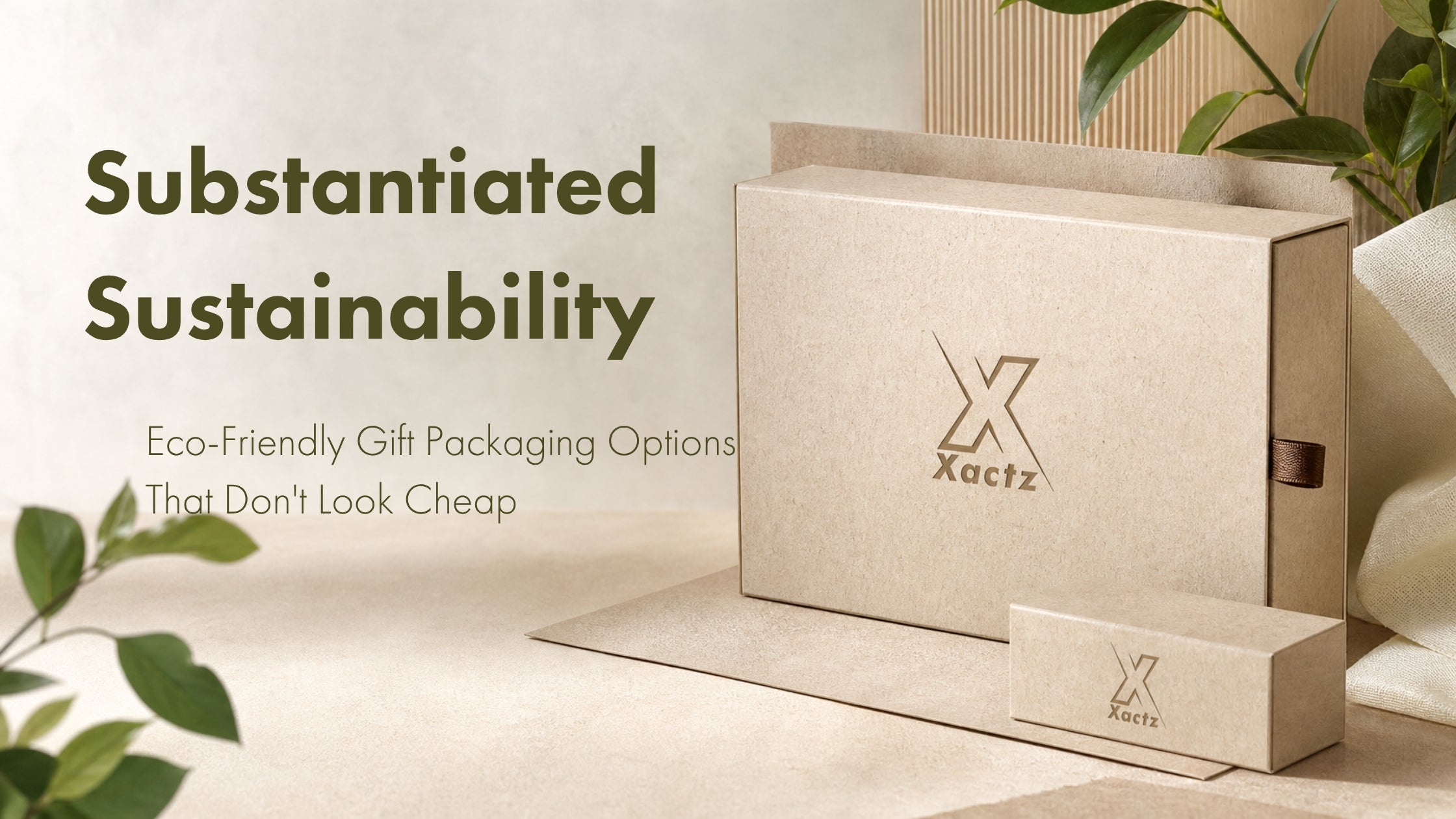
There is a persistent myth in packaging procurement that sustainability and premium aesthetics are mutually exclusive. That eco-friendly gift packaging means kraft tape, brown paper, and a look that communicates frugality rather than brand value. That choosing biodegradable gift boxes means accepting a visual downgrade.
This guide exists to dismantle that myth with data, material science, and manufacturing evidence.
The global sustainable packaging market was valued at USD 303.80 billion in 2025 and is projected to grow from USD 325.94 billion in 2026 to USD 463.41 billion by 2031. The green packaging market is on a parallel trajectory, expanding from USD 354.70 billion in 2025 to USD 594.50 billion by 2035 at a compound annual growth rate of 5.3%. These are not niche figures. They represent a fundamental restructuring of how the world's brands specify, source, and present their products.
The consumer signal driving this restructuring is unambiguous. 74% of consumers say they are willing to pay more for sustainable packaging. 67% of consumers consider the use of sustainable materials when making a purchase decision. And critically for B2B brand managers, brands that make credible, certified sustainability claims on their packaging command measurable price premiums and generate measurably higher customer loyalty scores than brands that do not.
The operative word in that last sentence is credible. The sustainable packaging landscape in 2026 is saturated with claims that do not survive scrutiny: "eco-friendly," "green," "natural," "planet-conscious." These are marketing adjectives, not material certifications. The brands that are winning in sustainable packaging are the brands that have moved from adjectives to evidence. From claims to certifications. From greenwashing to substantiated sustainability.
This guide covers the certified materials, the economic mechanics, and the aesthetic specifications that allow B2B brand managers and procurement teams to source eco-friendly gift packaging that is genuinely sustainable, independently verified, and visually premium. Because the box that arrives on your customer's doorstep should do three things simultaneously: protect the product, represent the brand, and leave the planet no worse than it found it.
Greenwashing is not a fringe problem in packaging. It is a structural one. A 2021 European Commission study found that 42% of green claims made online by brands were exaggerated, false, or deceptive. In packaging specifically, the problem is compounded by the fact that most sustainability claims are self-declared, unaudited, and legally unenforceable in most markets.
The EU Green Claims Directive, which entered enforcement in 2026, now requires that any environmental claim made on packaging or in marketing must be independently verified before it can be used. This is not a future risk for brands sourcing packaging. It is a present legal requirement in the EU's 27 member states and a leading indicator of regulatory direction in the UK, US, and APAC markets.
For B2B procurement teams, the practical implication is straightforward: if your packaging supplier cannot provide third-party certification documentation for every sustainability claim they make, those claims are a liability, not an asset. Here is what genuine certification looks like across the four material categories that matter most for eco-friendly gift packaging.
The Forest Stewardship Council certification is the global benchmark for responsible forest management. FSC-certified kraft paper and board carries one of the most rigorous chain-of-custody verification systems in the materials industry, requiring documented traceability from forest to finished product at every stage of the supply chain.
For rigid box and folding carton production, FSC certification means the greyboard core, the wrap paper, and any kraft liner used in the structure can be traced to forests managed under FSC's ten principles, which cover biodiversity protection, worker rights, indigenous community rights, and sustainable yield harvesting. Third-party certifications like FSC protect brands from greenwashing accusations by providing independently verified proof that the material claim is real.
At Xactz, our FSC certification number is SGS-COC-332603, independently audited by SGS, one of the world's leading inspection and certification bodies. Every FSC-certified packaging order we produce ships with full chain-of-custody documentation that your procurement team can present to retail buyers, ESG auditors, and EU regulatory authorities without qualification.
FSC-certified packaging does not look different from non-certified packaging. The certification is in the supply chain, not the surface. A rigid gift box produced from FSC-certified greyboard and wrap paper can carry soft-touch matte lamination, gold foil stamping, and debossed brand marks at exactly the same aesthetic standard as any non-certified equivalent. Sustainability and luxury are not in tension here. They are parallel specifications.
Plantable seed paper is one of the most compelling material innovations in sustainable gift packaging of the past decade. It is paper embedded with wildflower, herb, or vegetable seeds during the manufacturing process. When the recipient plants the paper in soil and waters it, the paper biodegrades and the seeds germinate.
The material mechanism is straightforward: the paper substrate is made from post-consumer recycled cotton or agricultural waste fibers, which are mixed with seeds during the pulping process and then formed into sheets. The result is a paper that is 100% biodegradable, plastic-free, and transforms from packaging waste into living plant matter.
For gift packaging applications, plantable seed paper is used for tissue wrap, gift tags, box liners, and outer wrap sheets. It accepts water-based ink printing in full color, which means brand graphics, logos, and messaging can be printed directly on the seed paper without compromising its biodegradability. The tactile quality of seed paper is distinctive: it has a slightly textured, handmade feel that communicates artisanal quality and environmental intentionality simultaneously.
For B2B brand managers, plantable seed paper inserts and wraps are a high-impact, low-cost upgrade to any gift packaging program. The cost differential over standard tissue paper is modest, and the brand storytelling value, particularly in direct-to-consumer gifting, is significant.
Specialty paper boxes refer to rigid and folding carton structures produced from papers with specific environmental credentials beyond standard FSC certification. The three most relevant categories for premium eco-friendly gift packaging are stone paper, recycled cotton paper, and agricultural waste paper.
Stone paper is produced from calcium carbonate powder bonded with a small amount of non-toxic resin. It contains no wood pulp, requires no water in its production process, and is tear-resistant, waterproof, and fully recyclable. Stone paper produces a distinctive smooth, slightly waxy surface that accepts high-resolution print and luxury finishes including soft-touch lamination and foil stamping.
Recycled cotton paper is produced from post-industrial cotton waste, primarily offcuts from garment manufacturing. It has a soft, tactile surface quality that is immediately associated with premium and artisanal products. For luxury gift boxes in fashion, jewelry, and lifestyle categories, recycled cotton wrap paper delivers both the environmental credential and the premium tactile signal that brand managers require.
Agricultural waste paper is produced from the fibrous byproducts of crop harvesting: sugarcane bagasse, wheat straw, bamboo, and rice straw. These materials are renewable on annual cycles rather than the decades required for forest timber, and their use diverts agricultural waste from burning or landfill. Bamboo paper in particular has achieved significant adoption in premium packaging because bamboo grows at rates up to 91cm per day, making it one of the most rapidly renewable raw materials available.
Lamination is the most overlooked sustainability variable in premium packaging specification. Most brand managers focus on the paper and board substrate when assessing a packaging program's environmental credentials, but the lamination film applied over the printed surface is equally critical.
Per- and polyfluoroalkyl substances, known as PFAS, are a class of synthetic chemicals used in some packaging coatings and laminates for their water and grease resistance. PFAS are persistent environmental contaminants that do not break down in soil or water and have been linked to significant health and ecological impacts. The EU PPWR regulation, effective August 2026, restricts the use of PFAS in food-contact packaging and is the leading indicator of broader PFAS restrictions across all packaging categories.
PFAS-free lamination alternatives, including water-based soft-touch matte, water-based gloss, and biodegradable PLA film, deliver equivalent aesthetic performance to conventional lamination films without the environmental liability. At Xactz, all lamination applied to our packaging production is PFAS-free as standard, compliant with EU PPWR requirements, and documented in our material safety data sheets.
The sustainability conversation in packaging procurement is almost always framed as a cost conversation: eco-friendly materials cost more, therefore sustainable packaging costs more. This framing is incomplete, and for most e-commerce and B2B shipping programs, it is factually incorrect when total landed cost is calculated rather than unit material cost alone.
The economic case for plastic-free and lightweight sustainable packaging rests on three mechanisms that operate independently of material cost: dimensional weight reduction, damage rate reduction, and regulatory cost avoidance.
Major carriers including FedEx, UPS, DHL, and Royal Mail calculate shipping fees on dimensional weight, which is the greater of actual weight and the volume of the package divided by a dimensional factor. This means that oversized, heavy packaging is penalized twice: once for its actual weight and once for the space it occupies in the carrier's vehicle.
Lightweight sustainable packaging options such as recycled kraft mailers, paper-based void fill, and right-sized rigid boxes weigh less per shipment than traditional plastic-heavy packaging formats. Sustainable packaging can lower shipping costs through right-sizing and lighter formats. Typical savings from switching to lightweight sustainable packaging run at 10 to 15% on shipping expenses. For a brand shipping 10,000 units annually, a 12% reduction in average shipping cost per unit compounds to a significant annual saving that offsets the material cost differential of sustainable substrates within the first year of a packaging program.
The calculation is straightforward. If your current packaging adds 150 grams of tare weight per shipment and a sustainable alternative adds 90 grams, the 60-gram reduction per shipment multiplied across 10,000 annual shipments produces 600 kilograms of eliminated tare weight. At an average dimensional weight surcharge of $0.50 per 100 grams, that is $3,000 in annual shipping savings from a single material substitution.
Premium sustainable packaging, particularly FSC-certified rigid boxes with appropriate structural specifications, reduces product damage rates in transit. The higher durability of well-specified rigid box construction reduces damage-related costs and return processing fees. For brands where a single product return costs $15 to $30 in reverse logistics, a 2% reduction in damage rate across 10,000 annual shipments eliminates 200 returns and saves $3,000 to $6,000 annually in return processing costs alone.
The EU Extended Producer Responsibility regulations, now active across all 27 EU member states, impose fees on brands for every unit of packaging placed on the EU market. These fees are calculated on the weight and material type of the packaging, with plastic packaging attracting the highest fee rates and paper, board, and certified sustainable materials attracting the lowest.
Brands that have already transitioned their packaging programs to FSC-certified paper and board, PFAS-free lamination, and plastic-free inserts are paying materially lower EPR fees than brands still using plastic-heavy packaging formats. For B2B brands with significant EU market exposure, the EPR fee differential between a plastic-heavy and a paper-based packaging program can exceed the total material cost premium of the sustainable alternative within a single annual reporting period.
Standard Plastic-Heavy Mailer Box Material cost per unit: Baseline. Tare weight: High. EPR fee category: Highest. Damage rate: Moderate. Total landed cost index: 100.
FSC-Certified Kraft Rigid Box, PFAS-Free Lamination Material cost per unit: 8 to 15% premium. Tare weight: 20 to 40% lower. EPR fee category: Lowest. Damage rate: Lower. Total landed cost index: 88 to 95.
Recycled Content Folding Carton Material cost per unit: 3 to 8% premium. Tare weight: 15 to 25% lower. EPR fee category: Low. Damage rate: Moderate. Total landed cost index: 92 to 97.
The total landed cost index demonstrates that when shipping savings, damage reduction, and EPR fee avoidance are included in the calculation, sustainable packaging is not more expensive than conventional packaging. For most e-commerce programs above 2,000 annual units, it is cheaper.
The following recommendations cover the full range of eco-friendly gift packaging formats available for B2B sourcing programs in 2026, from entry-level sustainable upgrades to ultra-premium certified luxury specifications.
The premium specification for eco-friendly gift packaging. FSC-certified greyboard core, recycled content or bamboo wrap paper, PFAS-free soft-touch matte lamination, and water-based foil stamping. This specification delivers the full luxury unboxing experience, including magnetic closure, ribbon pull, and EVA foam or paper pulp insert, with a complete chain-of-custody certification package.
Best for: Beauty, electronics, jewelry, watches, spirits, premium gifting programs, corporate gifting, retail launch packaging.
Minimum order quantity: Flexible for B2B programs. Sample turnaround: 1 to 3 business days at Xactz.
The highest-impact sustainable upgrade available at the lowest cost differential. Replaces standard tissue paper and inner wrap with seed-embedded, 100% biodegradable paper that the recipient can plant. Accepts full-color water-based ink printing for brand graphics and messaging.
Best for: Direct-to-consumer gifting, subscription boxes, seasonal gift programs, brands with strong environmental brand positioning.
DIY application: Plantable seed paper is available in sheet form from specialist paper suppliers including Botanical PaperWorks and Oblation Papers. For brands not yet ready for a full custom print run, unprinted seed paper sheets with a custom printed card insert achieve the same environmental and brand storytelling outcome at minimal cost.
The workhorse of sustainable e-commerce packaging. Produced from 100% recycled kraft board, curbside recyclable, and available with water-based flexographic print in full color. Lighter than conventional corrugated, right-sizeable to product dimensions, and accepted by all major carrier dimensional weight calculations at favorable rates.
Best for: High-volume e-commerce fulfillment, subscription boxes, FMCG brands transitioning away from plastic mailers.
DIY application: For small brands and independent retailers, recycled kraft mailer boxes are available without minimum order quantities from suppliers including EcoEnclose, Noissue, and Lumi. Custom stamp printing with a water-based ink stamp is a cost-effective branding solution for low-volume programs.
The premium specialty specification for brands requiring waterproof, tear-resistant packaging with a distinctive tactile surface. Stone paper contains no wood pulp, requires no water in production, and is fully recyclable through standard paper streams. Accepts soft-touch lamination and foil stamping at the same quality standard as conventional wrap paper.
Best for: Outdoor, wellness, cosmetics, and lifestyle brands where packaging may encounter moisture in transit or retail environments.
The sustainable replacement for plastic thermoform and EPE foam inserts. Moulded paper pulp inserts are produced from recycled newsprint or agricultural waste fibers, formed to precise product dimensions, and fully compostable. They provide equivalent product protection to plastic thermoform at comparable cost and are accepted by EU PPWR monomaterial packaging requirements, which mandate that packaging components be separable for recycling by 2030.
Best for: Any product category currently using plastic thermoform or EPE foam inserts. Particularly high-impact for beauty, electronics, and food gifting categories with significant EU market exposure.
For brands and individuals who want to implement sustainable gift wrapping without a full custom packaging program, the following approaches deliver genuine environmental credentials at minimal cost.
Furoshiki wrapping uses fabric offcuts or recycled textile squares to wrap gifts in the Japanese tradition. Zero packaging waste, reusable by the recipient, and visually distinctive. Particularly effective for premium gifting programs where the wrap itself becomes part of the gift.
Recycled newspaper and magazine wrapping with water-based ink stamps for brand personalization. Genuinely circular, zero additional material cost, and increasingly fashionable as an aesthetic choice in premium gifting contexts.
Beeswax wrap for small gifts and product protection. Reusable, compostable, and available in printed designs. A sustainable alternative to plastic cling film for food gifting and artisan product packaging.
Seed paper gift tags replacing conventional card tags. Available from multiple specialist suppliers, plantable by the recipient, and printable with brand messaging and product information.
Substantiated sustainability in gift packaging is not a design trend. It is a procurement standard that is being written into law, demanded by consumers, and rewarded by the market with measurable commercial returns.
The brands that are getting this right in 2026 share three characteristics. They specify certified materials rather than claiming adjectives. They calculate total landed cost rather than unit material cost. And they choose manufacturing partners who can provide documentation for every sustainability claim they make, from FSC chain-of-custody certificates to PFAS-free lamination data sheets to EU PPWR compliance records.
The five specifications that define a genuinely sustainable premium gift packaging program are these.
FSC-certified paper and board as the structural foundation, with SGS or equivalent chain-of-custody documentation. PFAS-free lamination as the surface finish standard, compliant with EU PPWR and documented in material safety data sheets. Paper pulp or moulded fibre inserts replacing plastic thermoform and EPE foam. Water-based inks and adhesives throughout the production process. And a manufacturing partner with ISO 9001:2015 quality management and independently audited environmental certifications.
Eco-friendly gift packaging that looks cheap is the result of poor specification, not poor sustainability. The materials exist. The manufacturing capability exists. The certifications exist. The only variable is whether the brand manager sourcing the packaging knows which questions to ask and which documentation to require.
Ask the right questions. Require the documentation. Source from a verified manufacturer. The box that arrives on your customer's doorstep can be genuinely sustainable, independently certified, and visually premium. These are not competing objectives. They are the same specification, correctly executed.
Xactz is a verified luxury packaging manufacturer with 40,000 sqm of production facilities in Huizhou and Shenzhen. We produce FSC-certified rigid gift boxes, folding cartons, paper pulp inserts, and full sustainable packaging programs directly, with no trading company intermediaries and no outsourced production.
Our sustainability credentials: FSC certified (SGS-COC-332603). PFAS-free lamination as standard. ISO 9001:2015 quality management. EU PPWR compliant material specifications. 18-point in-house QC protocol. Full chain-of-custody documentation provided with every FSC-certified order.
Sample turnaround: 1 to 3 business days. Production lead time: 10 to 18 days. MOQ: Flexible for B2B brand managers and procurement teams.
Ready to specify your sustainable packaging program?
Visit https://xactz.com/pages/get-a-factory-direct-quote to submit your specification and receive a factory-direct quote.
Browse our full range of sustainable gift boxes and rigid boxes at https://xactz.com/.
Read more B2B packaging sourcing guides at https://xactz.com/blogs/news.
بواسطة Xactz Packaging
16 أغسطس 2026
بواسطة Xactz Packaging
13 أغسطس 2026
بواسطة Xactz Packaging
12 أغسطس 2026
