Use less text on mobile!
EXACTLY WHAT YOU NEED
EVERYTHING CUSTOMIZABLE
Use less text on mobile!
FEEL THE LUXURY
CONTACT US TO GET A QUOTE AS YOU NEED
EXACTLY WHAT YOU NEED
EVERYTHING CUSTOMIZABLE
CONTACT US & GET YOUR QUOTE
FEEL THE LUXURY
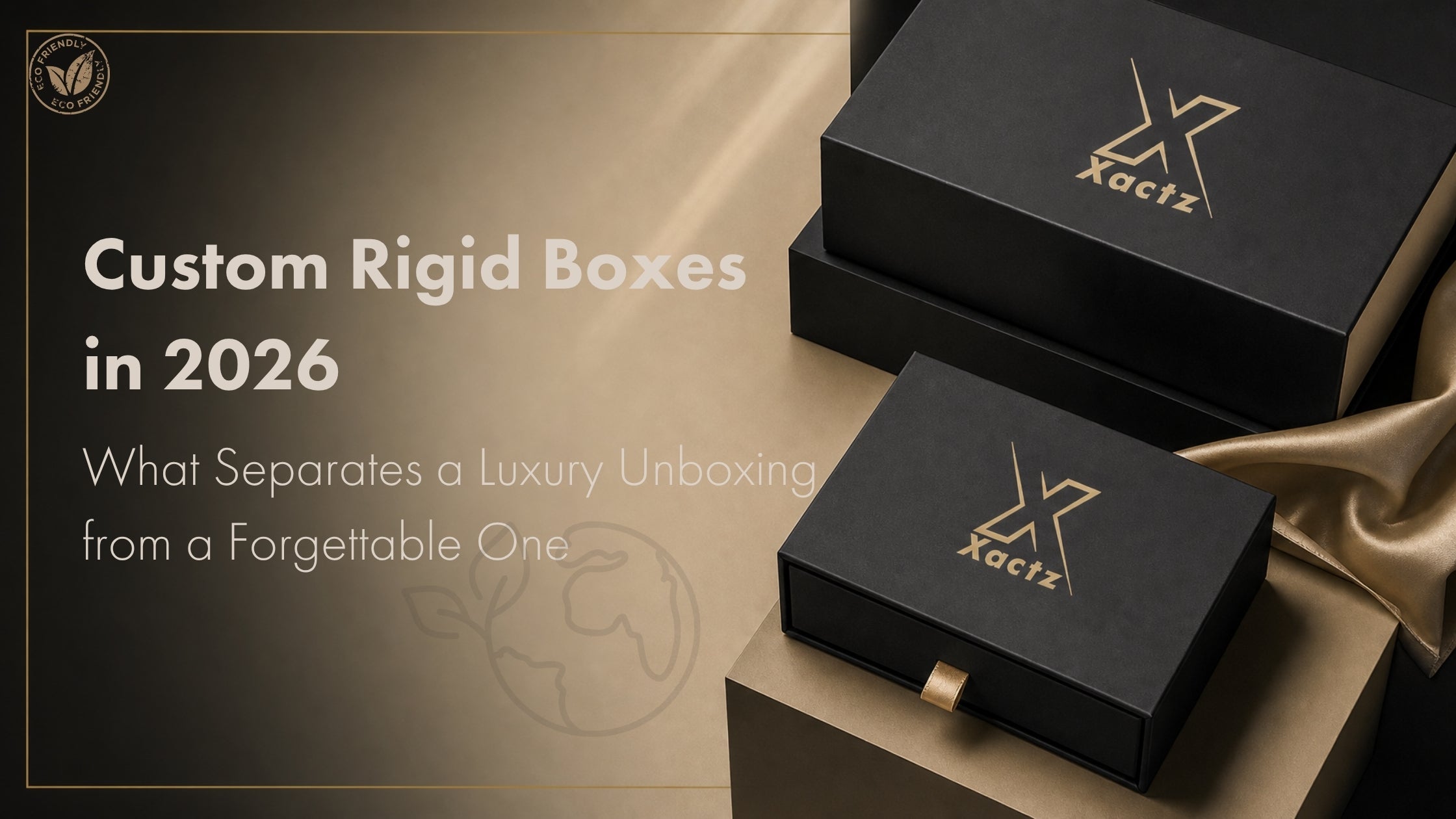
By Xactz Packaging
Jul 15, 2026
Add a comment
The rigid box market was valued at USD 65.44 billion in 2025. It is projected to reach USD 100.35 billion by 2034, growing at a CAGR of 4.92%. North America alone holds 33.21% of global market share.
Those numbers tell one story. Here is the more important one.
The brands driving that growth are not buying rigid boxes. They are buying the moment when a customer lifts a lid and decides, before they have touched the product, whether the brand deserves their loyalty. That moment is engineered. It is the result of specific decisions about board weight, wrap material, insert configuration, finish sequencing, and structural mechanics. Get those decisions right and the box does commercial work that no advertisement can replicate. Get them wrong and the most expensive product in the world arrives in something that feels like an afterthought.
This guide covers every decision that separates a luxury unboxing from a forgettable one, written from the factory floor.

A rigid box is not a folding carton with a premium finish. It is a structurally different object. Where a folding carton ships flat and is assembled at the point of packing, a rigid box arrives fully assembled, holding its shape permanently because it is built on thick chipboard or greyboard that does not collapse. That is why the industry also calls them rigid setup boxes: they are set up at the factory, not by the person unpacking them.
You have held one. The watch box. The iPhone box. The premium whiskey case. That solid, satisfying weight when you lift the lid? That is a rigid box doing its job before the customer has registered anything else about the product inside.
A rigid box is three things simultaneously: a structural system (the chipboard engineering that determines how the box feels and opens), a material stack (wrap paper, adhesive, coatings, foils, and inserts), and a brand asset (the sum of both expressed in the brand's colour, typography, and finish language). Get one wrong and the other two suffer. A flawless print on a warped lid still communicates poor manufacturing. A perfect structure with a muddy colour match still gets rejected by retail buyers.
Custom rigid boxes are the correct format for any product where the first physical interaction with the brand needs to communicate premium quality, considered design, and manufacturing investment: watches, spirits, skincare, fragrance, jewellery, electronics, gift sets, collectibles, and limited editions.
The data behind rigid box demand in 2026 makes the commercial case more clearly than any brand argument.
The global rigid box market was valued at USD 65.44 billion in 2025 and is projected to grow to USD 100.35 billion by 2034 at a 4.92% CAGR. North America held 33.21% of global market share in 2025. The luxury tier of that market, covering premium rigid boxes for beauty, spirits, jewellery, and electronics, was valued at USD 8.34 billion in 2025 and is forecast to reach USD 15.84 billion by 2036 at a 6.0% CAGR.
Two data points from the luxury tier are particularly relevant for brand managers specifying packaging in 2026. Paperboard accounts for an estimated 58.0% of product-type demand in the luxury rigid box segment. Cosmetics and personal care drive an estimated 37.0% of application demand. If you are a beauty or skincare brand, you are not a niche player in this market. You are the centre of gravity.
The broader paper packaging market reinforces this trajectory. The global paper packaging market is estimated at USD 416.07 billion in 2025, projected to reach USD 611.66 billion by 2033 at a 5.0% CAGR. The e-commerce and retail application segment is growing fastest at a 6.6% CAGR from 2026 to 2033. More products sold online means more first impressions that depend entirely on the box.
A significant trend driving this growth is the integration of premiumisation with sustainability. Brands are increasingly using rigid boxes crafted from recycled paperboard, biodegradable materials, and environmentally friendly inks while preserving a luxurious aesthetic. Innovations in digital printing and embossing technologies are enabling enhanced customisation at lower minimum order quantities than were previously viable.
Every rigid box is a system of seven components. The quality of the finished object is determined by the precision with which each component is specified and manufactured. Understanding what a rigid box is made of is the foundation for understanding why some boxes perform and others do not.

The chipboard is the structural core of the rigid box. It gives the box its weight, its rigidity, and its resistance to compression. Chipboard for rigid boxes is specified by thickness, typically 1.5mm, 2mm, or 3mm, and by density, which determines how cleanly it cuts, scores, and wraps.
Chipboard thickness is the single most important decision in rigid box specification because it determines how the box feels in the hand before the customer has registered anything else. A box built on 1.5mm board feels noticeably lighter and less substantial than a box built on 2mm or 3mm board. For premium and luxury applications, 2mm is the minimum specification. For ultra-premium applications such as watches, high-end spirits, and prestige skincare gift sets, 3mm is the correct specification.
Chipboard density matters as much as thickness. Low-density chipboard cuts with a rougher edge and wraps with more visible corner bulk. High-density chipboard cuts cleanly, wraps tightly, and produces the sharp, precise corners that are the visual signature of a well-manufactured rigid box.

The structural format determines how the lid and base relate to each other and how the box opens. The four primary structural formats for custom rigid boxes in 2026 are the lift-off lid box, the hinged lid box, the magnetic closure box, and the drawer box.
The lift-off lid box is the most widely used format in premium packaging. The lid sits over the base with a controlled fit, lifts cleanly and completely, and reveals the full contents in a single motion. The quality of the unboxing experience is determined by the lid-to-base fit tolerance. A lid that lifts with slight resistance and releases cleanly communicates precision manufacturing. A lid that lifts too easily communicates loose tolerances.
The hinged lid box opens on a fixed hinge at the back, revealing the contents progressively as the lid rises. The hinge mechanism requires precise engineering to ensure the lid opens smoothly, holds open at a stable angle, and closes without requiring the user to align the lid manually. Hinged lid boxes are the correct format for fragrance, jewellery, and premium electronics where the opening sequence is part of the brand experience.
The magnetic closure box uses embedded magnets in the lid and base to create a controlled, satisfying close. The click of the magnets engaging communicates precision and quality in a way that a simple press-fit lid cannot. Magnetic closure boxes are the dominant format in prestige beauty, skincare gift sets, and luxury gifting.
The drawer box, also called a sleeve and tray box, uses a sliding inner tray that pulls out from a fixed outer sleeve. The drawer format is the correct choice for products where the opening sequence needs to feel deliberate and considered, and for brands where the outer sleeve is a significant brand expression surface.

The wrap material is the primary tactile and visual surface of the rigid box and the component that carries the most brand expression. Wrap materials fall into four categories.
Coated papers produce a smooth, even surface that is the correct substrate for high-resolution print, photographic imagery, and full-coverage colour. They are the most widely used wrap material across all rigid box applications.
Uncoated and textured papers such as linen-effect papers, laid papers with visible fibre direction, and micro-embossed papers with subtle surface patterns communicate craft and material consideration in a way that smooth coated papers cannot. These surfaces interact with foil stamping and embossing to create more complex, layered premium effects. For prestige skincare, fragrance, and luxury gifting, textured papers are increasingly the dominant material choice in 2026.
Fabric wraps including linen, silk, velvet, and cotton are the correct specification for ultra-premium applications where the tactile quality of the wrap material needs to communicate the same level of investment as the product inside.
Specialty materials such as leatherette, wood veneer, and metal-effect papers are used for limited edition and collectible packaging where the material itself is part of the product story.

The surface finish is applied over the wrap material and determines the final tactile and visual quality of the box exterior.
Soft-touch matte lamination is the dominant finish in prestige packaging in 2026. It produces a velvety, matte surface that absorbs light and communicates restraint, quality, and considered design. Soft-touch matte is the finish that interacts most effectively with foil stamping, creating a contrast between the matte surface and the reflective foil that is the visual signature of prestige packaging.
Gloss lamination produces a high-shine surface that maximises colour vibrancy and print clarity. It is the correct finish for brands where print quality and colour accuracy are the primary brand expression vehicles.
Spot UV coating applies a high-gloss varnish to specific areas of a matte surface, creating a contrast that is visible in certain lighting conditions and invisible in others. It rewards close examination and communicates a level of finishing investment that is legible to a premium consumer without being immediately obvious to a casual observer.
Water-based aqueous coating is the most sustainable finish option and the correct specification for brands with EU PPWR compliance requirements and FSC certification commitments. It is fully recyclable and produces a finish that integrates with the paper surface rather than sitting on top of it.

Decorative finishing creates the brand-specific visual details that distinguish one premium box from another.
Hot foil stamping transfers a metallic or pigmented foil to the surface of the box using heat and pressure. Gold foil stamping on a soft-touch matte surface is the most widely specified decorative finish in prestige packaging and the combination that most effectively communicates luxury brand investment. Foil is available in gold, silver, rose gold, champagne, copper, and a full range of pigmented colours.
Embossing raises a design element above the surface of the wrap material, creating a three-dimensional tactile detail that is felt before it is seen.
Debossing presses a design element below the surface. Blind deboss, meaning debossing without foil or ink, is the most restrained decorative finish available and the correct choice for ultra-premium brands where the target consumer responds to material subtlety rather than visual announcement.
Screen printing applies opaque or metallic inks directly to the surface, creating colour and pattern effects that cannot be achieved through conventional printing. It is the correct technique for limited edition packaging where the finish needs to communicate handcraft and exclusivity.

The insert system determines whether the product sits correctly within the box, whether the unboxing sequence feels controlled and intentional, and whether the product arrives at the customer in the same condition it left the factory.
Paper tray inserts are the industry standard for premium rigid box packaging and the most sustainable insert option available. A die-cut and folded paper tray is made entirely from the same material as the box itself, making the entire secondary packaging construction recyclable in a single paper stream. Paper tray inserts must be engineered to the exact dimensions of the primary packaging. A tray that is two millimetres too wide allows the product to move. A tray that is two millimetres too narrow creates resistance when the product is placed and removed.
Moulded pulp inserts are the correct specification for brands with strong sustainability commitments and for products where the insert needs to absorb shock as well as hold the product in position. Moulded pulp is fully compostable and produces a natural, considered aesthetic that communicates environmental values effectively.
Foam inserts including EVA foam and polyurethane foam provide the highest level of product protection and are the correct specification for fragile products, precision instruments, and electronics where dimensional tolerance and shock absorption are the primary engineering requirements.
Fabric-lined inserts in velvet, silk, and satin are the correct specification for jewellery, watches, and ultra-premium products where the insert surface is a significant part of the brand experience.

The structural details including ribbon pulls, magnetic closures, ribbon hinges, foam bumpers, and corner reinforcements determine the quality of the physical interaction between the user and the box.
A ribbon pull is a fabric ribbon attached to the base of the insert that allows the user to lift the product out of the box without touching the product directly. It is a small detail that communicates a significant level of manufacturing consideration and is standard in prestige jewellery and watch packaging.
Foam bumpers applied to the interior corners of the lid prevent the lid from making contact with the product when closed and eliminate the risk of finish damage during transit.
The unboxing sequence is not a marketing concept. It is an engineering specification. Every physical interaction between the user and the box is the result of deliberate manufacturing decisions.
The sequence begins before the box is opened. The weight of the box in the hand is the first signal. A box built on 2mm or 3mm chipboard communicates substance and investment before the user has registered anything visual.
The second signal is the tactile quality of the exterior surface. A soft-touch matte finish communicates a level of material investment that a standard lamination cannot. The user registers this through touch before they have consciously evaluated the box.
The third signal is the opening mechanic. For a lift-off lid box, the lid should lift with slight resistance and release cleanly in a single smooth motion. For a magnetic closure box, the magnets should engage with a controlled click that is both audible and tactile. For a hinged lid box, the hinge should open smoothly and hold the lid at a stable angle without requiring the user to support it.
The fourth signal is the reveal. The product should be presented in a way that rewards the opening motion. For a single-product box, the product should sit at a height that makes it immediately visible and accessible when the lid is removed. For a multi-product gift set, the full collection should be visible simultaneously when the lid is lifted, framed and composed by the insert system.
The fifth signal is the extraction. The product should be easy to remove from the insert without requiring force, without leaving marks on the product surface, and without disturbing the arrangement of any other products in the box. A ribbon pull that lifts the product cleanly is the correct engineering solution for products that sit deep in a paper tray insert.
Every one of these signals is the result of a manufacturing decision. None of them happen by accident.
The finish combinations that define prestige packaging in 2026 are built on restraint. The goal is not to demonstrate the full range of available finishing techniques. The goal is to select one or two finishing details that communicate brand investment with precision and allow the structural quality of the packaging to carry the premium signal.
Soft-touch matte with gold foil brand mark is the most widely specified finish combination in prestige packaging and remains the most effective. The matte surface absorbs light and creates a quiet, considered backdrop. The gold foil brand mark reflects light and creates a single point of visual focus. The contrast between the two surfaces communicates luxury more effectively than any other finish combination available.
Soft-touch matte with blind deboss is the most restrained finish combination available and the correct choice for ultra-premium brands where the target consumer is design-literate and responds to material subtlety. The debossed brand mark creates a tactile detail that is discovered through touch rather than announced visually.
Soft-touch matte with spot UV accent is the correct choice for brands that want to add a second finish element without introducing a metallic colour. The spot UV creates a high-gloss accent on a matte surface, producing a contrast that rewards close examination.
Textured paper with foil and emboss is the most complex finish combination in common use and the correct specification for limited edition and seasonal packaging where the exterior needs to communicate that the box is a distinct, considered object rather than a standard production format.
Gloss lamination with full-coverage print is the correct finish combination for brands where photographic imagery or complex colour gradients are the primary brand expression vehicle on the exterior of the box.
Different product categories have different packaging requirements driven by the physical dimensions of the primary packaging, the retail and gifting context, and the brand positioning signals the secondary packaging needs to carry.
Custom rigid boxes for beauty and skincare need to communicate the clinical-luxury balance: scientific credibility and premium care simultaneously. The correct specification for prestige skincare is a lift-off lid or magnetic closure box in 2mm chipboard, wrapped in a textured or uncoated paper, finished in soft-touch matte with a single gold foil brand mark, and fitted with a paper tray insert engineered to the exact dimensions of the primary packaging. Cosmetics and personal care represent approximately 37% of luxury rigid box application demand globally, making this the single largest end-use category in the segment.
Custom rigid boxes for fragrance need to communicate luxury, occasion, and the emotional weight of the product category. Fragrance packaging tolerates more decorative complexity than skincare because the product itself is invisible until it is used, and the packaging carries the entire burden of the sensory and emotional promise. Hinged lid boxes and magnetic closure boxes are the dominant formats. Fabric wraps in velvet and linen are increasingly specified for ultra-premium fragrance.
Custom rigid boxes for spirits and wine need to communicate provenance, craft, and the occasion of the product. Board weight is critical in spirits packaging: a box that feels as substantial as the bottle it contains communicates that the brand has invested in the full product experience. Moulded pulp inserts are increasingly specified for spirits packaging as a sustainability signal that aligns with the provenance narrative of premium spirits brands.
Custom rigid boxes for jewellery and watches are the most technically demanding format in the category because the insert system must hold the product with absolute precision, the exterior finish must communicate the highest level of luxury investment, and the structural details including ribbon pulls, fabric linings, and foam bumpers must all perform flawlessly. Fabric-wrapped rigid boxes with velvet or satin interior linings are the standard specification for fine jewellery and watches.
Custom rigid boxes for electronics and technology need to communicate precision, innovation, and the quality of the product inside. The structural format is most commonly a lift-off lid box or a drawer box. Foam inserts with custom cut-outs are the standard specification for electronics packaging where the product has an irregular form. The exterior finish for premium electronics packaging is typically a clean, minimal specification: soft-touch matte, a single colour, and a restrained brand mark.
Custom rigid boxes for gift sets and limited editions are the most complex format in the category and the one that offers the greatest opportunity for brand expression. The multi-product insert system must hold each product securely in its designated position, prevent contact between products during transit, and present the full set in a visually composed arrangement when the box is opened. The exterior finish of a gift set or limited edition box is the primary brand expression vehicle and can accommodate more decorative complexity than a standard single-product format.
The most important decision in custom rigid box procurement is not the specification. It is the manufacturer.
A good manufacturer can produce a rigid box that matches a sample. A great manufacturer produces a rigid box that matches a sample consistently across a full production run of any size, from 100 units to 100,000 units, with the same board weight, wrap adhesion, foil registration, insert dimensional accuracy, and finish consistency in every single unit.
The difference is visible in five places.
The Golden Sample process. A great manufacturer produces a Golden Sample that is the exact specification of the production run, not a best-effort approximation. The Golden Sample is the contractual reference point for the production run and every unit in the run is measured against it.
Dimensional consistency. A great manufacturer engineers the insert to the exact dimensions of the primary packaging with tolerances measured in fractions of a millimetre. A good manufacturer works to standard sizes and expects the brand to adapt.
Finish consistency. A great manufacturer applies the same foil registration, lamination coverage, and coating thickness to every unit in the production run. A good manufacturer produces acceptable units on average but with visible variation across the run.
Transparency. A great manufacturer shows you the production floor. They provide footage of your order being made. They do not ask you to trust the process. They show you the process.
Lead time. A great manufacturer can deliver a custom rigid box from Golden Sample approval in 10 to 18 days because their production planning, material sourcing, and quality control systems are built for speed without compromising precision.
The most common mistakes in custom rigid box specification are over-finishing, under-engineering the insert, misaligned board weight, and approving a sample without verifying production consistency.
Over-finishing is the most frequent error. Applying foil stamping, spot UV, emboss, and a textured paper wrap simultaneously produces a packaging system that communicates effort rather than confidence. Prestige packaging communicates that the brand knows exactly what it is doing and has chosen each detail deliberately. Restraint is the signal of confidence.
Under-engineering the insert is the second most common error. An insert that does not hold the product precisely, that allows movement during transit, or that creates resistance when the product is placed or removed communicates poor manufacturing quality regardless of how well the exterior finish is executed.
Misaligned board weight is the third most common error. Specifying 1.5mm chipboard for a product that requires 2mm or 3mm to feel appropriately substantial is a mistake that cannot be corrected by any amount of finish quality. The weight of the box in the hand is the first signal the customer receives and it cannot be overridden by visual or tactile finish details.
Approving a sample without verifying production consistency is the fourth and most costly error. A sample that looks and feels correct does not guarantee that the production run will match it. The only way to verify production consistency is to work with a manufacturer whose quality control process covers every unit in the run, not a statistical sample.
A complete rigid box brief covers eight areas.
The structural specification: format, dimensions of the base and lid, board weight, lid-to-base fit tolerance, and any structural details including magnetic closures, ribbon pulls, and hinges.
The wrap material specification: paper type, weight, texture, and colour reference.
The surface finish specification: lamination type, coating coverage, and any spot UV or aqueous coating areas.
The decorative finishing specification: foil type and colour reference, foil coverage area, emboss or deboss design and depth, and screen print specification if applicable.
The insert specification: insert material, insert format, dimensional tolerances, and any fabric lining or ribbon pull details.
The print specification: colour references in Pantone and CMYK, print coverage, bleed dimensions, and any variable data requirements.
The quantity and timeline: production quantity, required delivery date, and any phased delivery requirements.
The Golden Sample requirement: the number of Golden Samples required, the approval timeline, and the contractual status of the Golden Sample as the production reference.
Sustainability in rigid box manufacturing in 2026 is defined by three verifiable standards: FSC certification, water-based coatings and inks, and recyclable insert systems.
FSC certification, the Forest Stewardship Council chain of custody certification, verifies that the paper and board used in the packaging comes from responsibly managed forests. FSC certification is a supply chain credential, not a product claim, and it requires the manufacturer to hold a valid chain of custody certificate that covers the specific materials used in your order. When specifying FSC-certified rigid boxes, always request the manufacturer's certificate number and verify it on the FSC database.
Water-based soft-touch coatings and water-based inks are the correct specification for brands with recyclability commitments. Solvent-based coatings and UV-cured inks create a plastic film on the surface of the paper that prevents the board from being recycled in a standard paper stream. Water-based alternatives produce comparable finish quality and are fully recyclable.
Paper tray inserts and moulded pulp inserts are the correct specification for brands with EU PPWR compliance requirements. Both are made from the same material as the box itself and are recyclable in a single paper stream. Thermoformed PET trays and EVA foam pads are not recyclable in a paper stream and create a compliance liability for brands selling into the EU market.
At Xactz, we manufacture custom rigid boxes from our 40,000 square metre facilities in Huizhou and Shenzhen. Every structural format covered in this guide is available from 100 units with a production lead time of 10 to 18 days from Golden Sample approval.
Our standard specification for luxury rigid boxes covers FSC-certified chipboard at 2mm and 3mm under certification SGSHK-COC-332603, a full range of wrap papers including coated, textured, linen-effect, and specialty materials, water-based soft-touch matte and gloss lamination, paper-backed hot foil stamping in gold, silver, rose gold, and custom colours, blind deboss and emboss, spot UV coating, paper tray inserts engineered to exact product dimensions, moulded pulp inserts, fabric-lined inserts, magnetic closure systems, and ribbon pull details.
Every order at Xactz is produced under our 18-point quality control process, which covers board weight verification, wrap adhesion, corner sharpness, lid-to-base fit tolerance, foil registration, lamination coverage, insert dimensional accuracy, and finish consistency across every unit in the production run. Every client receives weekly unedited footage from the production floor so you can see your order being made in real time.
We are a real source factory, not a trading company. We hold ISO 9001:2015 certification, FSC chain of custody certification SGSHK-COC-332603, TUV Rheinland verification, FDA compliance, and EU 94/62/EC compliance. We serve brands in 60+ countries across Europe, North America, Southeast Asia, and the Middle East.
If you are specifying custom rigid boxes for a product launch, a gift set, a rebrand, or a limited edition and want to work with a manufacturer who can deliver luxury-grade quality from 100 units in 10 to 18 days, contact the Xactz team to start your Golden Sample process today.
What is the minimum order quantity for custom rigid boxes at Xactz?
The minimum order quantity for custom rigid boxes at Xactz is 100 units across all formats, including lift-off lid boxes, hinged lid boxes, magnetic closure boxes, and drawer boxes.
How long does it take to manufacture custom rigid boxes?
Xactz produces custom rigid boxes in 10 to 18 days from Golden Sample approval. The Golden Sample itself is produced in 1 to 3 days from dieline approval.
What board weight should I specify for a luxury rigid box?
For premium and luxury applications, 2mm chipboard is the minimum specification. For ultra-premium applications including watches, high-end spirits, and prestige skincare gift sets, 3mm chipboard is the correct specification.
What is the difference between a rigid box and a folding carton? A rigid box is fully assembled at the factory, built on thick chipboard, and holds its shape permanently. A folding carton ships flat, is assembled at the point of packing, and is made from thinner board. Rigid boxes communicate premium quality and manufacturing investment. Folding cartons communicate efficiency and are the correct format for high-volume, lower-price-point products.
Are custom rigid boxes recyclable?
Custom rigid boxes manufactured with FSC-certified board, water-based coatings, and paper tray inserts are fully recyclable in a standard paper stream. Xactz manufactures all luxury rigid boxes using FSC-certified board under certification SGSHK-COC-332603 and water-based soft-touch and gloss coatings.
What is a Golden Sample and why is it important?
A Golden Sample is a pre-production sample that is the exact specification of the production run. It is the contractual reference point against which every unit in the production run is measured. Approving a Golden Sample before committing to production is the only reliable way to verify that the board weight, wrap material, surface finish, decorative finishing, insert engineering, and structural mechanics all perform as intended before the full production run begins.
Can Xactz manufacture custom rigid boxes for limited edition and short-run projects?
Yes. Xactz manufactures custom rigid boxes from 100 units, making short-run and limited edition production viable at luxury-grade quality standards. The 10 to 18 day production lead time from Golden Sample approval is consistent across all order sizes.
By Xactz Packaging
Aug 16, 2026
By Xactz Packaging
Aug 13, 2026
By Xactz Packaging
Aug 12, 2026
