Use less text on mobile!
EXACTLY WHAT YOU NEED
EVERYTHING CUSTOMIZABLE
Use less text on mobile!
FEEL THE LUXURY
CONTACT US TO GET A QUOTE AS YOU NEED
EXACTLY WHAT YOU NEED
EVERYTHING CUSTOMIZABLE
CONTACT US & GET YOUR QUOTE
FEEL THE LUXURY
By Xactz Packaging
Apr 23, 2026
Add a comment
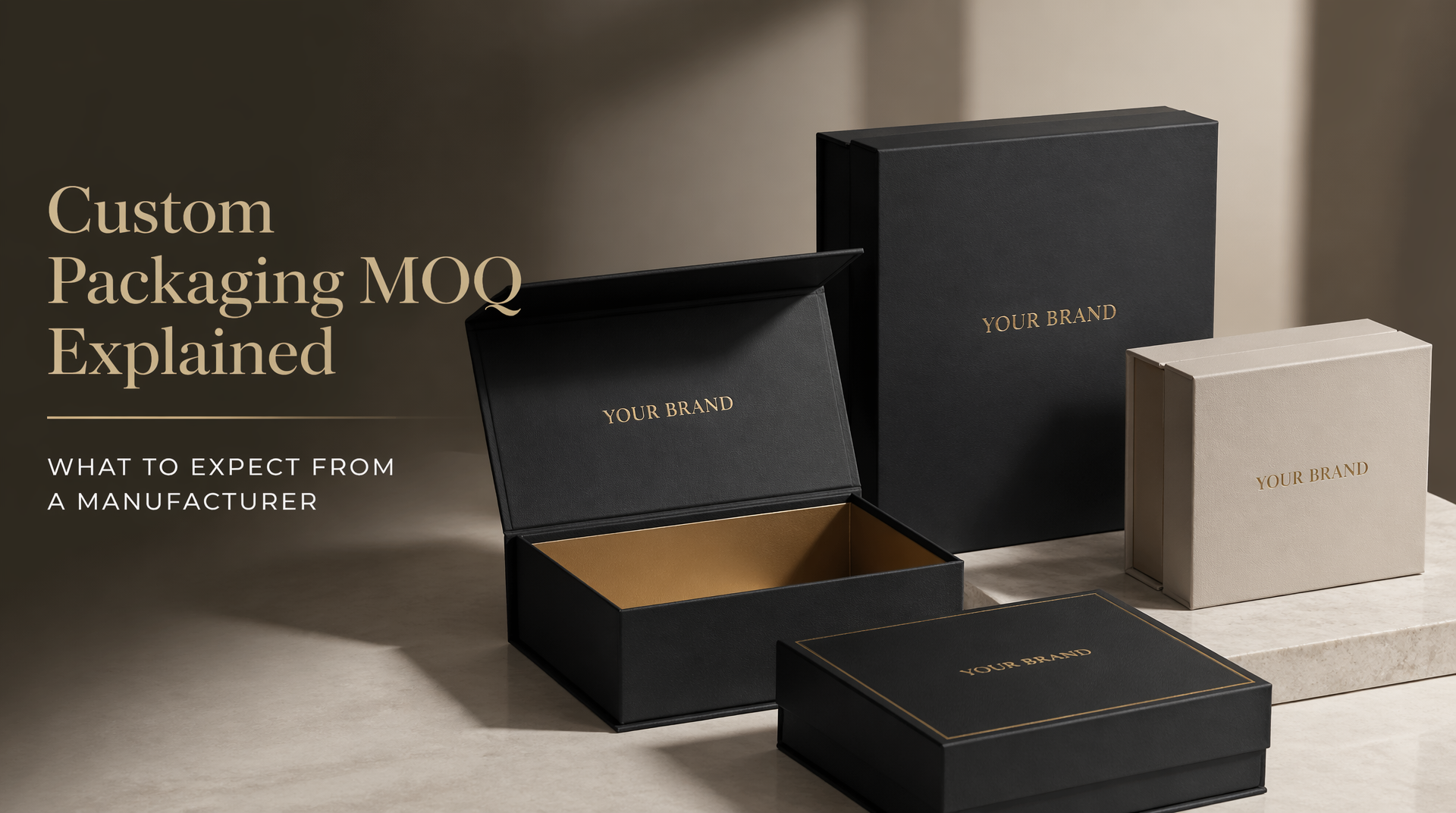
If you have ever reached out to a custom packaging manufacturer and been told there is a minimum order quantity, you are not alone. MOQ is one of the most common questions brands ask when sourcing packaging for the first time — and one of the most misunderstood.
This guide explains exactly what custom packaging MOQ means, why manufacturers set minimums, what affects the number, and how to find a manufacturer flexible enough to grow with your brand.
MOQ stands for Minimum Order Quantity. It refers to the smallest number of units a manufacturer is willing to produce in a single order. In custom packaging, MOQ is not just a business policy — it is directly tied to the economics of production setup, material sourcing and print runs.
When a manufacturer produces a custom box, they must:
All of that setup has a fixed cost — regardless of whether you order 100 units or 10,000 units. MOQ exists to ensure the manufacturer can recover that setup cost while still delivering your packaging at a viable price per unit.
Not all manufacturers set the same MOQ — and the difference can be significant. Here is what drives the variation:
Manufacturers using fully automated production lines can often accommodate lower MOQs because setup is faster and more efficient. Manufacturers relying on manual processes typically require higher minimums to justify the labour cost of setup.
A simple folding carton with one colour print will have a lower MOQ than a rigid gift box with foil stamping, embossing and a custom insert. The more complex the packaging, the higher the setup cost — and the higher the MOQ.
Specialty finishes such as foil stamping, spot UV, embossing and holographic effects each require separate setup processes. Every additional finish adds to the fixed cost of production, which pushes MOQ upward.
If your packaging requires a specialty paper or board that the manufacturer does not hold in standard inventory, they may need to source it in bulk — which increases the minimum quantity required to make the order viable.
A true manufacturer sets their own MOQ based on their actual production costs. A trading company, which outsources production to a third-party factory, often inflates MOQ because they are adding their own margin on top of the factory's minimum.
MOQ ranges vary widely depending on the packaging type and manufacturer. Here is a general guide:
Typically 100 to 500 units for standard designs. More complex finishes may push this to 500 to 1,000 units.
Typically 300 to 1,000 units. Rigid boxes require more labour-intensive production and specialty materials, which increases the minimum.
500 to 1000 units depending on material and print complexity.
For brands scaling into retail distribution, MOQs of 2,000 to 10,000+ units are common, but unit costs drop significantly at higher volumes.
The key point: MOQ is not fixed. It is negotiable, especially when you work directly with a manufacturer rather than a trading company.
Understanding MOQ is inseparable from understanding cost per unit. The relationship is straightforward, the higher your order quantity, the lower your cost per unit. This is because the fixed setup cost is spread across more units.
Here is a simplified example:
Setup cost: $500
Unit production cost: $2.00
Starting small is not a weakness. It is smart brand management. The right manufacturer will support you at every stage.
Xactz supports flexible order quantities from small pilot runs to large-scale programs, without sacrificing quality at any volume.
Before committing to a full production run, most brands request samples. A sample order is different from a minimum order quantity:
Sample costs are usually higher per unit than production costs, this is normal and expected. The purpose of a sample is quality assurance, not cost efficiency. Never skip the sample stage, regardless of how confident you are in your manufacturer.
A reputable manufacturer will always offer free samples. A manufacturer that refuses to produce samples before a full run is a significant red flag.
MOQ is not always set in stone. Here are practical strategies for negotiating a lower minimum with your manufacturer:
Manufacturers are more willing to accommodate lower MOQs for brands they believe have long-term potential. Come prepared with your brand story, your growth plans and a clear brief, it signals that you are a serious partner, not a one-time buyer.
A simpler design means lower setup costs, which means a lower MOQ is viable. Consider launching with a cleaner version of your packaging for the pilot run, then adding complexity as your volume grows.
Offering to commit to a follow-up order, even informally, gives the manufacturer confidence that the setup cost will be recovered across multiple runs. This often unlocks lower MOQs for the first order.
Cutting out trading companies and working directly with the manufacturer removes the middleman markup and gives you direct access to the factory's actual MOQ, which is almost always lower than what a trading company quotes.
Not every manufacturer is transparent about MOQ. Watch for these warning signs:
These are signs you may be dealing with a trading company, or a manufacturer that does not value long-term partnerships.
At Xactz, we understand that brands come in all sizes, and that your packaging needs at launch look very different from your packaging needs at scale. That is why we offer flexible order quantities across all packaging types, from your first pilot run to your largest retail program.
Whether you are a new brand testing your first custom box or an established label rolling out packaging across multiple markets, Xactz scales to your volume without sacrificing quality.
Two fully automated manufacturing facilities. 40,000 sqm of production capacity. 300+ specialists in printing, engineering, die-cutting and quality control. 20+ years of luxury packaging expertise since 2006.
Xactz has been the trusted custom packaging manufacturer for brands in 60+ countries. ISO 9001 certified, FSC certified, TÜV Rheinland verified — and ready to produce exactly what your brand needs, at exactly the volume you need it.
Ready to discuss your MOQ? Contact the Xactz team today and request your sample pack.
By Xactz Packaging
Jun 23, 2026
By Xactz Packaging
Jun 21, 2026
By Xactz Packaging
Jun 15, 2026

