Use less text on mobile!
EXACTLY WHAT YOU NEED
EVERYTHING CUSTOMIZABLE
Use less text on mobile!
FEEL THE LUXURY
CONTACT US TO GET A QUOTE AS YOU NEED
EXACTLY WHAT YOU NEED
EVERYTHING CUSTOMIZABLE
CONTACT US & GET YOUR QUOTE
FEEL THE LUXURY
By Xactz Packaging
Jun 23, 2026
Add a comment
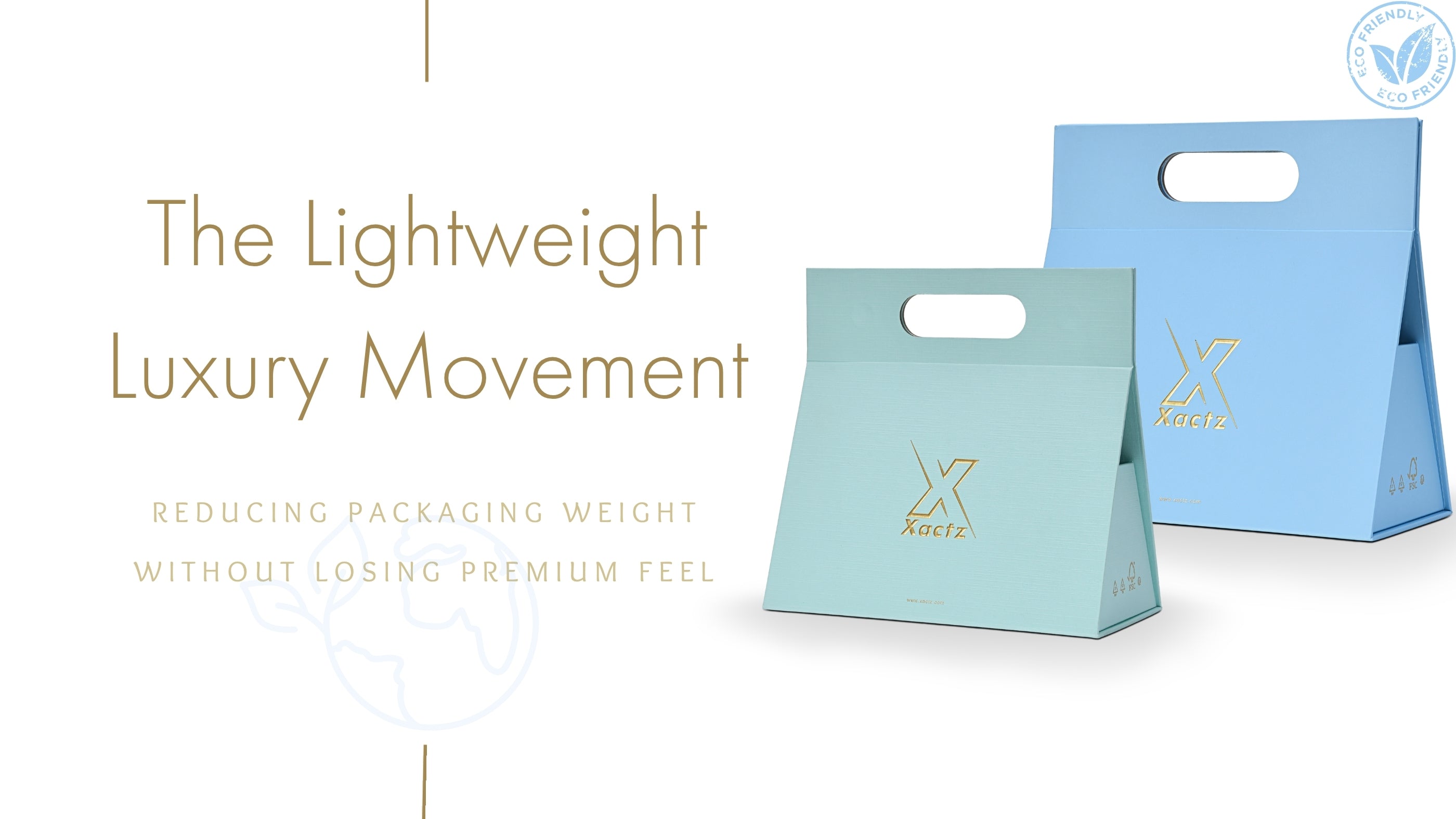
For decades, weight was the default signal of quality in luxury packaging. A heavy rigid box felt expensive. A thick glass bottle felt premium. A dense foam-filled insert felt protective. Brands deliberately over-engineered their packaging to communicate value through mass.
In 2026, that logic has been completely inverted. The modern luxury consumer no longer equates weight with quality. They equate restraint, precision, and material intelligence with quality. A beautifully engineered lightweight box that opens perfectly, feels tactilely rich in hand, and ships without damage communicates far more craft than a heavy, over-laminated box that costs three times as much to ship.
The shift is being driven by three converging forces. First, Extended Producer Responsibility regulations in the EU, UK, and multiple US states now include weight-based fee calculations, meaning heavier packaging costs brands more per unit in compliance fees. Second, global shipping costs have risen sharply, making packaging weight a direct line item in the profit and loss statement. Third, consumer research consistently shows that younger luxury buyers associate minimal, lightweight packaging with environmental responsibility and brand authenticity.
In 2026, luxury no longer means heavy glass and excess material. It means restraint, precision engineering, and the confidence to let the product speak for itself.
Most brand managers calculate packaging cost at the unit level. They compare the price per box from two suppliers and choose the lower number. In 2026, this calculation misses the majority of the true cost of heavy packaging.
The first hidden cost is dimensional weight shipping fees. Carriers including FedEx, DHL, and UPS calculate shipping charges based on whichever is greater between actual weight and dimensional weight. A heavy, thick-walled rigid box increases both measurements simultaneously, compounding the shipping surcharge on every single unit shipped to a consumer or retail partner.
The second hidden cost is EPR eco-modulation fees. Under the weight-based fee structures now active in France, Germany, the UK, and multiple US states, brands pay higher compliance fees for packaging that uses more material per unit than necessary. Reducing the greyboard thickness from 2mm to 1.5mm across a product line of 100,000 units per year can generate significant annual savings in EPR fees alone.
The third hidden cost is warehousing. Heavy, pre-assembled rigid boxes take up significantly more warehouse space than flat-packed alternatives. For brands storing packaging inventory at third-party logistics facilities, this translates directly into higher monthly storage fees.
The fourth hidden cost is carbon liability. As Scope 3 emissions reporting becomes mandatory for brands operating in the EU under the Corporate Sustainability Reporting Directive, the carbon footprint of packaging materials and transport is now a financial and legal exposure. Lighter packaging means lower transport emissions, which means lower carbon liability on the balance sheet.
Lightweight luxury is not about making cheap packaging. It is a precise engineering philosophy that asks a single question at every stage of the design process. Does this material, this layer, or this component add structural value, tactile value, or brand value? If the answer is no, it is removed.
The result is packaging that uses exactly the right amount of material in exactly the right places. A lightweight luxury rigid box might use 1.5mm greyboard instead of 2mm, but reinforce the corners with precision-folded double-wall construction to maintain drop resistance. It might replace a heavy plastic soft-touch laminate with a water-based haptic coating that delivers the same velvety texture at a fraction of the weight. It might replace a dense foam insert with a precision-folded paperboard tray that holds the product just as securely.
Every gram removed is intentional. Every material retained earns its place. The finished box feels considered and precise, which is exactly the signal that premium brands want to send to their customers in 2026.
The greyboard core is the structural foundation of every rigid box. Standard premium rigid boxes use greyboard ranging from 1.5mm to 3mm in thickness. The instinct of many brand managers is to specify the thickest available greyboard to maximize the feeling of solidity. In 2026, advanced structural engineering makes this approach unnecessary.
By using precision-scored folding lines, reinforced corner geometry, and double-wall construction at stress points, our structural engineers at Xactz can achieve the same drop resistance and compression strength using 1.5mm greyboard as a standard box achieves with 2mm greyboard. The key is understanding where structural load is actually applied during transit and reinforcing those specific points rather than adding uniform thickness across the entire box.
This approach reduces the total material weight of the box by up to 25 percent without any measurable reduction in structural performance. For brands shipping internationally, this weight reduction translates directly into lower per-unit shipping costs and lower EPR material fees across every market they serve.
The greyboard we use at Xactz is manufactured from recycled paper fibers and carries full FSC certification, ensuring that the material reduction also contributes to a lower overall carbon footprint per unit produced.
Surface finishing is one of the most significant contributors to packaging weight that brands rarely consider. A standard plastic soft-touch laminate adds a measurable layer of BOPP film to every surface of the box. Multiply this across the lid, base, and all interior surfaces, and the lamination alone adds meaningful weight per unit while also making the box non-recyclable.
In 2026, advanced water-based haptic coatings deliver the same velvety, tactile surface experience as plastic soft-touch lamination at a fraction of the weight. These coatings are applied as a liquid and cure to a microscopically thin layer that provides scratch resistance, a premium matte finish, and a soft tactile feel without adding any significant mass to the packaging structure.
Beyond coatings, premium uncoated and lightly textured FSC-certified papers are now being used as the primary surface treatment for lightweight luxury packaging. Papers with natural grain textures, linen weaves, and cotton-blend surfaces communicate premium quality through tactile richness rather than through weight or shine. When a customer picks up a box wrapped in a beautifully textured uncoated paper, their hands register craftsmanship and quality immediately, without any need for heavy lamination or metallic foil.
Blind debossing on lightweight uncoated paper produces particularly striking results. Because the paper fibers compress cleanly under a brass die, the debossed impression appears deep and precise, creating a strong visual and tactile brand mark using no ink, no foil, and no additional weight whatsoever.
One of the most impactful changes a brand can make to reduce packaging weight and cost is switching from pre-assembled rigid boxes to flat-pack collapsible rigid boxes. This single structural decision can reduce inbound shipping volume by up to 70 percent compared to pre-assembled boxes, dramatically lowering both transport costs and carbon emissions per unit.
Flat-pack rigid boxes are manufactured from the same premium greyboard and FSC-certified paper as standard rigid boxes. The difference is in the assembly mechanism. Instead of being glued into a fixed three-dimensional shape at the factory, flat-pack boxes are engineered with precision-scored fold lines and integrated corner tabs that allow them to ship completely flat and assemble on-site in seconds.
For brands that receive packaging inventory at a warehouse or fulfillment center before shipping to consumers, this means storing the same number of boxes in a fraction of the floor space. For brands that ship directly from a factory to a retail partner overseas, this means fitting significantly more units into a single shipping container, reducing the per-unit freight cost substantially.
The flat-pack format also reduces the risk of transit damage to the packaging itself. Pre-assembled rigid boxes can be crushed or deformed during ocean freight if stacking weight is applied unevenly. Flat-pack boxes ship as a solid stack of flat panels that are inherently more resistant to compression damage during transit.
The insert is often the heaviest single component inside a luxury rigid box. Dense EVA foam inserts cut to the shape of a perfume bottle or cosmetic compact can weigh as much as the box itself. In 2026, brands are replacing these heavy foam inserts with precision-engineered paper-based alternatives that provide equivalent protection at a fraction of the weight.
Custom-molded paper pulp inserts are the most widely adopted replacement for foam in the lightweight luxury segment. Manufactured by pressing recycled paper fiber into precision molds, these inserts hold products with millimeter accuracy and absorb transit impact through the natural compression properties of paper fiber. A molded pulp insert for a standard 50ml perfume bottle weighs approximately 60 to 70 percent less than an equivalent EVA foam insert while providing comparable drop protection.
Precision-folded paperboard inserts are the second major alternative. Structural engineers design single-sheet cardboard structures that fold into secure product chambers using no adhesive and no additional components. These folded inserts are extremely lightweight, fully recyclable, and visually striking when the box is opened, presenting the product in a clean, architectural setting that communicates engineering precision.
Both insert types contribute directly to the lightweight luxury philosophy. Every gram removed from the insert reduces shipping cost, EPR material fees, and carbon emissions per unit shipped, while simultaneously improving the recyclability of the entire package.
The lightweight luxury engineering approach applies across every structural format we manufacture at Xactz. Each box type offers specific opportunities to reduce weight without compromising the premium opening experience.
Foldable rigid boxes are the definitive lightweight luxury format. They ship flat, assemble instantly, and use precision-engineered fold geometry to achieve structural rigidity without requiring thick greyboard. For brands prioritizing shipping cost reduction and warehousing efficiency, foldable boxes deliver the most significant weight and volume savings of any rigid box format available.
Magnetic hinge-lid boxes can be engineered for lightweight performance by specifying 1.5mm greyboard for the lid and base panels while using double-wall reinforcement at the hinge point and corners. Ultra-thin neodymium magnets embedded between the greyboard layers add minimal weight while delivering the satisfying snap closure that makes this format so popular with premium brands.
Book-shaped boxes benefit from lightweight engineering at the hinge and spine. By using paper-based hinge tape and precision-scored fold lines instead of rigid plastic spine supports, we reduce the weight of the spine assembly significantly while maintaining the smooth, controlled opening action that defines this format.
Drawer boxes are naturally well-suited to lightweight engineering because the sleeve and tray mechanism distributes structural load across two separate components. By specifying 1.5mm greyboard for the outer sleeve and 1.2mm for the inner tray, and replacing polyester ribbon pulls with die-cut paper finger notches, we reduce total box weight by up to 30 percent compared to a standard specification drawer box.
Classic lid and base boxes achieve lightweight performance through precise tolerance engineering. By calibrating the fit between lid and base to within 0.3mm, we create the controlled air-release opening action that signals premium quality using nothing but paper geometry, eliminating the need for additional structural components that add weight without adding value.
| Component | Lightweight Material | Technical Detail | Weight Saving vs Standard |
|---|---|---|---|
| Core Structure | Recycled Greyboard | 1.2mm to 1.5mm with reinforced corner geometry | Up to 25% lighter |
| Outer Wrap | FSC Certified Uncoated Paper | 120gsm textured or cotton blend paper | Up to 15% lighter |
| Inner Liner | FSC Certified Paper | 100gsm uncoated paper | Up to 10% lighter |
| Product Insert | Molded Paper Pulp | Precision molded recycled fiber insert | Up to 65% lighter than foam |
| Adhesive | Water Based Starch Glue | Soy-based non-toxic starch adhesive | Negligible weight addition |
| Surface Finish | Aqueous Haptic Coating | Water-based matte haptic varnish | Up to 80% lighter than BOPP laminate |
| Branding | Blind Deboss or Soy Ink | Inkless debossing or vegetable-based printing | Zero additional weight |
At Xactz, we operate across more than 40,000 square meters of advanced manufacturing facilities in Shenzhen and Huizhou. Our structural engineering team works directly with brand managers and procurement teams to identify every opportunity to reduce packaging weight without compromising structural performance or premium aesthetics.
Our FSC certification code SGSHK-COC-332603 ensures full material traceability across all lightweight paper and greyboard specifications. We manufacture custom-molded paper pulp inserts in-house, ensuring perfect product fit and consistent weight performance across production runs. All debossing dies are crafted in-house from high-grade brass, delivering deep, precise impressions on lightweight uncoated papers without tearing or distorting the fiber.
Every lightweight luxury box undergoes our 18-point in-house quality control process, with specific attention to corner integrity, hinge performance, and insert fit tolerance. Drop testing and compression testing are conducted on pre-production samples to verify that the lightweight specification meets the structural requirements of international shipping before mass production begins.
As a real source factory, we eliminate trading company markups and hidden costs, making lightweight luxury packaging engineering accessible for brands at every scale, from 100-unit startup launches to 500,000-unit global enterprise rollouts.
All materials are FDA compliant and meet EU 94/62/EC environmental standards. Our manufacturing facilities are independently verified by TÜV Rheinland.
We operate a dedicated department for personalized small-order production, supporting startups, growing brands, and enterprise micro-orders with the same premium materials and engineering precision as our high-volume runs.
Minimum Order Quantity starts from 100 units across all custom box styles.
Structural dieline creation takes 1 to 2 business days.
Physical white sample for structural review is ready in 1 to 3 business days.
Physical printed sample to full specification is ready in 3 to 5 business days.
Mass production turnaround is 10 to 18 days from final sample approval.
Xactz is consecutively ranked in the Top 5 percent of exhibitors for innovation and quality at Paris Packaging Week 2026, Packaging Innovations Birmingham 2026, and Packaging Première Milan 2026.
We are a real source factory with over 40,000 square meters of advanced manufacturing. There are no trading company showrooms, no middlemen, and no hidden costs. Our facilities are open for in-person visits and factory audits at any time.
We serve premium brands across 60 plus countries, delivering worldwide to Europe, North America, Southeast Asia, and the Middle East. Whether you need 100 units for a startup launch or 500,000 units for a global enterprise rollout, our production infrastructure scales to meet your requirements without compromising on material quality or structural precision.
Ready to reduce your packaging weight, lower your shipping costs, and meet 2026 EPR compliance requirements without losing a single point of premium feel? Our structural engineers and material specialists are ready to design your lightweight luxury packaging solution from the ground up.
What you get when you work directly with Xactz
FSC Certified Lightweight Papers and Precision Greyboard across all structural formats
Custom Molded Paper Pulp Inserts up to 65 percent lighter than foam
Water Based Haptic Coatings up to 80 percent lighter than plastic lamination
Deep Blind Debossing on lightweight uncoated paper using in-house brass tooling
Soy and Vegetable Based Printing Inks for full color and spot color applications
Lightweight Foldable, Magnetic, Drawer, Book Shaped, and Lid and Base Structures
MOQ from 100 units with 1 to 3 day sample turnaround
10 to 18 day mass production turnaround
Get a direct factory quote at https://xactz.com/pages/contact-us
Explore our full range of custom packaging solutions at https://xactz.com/
By Xactz Packaging
Aug 16, 2026
By Xactz Packaging
Aug 13, 2026
By Xactz Packaging
Aug 12, 2026
