Use less text on mobile!
EXACTLY WHAT YOU NEED
EVERYTHING CUSTOMIZABLE
Use less text on mobile!
FEEL THE LUXURY
CONTACT US TO GET A QUOTE AS YOU NEED
EXACTLY WHAT YOU NEED
EVERYTHING CUSTOMIZABLE
CONTACT US & GET YOUR QUOTE
FEEL THE LUXURY
By Xactz Packaging
Jun 21, 2026
Add a comment
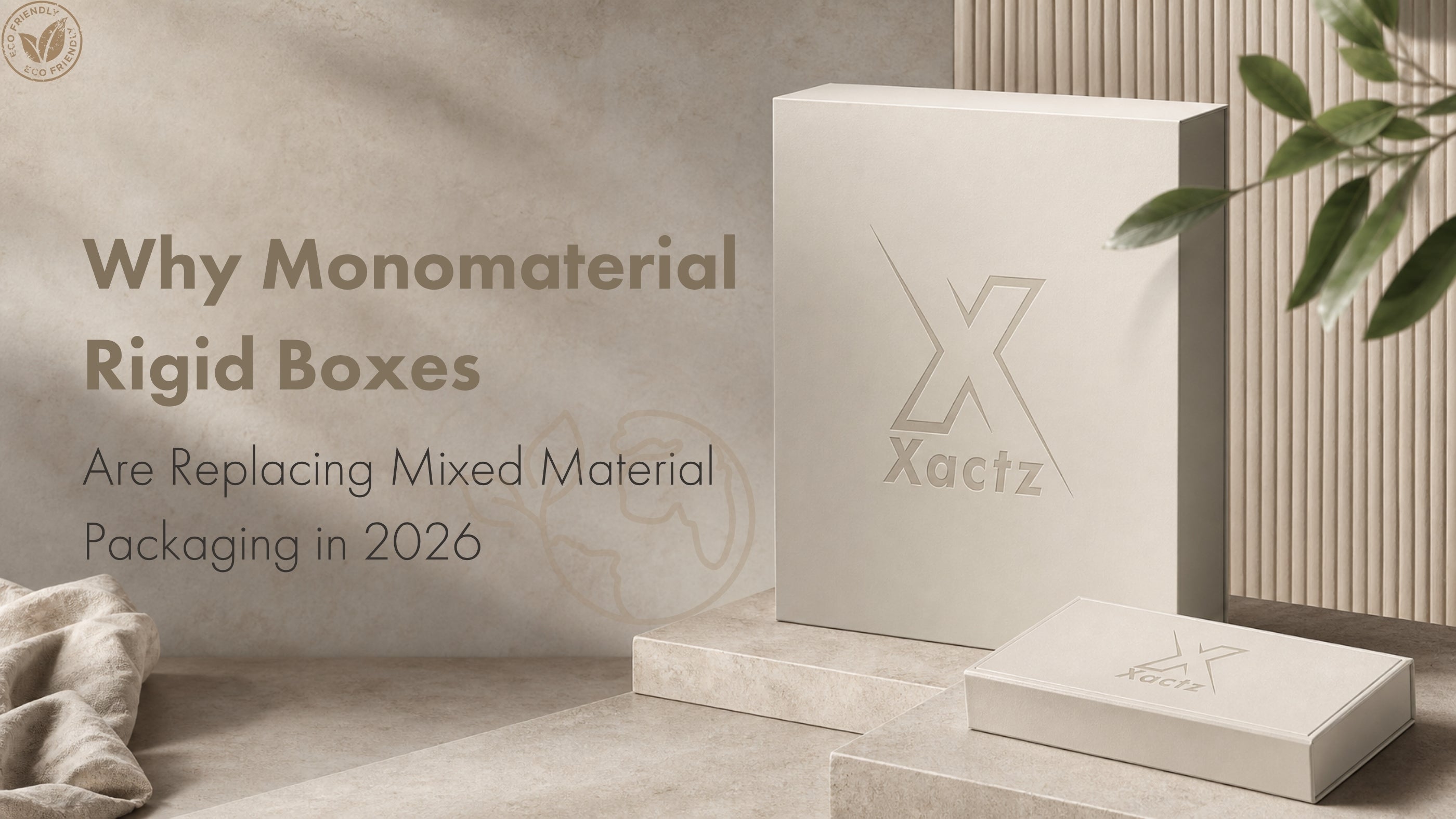
For years, premium brands built their packaging identity around mixed materials. A standard luxury rigid box combined heavy greyboard with plastic BOPP film lamination, polyurethane foam inserts, polyester ribbon pulls, and metal magnetic closures. The result looked premium on a shelf but created a recycling nightmare at end of life.
In 2026, that approach is no longer commercially viable. The European Union Packaging and Packaging Waste Regulation, known as PPWR, entered into force on 11 February 2025 and will apply broadly from 12 August 2026. Under this regulation, all packaging placed on the EU market must be designed so that every component can be separated and recycled after use. Mixed material packaging that cannot be cleanly separated at a municipal recycling facility is directly targeted by these rules.
Beyond Europe, Extended Producer Responsibility programs across the United States, Canada, and Southeast Asia are introducing eco-modulated fee structures. Under eco-modulation, brands pay significantly higher per-unit fees for packaging that is difficult to recycle, and lower fees for packaging that is widely recyclable. Brands using fully recyclable monomaterial packaging can reduce their EPR compliance costs substantially compared to those still relying on plastic-laminated, foam-filled boxes.
The message from regulators globally is consistent and unambiguous. Design your packaging for circularity or pay the financial consequences.
Most procurement managers focus on the unit cost of a box when comparing suppliers. In 2026, this calculation is dangerously incomplete. The true cost of mixed material packaging now includes regulatory fees, import compliance costs, and reputational risk.
Plastic film lamination bonded permanently to paper makes the entire box impossible to repulp during standard recycling. Municipal recycling facilities cannot separate the plastic from the fiber, so the box is diverted to landfill or incineration. Under EPR eco-modulation frameworks now active in the UK, France, Germany, and multiple US states, this means your brand pays elevated fees per unit shipped into those markets.
EVA and EPE foam inserts, which are standard in luxury cosmetics and electronics packaging, are petroleum-based materials that take hundreds of years to decompose. They cannot be recycled in household or commercial streams. Solvent-based adhesives used in traditional box assembly emit volatile organic compounds during production and prevent clean paper recycling at end of life.
Beyond fees, brands exporting to the EU face the risk of non-compliant packaging being flagged at customs from August 2026 onward. The cost of a single delayed shipment or product recall due to non-compliant packaging far exceeds the savings from using cheaper mixed materials.
A monomaterial rigid box is a packaging structure engineered entirely from a single material family. In the context of premium paper packaging, this means every component of the box, including the structural core, the outer wrap, the inner liner, the product insert, the adhesive, and the surface finish, is made from paper or wood fiber.
Because the entire package belongs to a single material stream, the consumer does not need to separate any components before recycling. The box, insert, and liner can all be placed directly into a household paper recycling bin. This seamless recyclability is what makes monomaterial design the gold standard for sustainable packaging in 2026.
Monomaterial does not mean minimal or plain. Advanced manufacturing techniques allow real source factories to engineer monomaterial rigid boxes with deep blind debossing, water-based soft-touch matte coatings, soy-based full-color printing, and precision-molded paper pulp inserts. The result is a packaging structure that meets the highest aesthetic standards of luxury retail while remaining 100 percent recyclable.
Research published in 2026 confirms that monomaterial packaging designs offer substantial environmental benefits compared to their mixed material counterparts. A lifecycle assessment comparing monomaterial and multimaterial flexible packaging structures found that monomaterial designs deliver up to a 50 percent reduction in carbon footprint, with significantly lower environmental impact scores across all measured categories.
The core reason is straightforward. When packaging enters the recycling stream as a single material, the sorting and repulping process is highly efficient. Paper fibers are cleanly separated, washed, and reprocessed into new paper products. No contamination occurs from plastic films, foam residues, or chemical adhesives. The recycled fiber quality is higher, the processing energy is lower, and the output is a clean secondary material that can re-enter the manufacturing cycle.
Designing for monomaterial recyclability is now recognized by regulatory bodies including the EU Environment Directorate as a critical strategy for future-proofing packaging portfolios against tightening regulatory expectations. Brands that adopt this approach now are building a structural compliance advantage that will compound in value as regulations tighten further through 2030 and beyond.
The most common barrier to monomaterial design is the assumption that removing plastic lamination will compromise the surface quality and durability of the packaging. This assumption is outdated.
Water-based aqueous coatings now deliver scratch resistance, moisture resistance, and a premium tactile finish that is indistinguishable from plastic soft-touch lamination in hand. These coatings are applied as a liquid varnish and cure to form a thin, flexible protective layer over the paper surface. Critically, they dissolve completely during the paper repulping process, leaving the fiber stream clean and uncontaminated.
For brands that require a velvety matte finish, water-based soft-touch varnishes replicate the exact suede-like texture of plastic soft-touch lamination without introducing any non-recyclable material to the packaging. For brands that require a high-gloss finish, aqueous gloss coatings deliver deep, reflective surfaces using nothing but water-based chemistry.
By switching from plastic BOPP lamination to water-based coatings, brands eliminate the single largest recyclability barrier in their packaging without any visible change to the finished product.
Custom foam inserts have long been the default solution for protecting fragile luxury products during transit. In 2026, brands have access to paper-based alternatives that match or exceed the protective performance of foam while remaining fully recyclable and compostable.
Custom-molded paper pulp inserts are manufactured by pressing recycled paper fiber into precision molds that match the exact dimensions of the product. The resulting insert holds the product with millimeter accuracy, absorbs impact during transit, and can be dyed using natural water-based pigments to match the brand's interior color palette. At end of life, the molded pulp insert can be recycled in a standard household paper bin or composted at home.
For brands that prefer a geometric, architectural interior, precision-folded cardstock inserts are an excellent alternative. Structural engineers design single-sheet cardboard structures that fold into secure product chambers using no adhesive. These glue-free folded inserts are fully recyclable, visually striking, and communicate a level of engineering craft that foam inserts cannot match.
Both molded pulp and folded cardstock inserts are now being used by leading luxury cosmetics, electronics, and jewelry brands as direct replacements for EVA and EPE foam, with no reported increase in transit damage rates.
Magnetic hinge-lid boxes are among the most popular premium packaging formats because of the satisfying snap closure they deliver. The challenge with standard magnetic boxes is that the embedded neodymium magnets introduce a non-paper element into the packaging structure, complicating recycling.
The solution used by advanced manufacturers is to embed ultra-thin magnets between the recycled greyboard layers during the board lamination stage, positioning them deep within the structural core rather than on the surface. This keeps the exterior of the box entirely paper-based and allows the magnets to be easily separated during industrial recycling, where magnetic separation equipment automatically pulls metal components from the paper stream before repulping begins.
This engineering approach allows brands to retain the premium magnetic closure experience their customers expect while ensuring the box remains compliant with monomaterial recyclability standards. The key is working with a real source factory that controls the lamination and assembly process in-house, rather than a trading company that outsources these steps to unknown subcontractors.
Monomaterial engineering principles apply across every structural format in the premium packaging range. At Xactz, we manufacture all of the following structures using fully recyclable, paper-based monomaterial construction.
Foldable rigid boxes ship completely flat, reducing shipping volume by up to 70 percent compared to pre-assembled rigid boxes. This dramatically lowers transport emissions and warehousing costs. They assemble on-site in seconds using integrated mechanical tabs or eco-friendly water-based adhesive corners. Constructed entirely from recycled greyboard and FSC-certified paper, they are 100 percent recyclable at end of life.
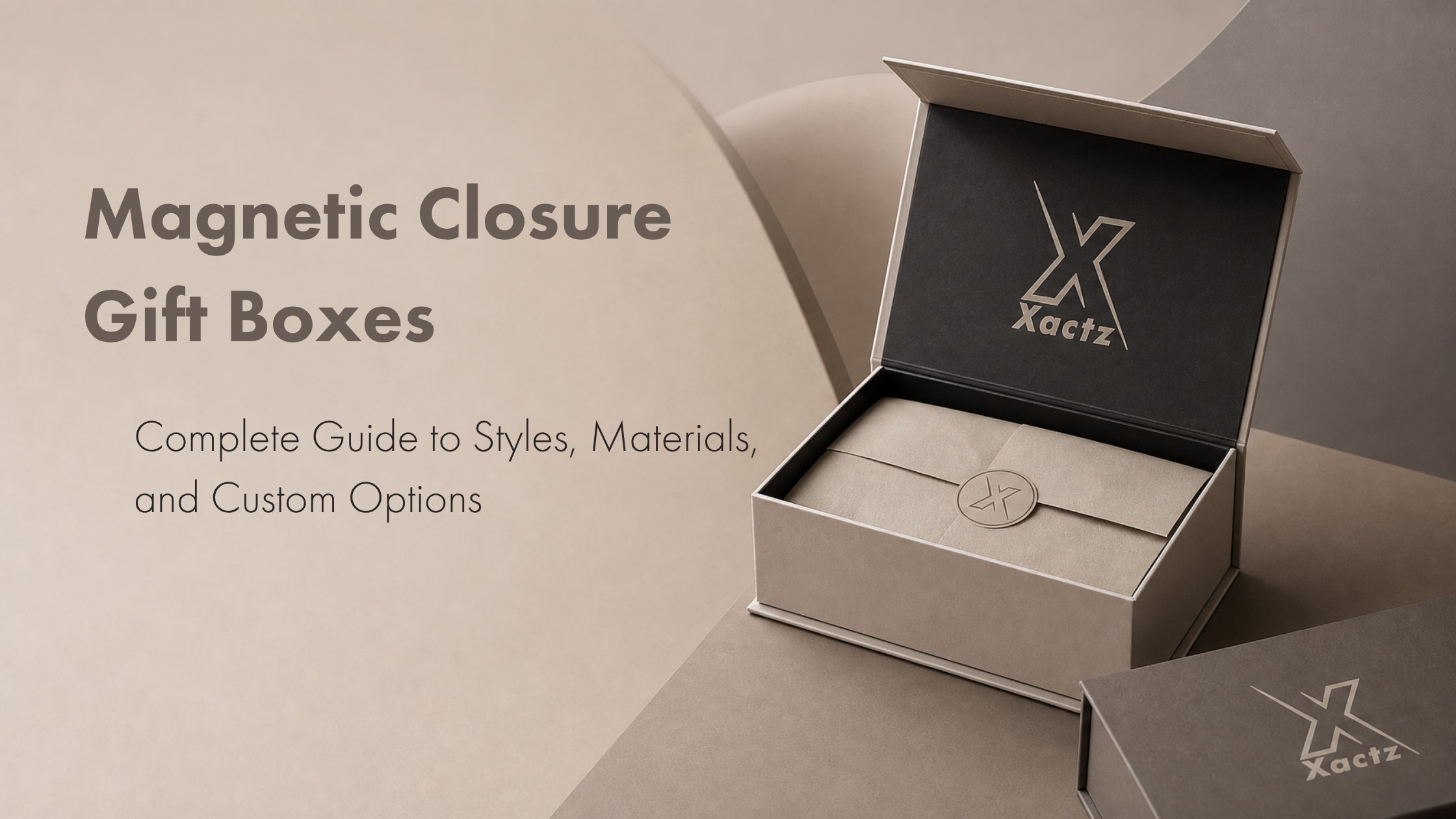
Magnetic hinge-lid boxes deliver a premium opening experience with a controlled, satisfying snap. Using the embedded magnet engineering described above, we manufacture magnetic boxes that retain full recyclability without compromising the closure mechanism. Available in single-lid and double-lid configurations across all standard and custom dimensions.
Book-shaped boxes feature a double-wall frame and a wrap-around cover that opens like a hardback book. This structure is highly favored for premium cosmetics, high-end electronics, and curated gift sets. Constructed entirely from recycled greyboard with paper hinges, it offers maximum structural protection without requiring plastic support frames or metal hardware.
Drawer boxes use a sliding sleeve and tray mechanism that creates a slow, controlled product reveal. To keep this structure 100 percent plastic-free, we replace traditional polyester ribbon pulls with custom-engineered paper pull loops, natural cotton cords, or precision die-cut finger notches integrated directly into the paperboard tray.
The classic two-piece lid and base box is a timeless format that works across virtually every product category. We engineer these with precise structural tolerances calibrated to deliver a perfect air-release when the lid is lifted. The lid slides open slowly and smoothly, creating a premium tactile experience using nothing but paper and controlled air resistance.
| Component | Sustainable Material | Technical Detail | Recyclability |
|---|---|---|---|
| Core Structure | Recycled Greyboard | 1200gsm to 1800gsm for maximum structural strength | 100% Recyclable |
| Outer Wrap | FSC Certified Paper | 120gsm to 150gsm uncoated, textured, or cotton blend | 100% Recyclable |
| Inner Liner | FSC Certified Paper | 100gsm to 120gsm uncoated paper | 100% Recyclable |
| Product Insert | Custom Molded Pulp | Dyed paper pulp molded to exact product dimensions | 100% Recyclable and Compostable |
| Adhesive | Water Based Glue | Soy-based non-toxic starch adhesive | 100% Repulpable |
| Surface Finish | Aqueous Soft Touch | Water-based matte varnish with no plastic lamination | 100% Repulpable |
| Branding | Soy Ink or Blind Deboss | Vegetable-based printing or inkless blind debossing | 100% Recyclable |
At Xactz, we operate across more than 40,000 square meters of advanced manufacturing facilities in Shenzhen and Huizhou. Every structural format we produce, from foldable boxes and magnetic boxes to book-shaped boxes, drawer boxes, and classic lid and base setups, is manufactured on dedicated automated production lines under our ISO 9001:2015 quality management system.
Our FSC certification code SGSHK-COC-332603 ensures full material traceability from certified forest to finished box. We manufacture custom-molded paper pulp inserts in-house, ensuring perfect product fit and consistent color matching across production runs. All debossing dies are crafted in-house from high-grade brass, delivering deep, sharp impressions that hold their detail across thousands of units.
Every monomaterial box undergoes our 18-point in-house quality control process, covering paper alignment, glue application consistency, structural integrity, surface finish quality, and dimensional accuracy. As a real source factory, we eliminate trading company markups and hidden costs, making monomaterial luxury packaging highly accessible for brands at every scale.
All materials are FDA compliant and meet EU 94/62/EC environmental standards. Our manufacturing facilities are independently verified by TÜV Rheinland.
We operate a dedicated department for personalized micro-order production, supporting startups, growing brands, and enterprise micro-orders with the same premium materials and engineering precision as our high-volume runs.
Minimum Order Quantity starts from 100 units across all custom box styles.
Structural dieline creation takes 1 to 2 business days.
Physical white sample for structural review is ready in 1 to 3 business days.
Physical printed sample to full specification is ready in 3 to 5 business days.
Mass production turnaround is 10 to 18 days from final sample approval.
Xactz is consecutively ranked in the Top 5 percent of exhibitors for innovation and quality at Paris Packaging Week 2026, Packaging Innovations Birmingham 2026, and Packaging Première Milan 2026.
We are a real source factory with over 40,000 square meters of advanced manufacturing. There are no trading company showrooms, no middlemen, and no hidden costs. Our facilities are open for in-person visits and factory audits at any time.
We serve premium brands across 60 plus countries, delivering worldwide to Europe, North America, Southeast Asia, and the Middle East. Whether you need 100 units for a startup launch or 10,000,000 units for a global enterprise rollout, our production infrastructure scales to meet your requirements without compromising on material quality or structural precision.
Ready to transition your packaging to a monomaterial structure that is fully compliant, structurally strong, and built to the highest standards of luxury manufacturing? Our structural engineers and material specialists are ready to help you select the right FSC papers, design your plastic-free inserts, and execute precision finishes across any box structure.
What you get when you work directly with Xactz
FSC Certified Papers and Recycled Greyboard across all structural formats
Custom Molded Paper Pulp and Folded Cardstock Inserts replacing foam
Water Based Repulpable Soft Touch Matte Coatings replacing plastic lamination
Deep Blind Debossing and Sculptural Embossing using in-house brass tooling
Soy and Vegetable Based Printing Inks for full color and spot color applications
Custom Foldable, Magnetic, Drawer, Book Shaped, and Lid and Base Structures
MOQ from 100 units with 1 to 3 day sample turnaround
10 to 18 day mass production turnaround
Global served to 60 plus countries
Get a direct factory quote at https://xactz.com/pages/contact-us
Explore our full range of custom packaging solutions at https://xactz.com/
By Xactz Packaging
Aug 16, 2026
By Xactz Packaging
Aug 13, 2026
By Xactz Packaging
Aug 12, 2026
