Use less text on mobile!
EXACTLY WHAT YOU NEED
EVERYTHING CUSTOMIZABLE
Use less text on mobile!
FEEL THE LUXURY
CONTACT US TO GET A QUOTE AS YOU NEED
EXACTLY WHAT YOU NEED
EVERYTHING CUSTOMIZABLE
CONTACT US & GET YOUR QUOTE
FEEL THE LUXURY
بواسطة Xactz Packaging
3 أغسطس 2026
أضف تعليقًا
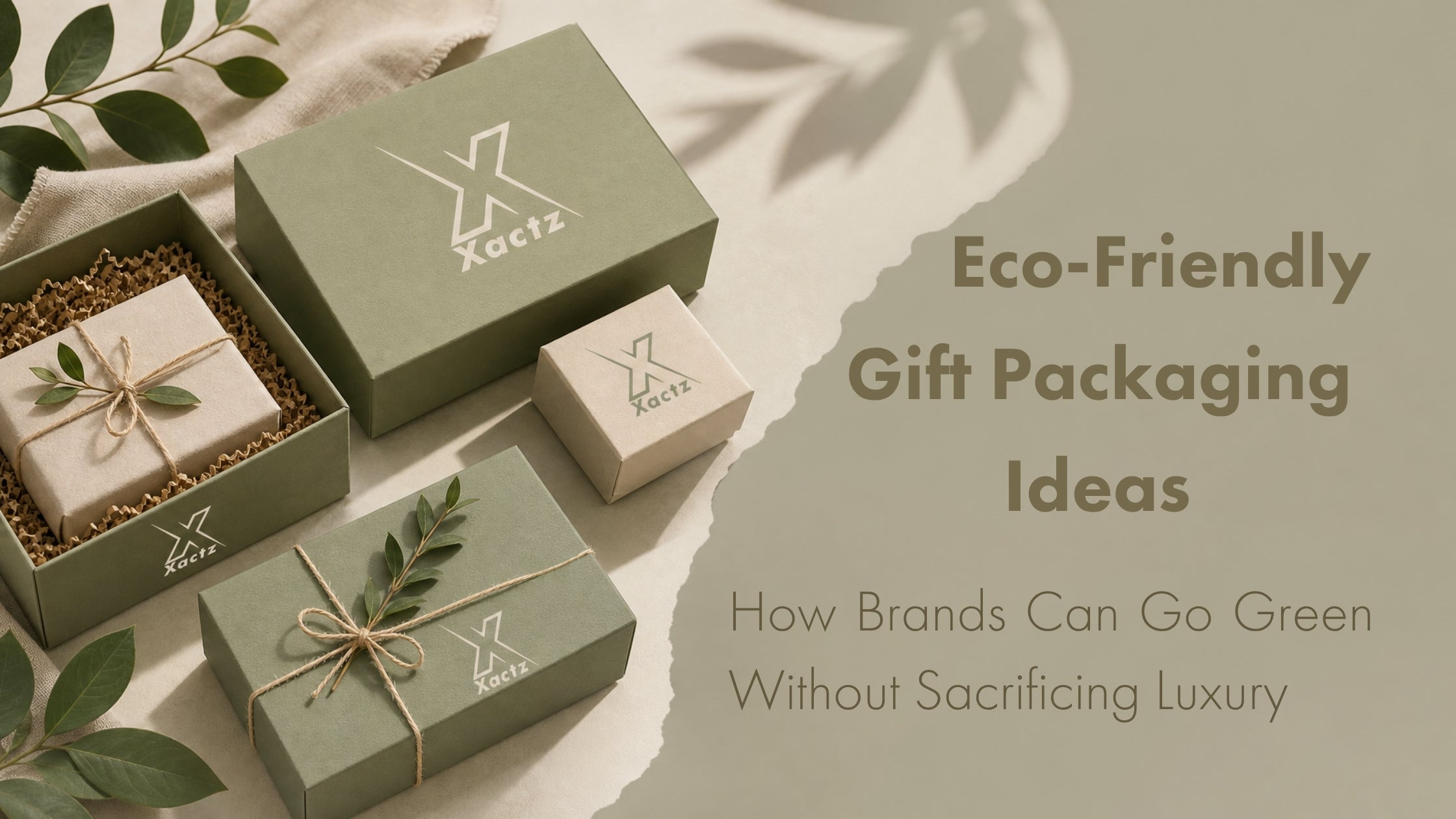
The definition of luxury has changed. For decades, premium packaging was measured by how opulent it looked, how heavy it felt, and how much material went into producing it. In 2026, the most discerning consumers measure luxury by something entirely different: how responsibly it was made.
Eco-friendly gift packaging is no longer a niche preference or a marketing add-on. It is a core expectation from the customers who matter most to premium brands. According to the 2026 Consumer Packaging Report by UPrinting, 32% of Americans are willing to pay 6 to 10% more for products that come in sustainably made, well-designed packaging. A separate report by Shorr found that 43% of consumers are willing to pay extra specifically for sustainable packaging, and 39% have actively switched brands because of it.
For premium retailers, D2C brand owners, and event planners, this shift represents one of the most significant commercial opportunities in modern brand-building. The brands that align their packaging with their customers' values are building loyalty that no advertising budget can replicate. The brands that do not are quietly losing ground to competitors who have already made the transition.
This guide covers everything you need to know about making the switch to sustainable luxury packaging without compromising a single element of the premium experience your customers expect.
The foundation of any successful eco-friendly gift packaging strategy is material selection. The right materials do not ask you to choose between sustainability and luxury. They deliver both simultaneously. Here are the three material categories that are defining the sustainable luxury packaging space in 2026.
Rigid boxes have long been the gold standard of luxury packaging. The structured walls, the magnetic or ribbon closure, the satisfying weight when lifted, these are the physical signals that tell a customer they are holding something premium. FSC-certified rigid boxes deliver all of that while adding a layer of environmental credibility that modern consumers actively look for.
FSC certification, issued by the Forest Stewardship Council, guarantees that the paperboard used in your rigid box was sourced from responsibly managed forests where biodiversity is protected, workers are treated fairly, and replanting is mandated. It is one of the most recognized and trusted environmental certifications in the global packaging industry.
The structural performance of FSC-certified rigid boxes is identical to that of conventional rigid boxes. They can be produced in any dimension, finish, or configuration. They support hot stamping, embossing, debossing, soft-touch lamination with water-based alternatives, and full-color printing. The certification adds no visual compromise and no structural limitation. What it does add is a verifiable supply chain story that resonates with the premium consumers who research the brands they buy from.
For D2C brands and luxury retailers, FSC-certified rigid boxes are the most direct upgrade available. Same premium look. Same structural integrity. Fully certified sustainable sourcing. The certification mark itself, when printed on the box base, communicates brand values without a single word of copy.
Every premium packaging design depends on print quality. Color accuracy, vibrancy, and consistency across production runs are non-negotiable for luxury brands. Conventional petroleum-based inks have delivered on those requirements for decades, but they carry a significant environmental cost: volatile organic compound (VOC) emissions during manufacturing, contamination of the paper recycling stream during de-inking, and reliance on non-renewable petroleum inputs.
Soy-based inks solve all three problems without asking brands to accept any reduction in print quality. In fact, modern soy-based ink formulations produce richer, more vibrant color reproduction than petroleum alternatives, with superior color retention over time and better rub resistance on finished surfaces. For luxury packaging where color accuracy is a brand identity requirement, soy inks are not a compromise. They are an upgrade.
The environmental case is equally strong. Soy-based inks are derived from a renewable agricultural source. They release up to 78% fewer VOCs than petroleum inks during production. And critically, they are substantially easier to remove during the paper de-inking process at recycling mills, which means the recycled pulp produced from soy-ink-printed packaging is cleaner and higher quality. This supports a genuinely circular material system where your packaging contributes to better recycled paper rather than degrading it.
For brands printing biodegradable gift boxes, sustainable custom boxes, or any eco-friendly gift packaging at commercial volumes, soy-based inks are the professional standard. They align your print process with your sustainability commitments at zero cost to visual quality.
Hemp paper is one of the most compelling material stories in sustainable luxury packaging today. It is not a new material. Hemp has been used for paper production for centuries. What is new is the quality and accessibility of commercial hemp paper products, which have advanced significantly in recent years to the point where they are now a genuine premium packaging option.
Hemp paper is produced from the bast fibers of the hemp plant, which grows rapidly, requires minimal water, needs no pesticides, and replenishes soil health rather than depleting it. The resulting paper has a natural texture, a warm organic tone, and a tactile quality that is distinctly different from conventional wood-pulp paper. For luxury wrapping paper, tissue paper, envelope liners, and box wrap applications, hemp paper delivers a sensory experience that communicates craft, intentionality, and quality.
Beyond the tactile premium, hemp paper is significantly more durable than conventional paper at equivalent weights. It resists tearing, holds embossing and debossing with exceptional definition, and ages gracefully without yellowing. For event planners and premium retailers who want packaging that customers keep rather than discard, hemp paper creates a physical object worth holding onto.
The sustainability credentials are among the strongest of any packaging material available. Hemp sequesters carbon during growth, requires a fraction of the land and water needed for equivalent wood-pulp production, and produces a fully biodegradable end product. For brands building a sustainable luxury packaging system, hemp paper is the material that makes the story tangible at the moment of touch.
Material selection is the foundation. But the unboxing experience is where sustainable luxury packaging either succeeds or falls apart. A box made from FSC-certified board with soy-based ink printing and a hemp paper wrap can still generate unnecessary waste if the interior system is not designed with the same level of intention.
Zero-waste unboxing design is built on four core strategies.
Right-Sizing Every Component
The single most impactful design decision in sustainable packaging is also the simplest: make the box the right size for the product. Oversized packaging requires more material to produce, more void fill to compensate for empty space, more dimensional weight in shipping, and more waste at the point of unboxing. Custom-sized packaging that fits your product precisely eliminates all of these inefficiencies simultaneously. It also creates a more premium unboxing experience. A product that fits its box with precision communicates that the packaging was designed specifically for it, which is one of the clearest signals of luxury craftsmanship available.
Paper-Based Interior Systems
Plastic foam inserts and vacuum-formed plastic trays are the most common source of non-recyclable waste in luxury packaging. Custom paper partitions, die-cut corrugated inserts, and molded pulp trays replace plastic interiors with fully recyclable, paper-based alternatives that can match the protective performance of foam at equivalent product weights. When the interior system is paper-based and the outer box is paper-based, the entire package can be recycled as a single unit, which is the practical definition of a zero-waste unboxing experience.
Eliminating Non-Recyclable Closures
Conventional plastic tape is one of the most overlooked sources of packaging waste. A corrugated box sealed with polypropylene tape cannot be recycled as a single unit. Water-activated tape, made from kraft paper with a starch-based adhesive, bonds directly to the box surface and recycles with it. For decorative closures, organic cotton ribbons, natural raffia ties, and recycled polyester bows replace synthetic alternatives without reducing the ceremonial quality of the unboxing moment.
Designing for Reuse
The most sustainable package is one that is never discarded. Rigid boxes with magnetic closures, premium drawer-style boxes, and structured gift boxes with reinforced bases are all packaging formats that customers keep and repurpose. When the box is beautiful enough to reuse as a storage box, a display piece, or a re-gifting vessel, its lifecycle extends indefinitely and its environmental footprint per use drops to near zero. Designing for reuse is the highest expression of zero-waste packaging philosophy.
The most persistent objection to sustainable luxury packaging is cost. The assumption is that eco-friendly materials carry a premium that erodes margin. The data tells a more nuanced and ultimately more optimistic story.
Consumers Are Paying the Premium
The willingness-to-pay data is unambiguous. According to Shorr's 2025 Sustainable Packaging Consumer Report, 43% of consumers will pay more for sustainable packaging. Woola's research found that 64% of buyers are more likely to purchase from a brand whose packaging is sustainable. UPrinting's 2026 Consumer Packaging Report confirmed that 32% of Americans will pay 6 to 10% more specifically for sustainably packaged products. For luxury brands whose customers are already paying a premium for quality, the incremental willingness to pay for sustainability is additive, not competitive with other value drivers.
Right-Sizing Reduces Material Cost
Custom-sized packaging uses less material than oversized standard boxes. Less material means lower per-unit production cost. It also means lower dimensional weight shipping costs, which for high-volume D2C brands can represent a significant annual saving. The cost efficiency of right-sized sustainable packaging frequently offsets the material premium of FSC-certified board or hemp paper components.
Brand Equity Compounds Over Time
The commercial value of sustainable packaging extends far beyond the transaction. Brands that have made credible, visible commitments to eco-friendly gift packaging are building a brand equity asset that compounds with every customer interaction. Unboxing content featuring beautiful, sustainable packaging consistently outperforms generic packaging in social media engagement. Customer retention rates are measurably higher among consumers who feel their values are reflected in the brands they buy from. And as EPR regulations expand across the US, EU, and UK, brands with fully recyclable packaging systems face no compliance cost or operational disruption.
Case Study Signal: The Market Leaders Have Already Moved
Across the luxury, beauty, and premium D2C sectors, the brands that invested earliest in sustainable packaging are now reporting it as a competitive differentiator rather than a cost center. The transition is no longer a question of whether the economics work. It is a question of timing. The brands that move now capture the loyalty of sustainability-conscious consumers before their competitors do. The brands that wait face a forced transition under regulatory pressure with none of the brand equity benefit.
Eco-friendly gift packaging is not a trend. It is a permanent shift in what luxury means. The consumers who define the premium market in 2026 expect the brands they invest in to reflect their values, and sustainability is at the top of that list. FSC-certified rigid boxes, soy-based inks, hemp paper, and zero-waste unboxing design are not constraints on premium packaging. They are the new vocabulary of it.
The brands that understand this are building something more durable than a beautiful box. They are building trust. And in the luxury market, trust is the only currency that compounds.
The path forward is clear. Audit your current packaging system. Identify every non-recyclable component. Replace it with a material that performs at the same level or better. Design every element for mono-material recyclability or reuse. And tell that story clearly, because your customers are listening.
Ready to build a sustainable luxury packaging system that matches your brand's premium standards? Xactz specializes in factory-direct, fully customizable eco-friendly gift packaging including FSC-certified rigid boxes, biodegradable gift boxes, and sustainable custom boxes with soy-based ink printing. For custom specifications and factory-direct quotes, visit xactz.com or contact us directly.
بواسطة Xactz Packaging
16 أغسطس 2026
بواسطة Xactz Packaging
13 أغسطس 2026
بواسطة Xactz Packaging
12 أغسطس 2026
