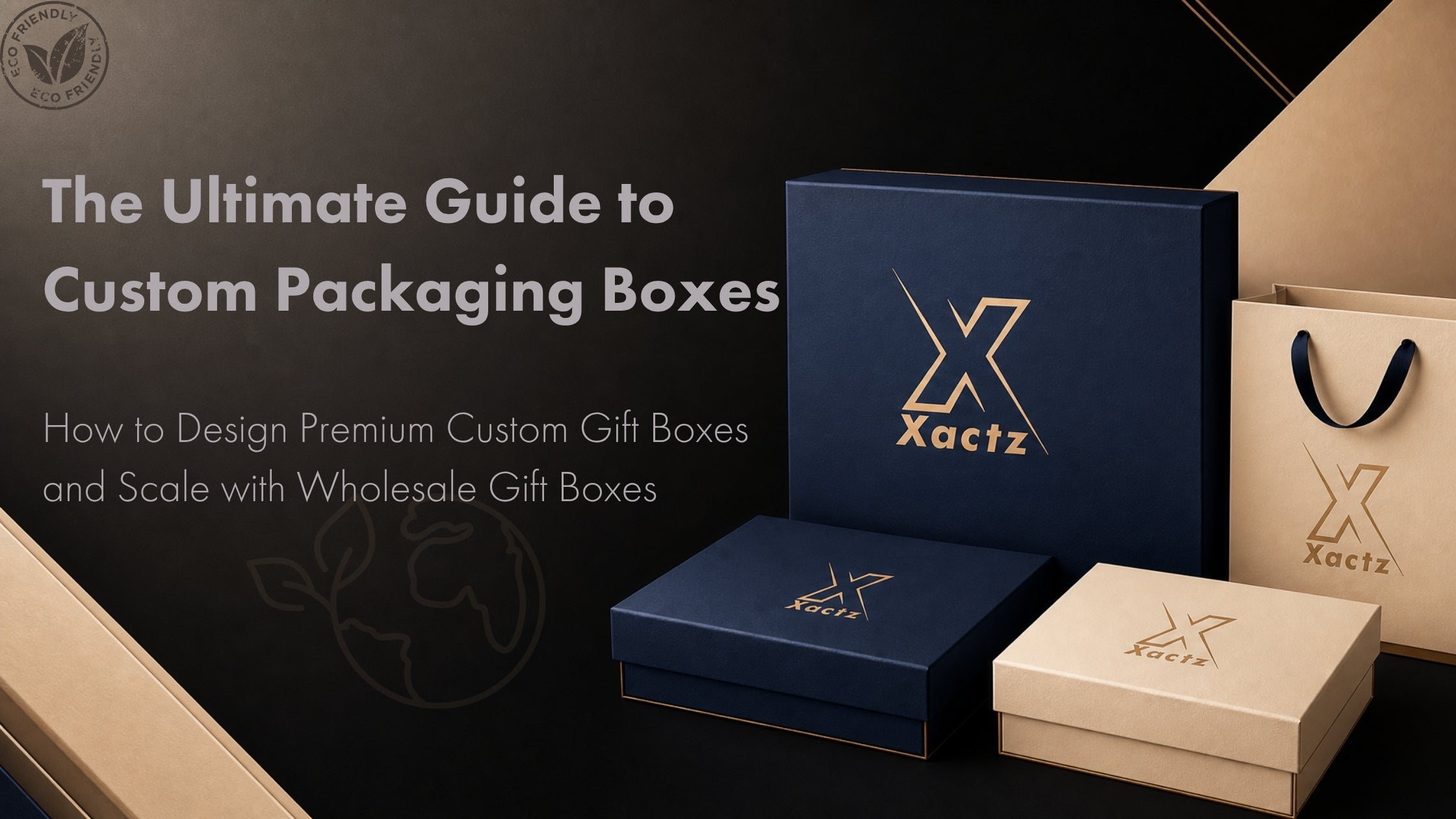
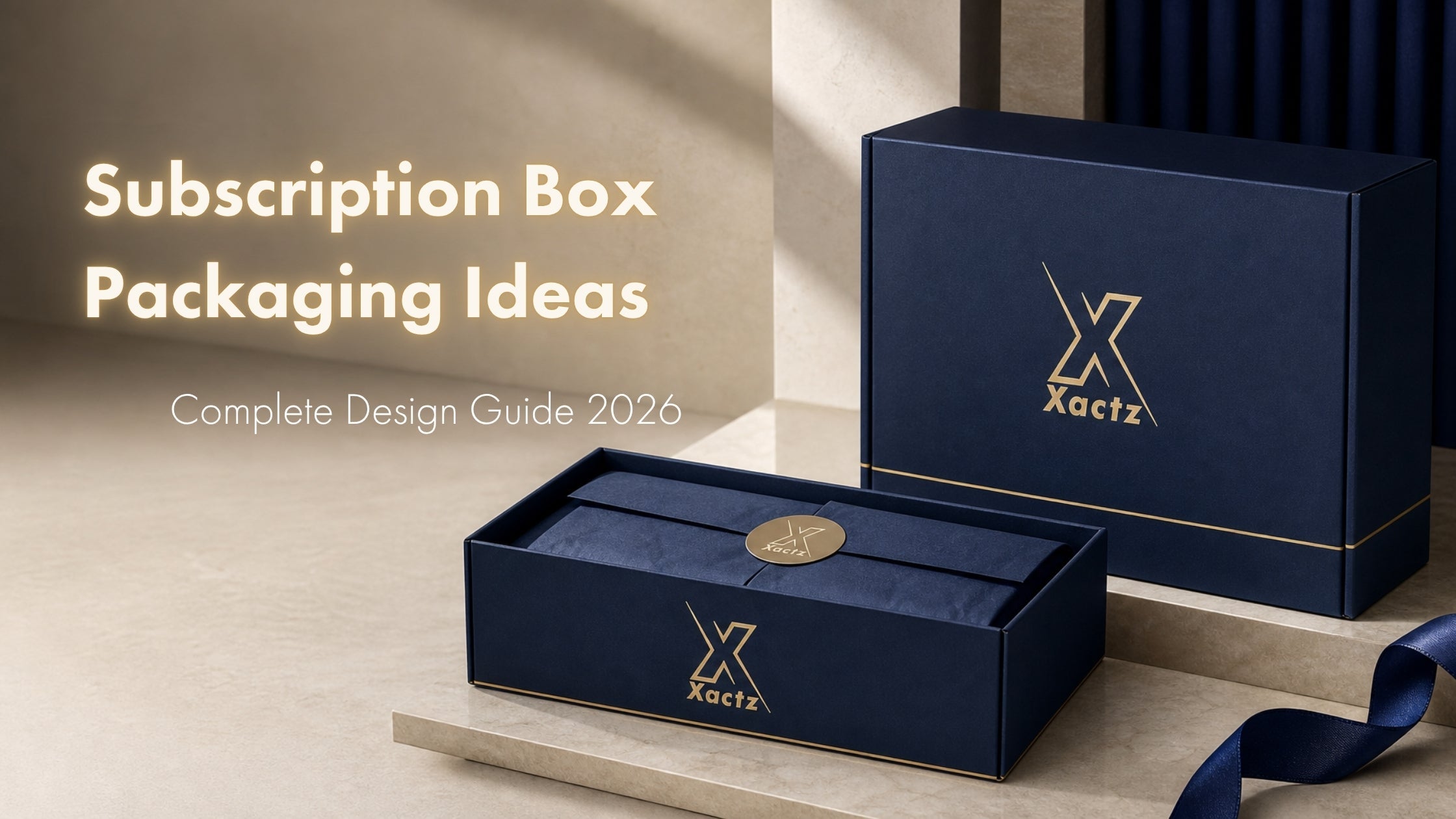
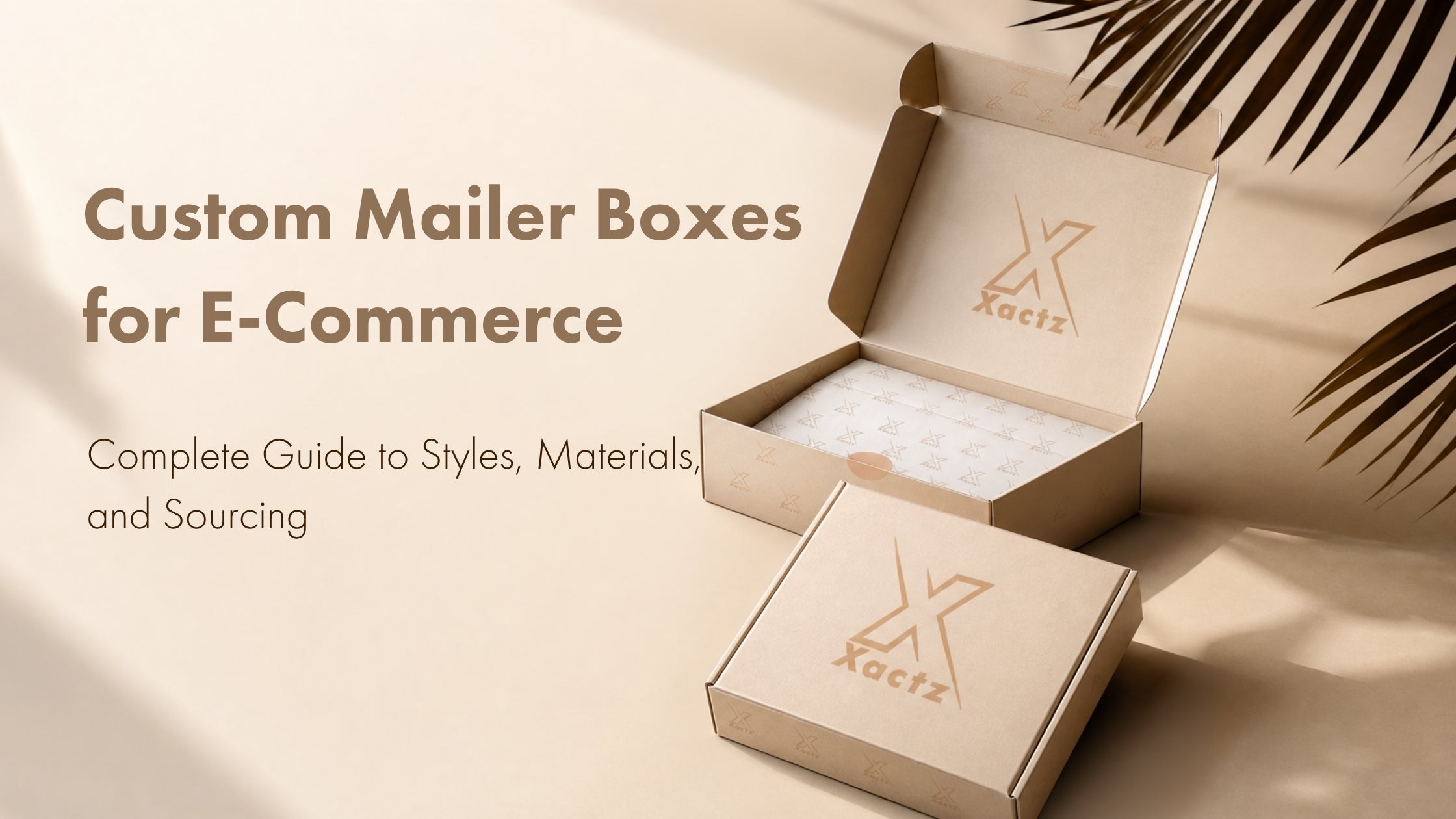
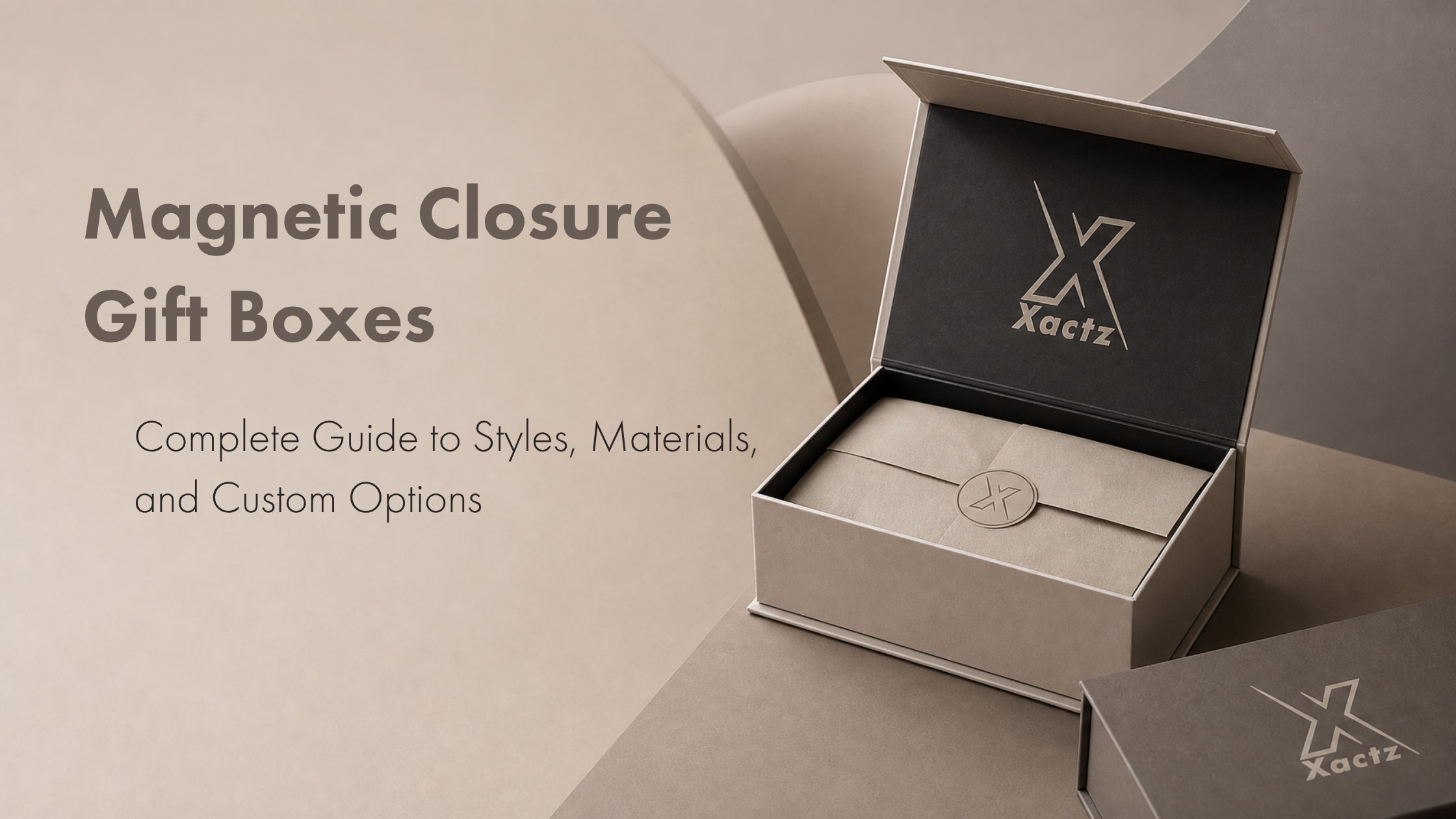
The global custom packaging market is projected to grow from USD 50.63 billion in 2026 to USD 81.04 billion by 2034. That number represents one of the clearest signals in modern commerce: brands across every category are investing more in packaging, raising their material standards, and recognising that the box is not a cost line. It is a revenue driver.
Custom packaging boxes are the first physical interaction a customer has with your brand. Before they see the product, before they read the label, before they experience what is inside, they are forming a perception of your brand based on the weight of the box in their hands, the texture of the surface under their fingers, and the resistance of the lid as it opens. Every one of those moments is either building brand equity or eroding it.
This guide covers everything a brand needs to know about custom packaging boxes in 2026: the formats that perform best by product category, the finish combinations that communicate premium quality, the structural specifications that separate luxury packaging from average packaging, and the wholesale ordering process that allows brands to scale without sacrificing quality.
Table of Contents
What Are Custom Packaging Boxes and Why Do They Matter in 2026
Custom packaging boxes are structural packaging formats manufactured to exact brand specifications. Unlike stock packaging, which is produced in standard dimensions and generic finishes and purchased off the shelf, custom packaging is engineered from the board up to match a brand's visual identity, product dimensions, and customer experience objectives.
The distinction matters commercially. A brand that ships its products in stock packaging is communicating to its customer that the packaging was an afterthought. A brand that ships its products in custom packaging is communicating that every detail of the customer experience has been considered, including the moment before the product is seen.
In 2026, the unboxing experience has become a primary brand touchpoint. Consumer research consistently shows that packaging quality directly influences repeat purchase intent, gifting behaviour, and social sharing. A customer who receives a product in packaging that communicates care and investment is more likely to retain the brand, gift from the brand, and share the experience. A customer who receives a product in generic packaging is evaluating the product in isolation, without the emotional amplification that considered packaging provides.
The personalised packaging market is projected to grow from USD 41.0 billion in 2025 to USD 77.7 billion by 2035 at a CAGR of 6.6%. That growth is being driven by brands that understand packaging is not a container. It is a conversion tool.
The Main Formats of Custom Packaging Boxes
Understanding the structural formats available is the foundation of any custom packaging specification. Each format has a distinct set of structural properties, aesthetic characteristics, and appropriate use cases.
Rigid Boxes (Set-Up Boxes)
Rigid boxes are the premium standard in custom packaging. They are constructed from high-density chipboard at 2mm or 3mm thickness, wrapped in a chosen paper or fabric, and produced in a set structure that does not collapse or fold. The rigidity of the board communicates weight, permanence, and quality at the moment of first contact. They are the correct format for fine jewellery, luxury cosmetics, premium spirits, high-end electronics accessories, and any product where the packaging must communicate a price point above the mid-market. Rigid boxes are available in lift-off lid, hinged lid, drawer, and clamshell configurations.
Folding Carton Boxes
Folding cartons are produced from lighter paperboard, printed and finished flat, and assembled at the point of packing. They are the most widely used format in retail packaging because they are cost-effective, lightweight, and compatible with high-volume automated packing lines. They are the correct format for cosmetics, food and beverage, pharmaceutical, and consumer goods packaging where volume is high and unit cost must be controlled. Premium folding cartons can be elevated significantly with the right finish combination.
Corrugated and Mailer Boxes
Corrugated boxes use a fluted internal layer between two flat liner sheets to create a structure that is lightweight relative to its load-bearing capacity. They are the dominant format for e-commerce shipping and secondary packaging. In 2026, corrugated packaging is increasingly being specified as a primary brand touchpoint, with brands investing in printed and finished corrugated boxes that communicate brand identity at the moment of delivery. Mailer boxes are a self-locking corrugated format designed for direct-to-consumer shipping that requires no additional tape or outer packaging, making them the correct format for subscription boxes, DTC brand launches, and gifting programmes.
Drawer Boxes and Two-Piece Boxes
Drawer boxes feature an inner tray that slides out of an outer sleeve, creating a two-stage reveal that builds anticipation and communicates structural sophistication. They are increasingly specified for premium cosmetics, electronics accessories, and gift sets. Two-piece boxes consist of a separate base and lid produced to close tolerances so the lid sits flush with the base without gap or resistance. The fit of the lid is one of the most legible quality signals in rigid box manufacturing and the specification that most immediately communicates precision manufacturing to a premium consumer.
How to Design Premium Custom Gift Boxes
Designing a premium custom gift box is a process that moves from structural specification to material selection to finish combination to interior engineering. Each stage builds on the previous one, and a decision made at the structural stage will constrain or enable every decision that follows.
Define the structural format first. The format must be determined by the product being packaged, the price point being communicated, and the customer experience being engineered. A rigid hinged lid box communicates a different brand position from a drawer box, which communicates a different position from a two-piece lift-off lid box. The format is the first brand signal the customer receives and the decision that all subsequent specifications depend on.
Specify the board weight. Board weight determines the physical weight and rigidity of the finished box. For premium gift boxes, 2mm chipboard is the minimum specification. For ultra-premium and fine jewellery packaging, 3mm is the correct specification. The weight of the box in the customer's hands is one of the most immediate quality signals in packaging and one that cannot be recovered by any surface finish or decorative technique.
Choose the wrap material. The wrap material is the paper or fabric applied to the exterior of the chipboard structure. It determines the colour, texture, and tactile quality of the exterior surface. Textured specialty papers are the dominant specification for premium gift boxes in 2026 because they communicate craft and material investment without requiring additional finishing. A deep-embossed linen texture or a fine-grain leather texture communicates quality at the moment of touch, before any print or finish is applied.
Select the surface finish. The surface finish is applied over the wrap material to protect the surface and add a visual and tactile quality layer. Soft-touch matte lamination is the dominant specification for premium gift boxes in 2026 because it creates a surface that absorbs light, resists fingerprints, and communicates a quiet, considered luxury that gloss lamination cannot replicate.
Add decorative finishing. Decorative finishing techniques including hot foil stamping, embossing, debossing, and spot UV are applied after the surface finish to add brand marks, patterns, and visual focal points. The most effective finish combination for premium gift boxes in 2026 is soft-touch matte lamination with a single gold or rose gold foil brand mark. The contrast between the matte surface and the reflective foil creates a focal point that communicates luxury without visual complexity.
Engineer the interior. The interior of a premium gift box is as important as the exterior. The insert system must hold the product securely, present it at the correct height and angle for the reveal, and communicate the same level of material investment as the exterior. Velvet, suede, and linen fabric linings are the correct specification for premium gift boxes. EVA foam inserts covered in fabric are the correct specification for products that require precise dimensional holding.
Materials and Board Specifications for Custom Packaging Boxes
The material specification is the foundation of packaging quality. Every finish, every structural property, and every tactile quality signal that the customer experiences is determined by the materials specified at the brief stage.
Chipboard (Greyboard)
Chipboard is the structural core of rigid box manufacturing. It is produced from recycled paper fibre and is available in weights from 1mm to 4mm. For premium custom gift boxes, 2mm to 3mm chipboard is the standard specification. High-density chipboard at 3mm produces a box with a weight and rigidity that is immediately legible as premium. FSC-certified chipboard is the correct specification for brands with sustainability commitments or EU market obligations under the Packaging and Packaging Waste Regulation. FSC certification provides a verified chain of custody from forest to finished box.
Specialty Wrap Papers
The wrap paper market for premium packaging has expanded significantly in 2026. Coated art paper provides a smooth, printable surface and is correct for high-resolution print applications. Uncoated textured paper provides a natural, tactile surface and is correct for craft and sustainability positioning. Embossed specialty paper carries pre-embossed texture patterns including linen, leather, and canvas, and is correct for premium gift boxes where tactile quality is a primary brand signal. Metallic paper provides a reflective surface in gold, silver, and rose gold and is correct for limited edition and seasonal gift packaging. Velvet paper provides a soft, fabric-like surface and is correct for fine jewellery and ultra-premium cosmetics packaging.
Interior Lining Materials
Interior lining materials determine the tactile quality of the product presentation surface. Velvet remains the dominant specification for jewellery and fine goods packaging. Suede communicates a contemporary premium positioning. Linen and unbleached cotton are increasingly specified for brands with sustainability positioning and communicate craft and considered material sourcing in a way that synthetic linings cannot.
Surface Finishes That Communicate Premium Quality
The surface finish applied to a custom packaging box is one of the most significant quality signals in the entire specification. The wrong finish can undermine an otherwise excellent structural and material specification. The right finish elevates the entire box.
Soft-touch matte lamination is the dominant surface finish for premium custom packaging in 2026. It applies a thin polymer film to the exterior surface that creates a velvety, light-absorbing finish that resists fingerprints and communicates a quiet, considered luxury. It is the correct specification for any custom gift box where the brand positioning is premium or above.
Gloss lamination creates a high-shine, light-reflecting surface that maximises colour vibrancy and print contrast. It is the correct specification for consumer goods packaging where shelf impact and colour accuracy are the primary objectives, but not the correct specification for ultra-premium or fine goods packaging where the gloss surface communicates a mass-market positioning.
Satin lamination sits between matte and gloss, creating a low-sheen surface with moderate light reflection. It is the correct specification for brands that want the colour vibrancy of gloss without the full reflective quality.
Spot UV coating applies a high-gloss coating to specific areas of the surface, creating a contrast between the coated and uncoated areas. When applied over a soft-touch matte base, spot UV creates a tactile and visual contrast that is one of the most effective premium finish techniques available and the specification that most rewards the customer who handles the box.
Decorative Finishing Techniques for Custom Gift Boxes
Decorative finishing is where the brand identity is applied to the packaging structure. The techniques available in 2026 allow for a level of precision and complexity that was not accessible to mid-market brands at scale five years ago.
Hot foil stamping applies a metallic or pigmented foil to the surface using heat and pressure. It is available in gold, silver, rose gold, copper, holographic, and custom colours. Gold foil on a soft-touch matte surface is the most widely specified decorative finish in premium gift box manufacturing and the one that most consistently communicates luxury to a premium consumer.
Embossing and debossing create a tactile quality that is legible to the customer through touch as well as sight. Embossing raises a design element above the surface. Debossing presses it below. Blind debossing, where no foil or ink is applied to the recessed area, is the most restrained and design-literate finish available and the correct specification for brands where the target consumer responds to material subtlety over visual complexity.
Screen printing applies ink directly to the surface through a mesh screen and is the correct specification for bold, single-colour graphic applications and for surfaces that are not compatible with standard offset or digital printing.
Digital and offset printing serve different production requirements. Digital printing allows for variable data, short runs, and photographic-quality imagery without the plate costs of offset. Offset printing delivers the highest colour accuracy and consistency for long production runs. For premium custom gift boxes, offset printing with Pantone colour matching is the correct specification where colour accuracy is critical to brand identity.
Interior Systems: Inserts, Linings and Presentation Engineering
The interior of a custom gift box is the product presentation stage. It is the surface the customer sees at the moment of reveal, and it must be engineered to present the product at its best.
Fabric-covered foam inserts are the most widely specified interior system for premium gift boxes. A block of EVA foam or polyurethane foam is cut to the exact dimensions of the product and covered in velvet, suede, or linen fabric. The product sits in a precisely dimensioned cavity that holds it at the correct presentation height and prevents movement during transit.
Paper pulp inserts are moulded from recycled paper fibre to the exact dimensions of the product. They are the most sustainable insert option available and the correct specification for brands with EU PPWR compliance obligations or strong sustainability positioning. Paper pulp inserts have improved significantly in surface quality in 2026 and are now available in premium finishes suitable for luxury packaging applications.
Ribbon pulls are a simple but highly effective interior detail. A ribbon is threaded under the insert so the customer can lift the insert and the product together without touching the product directly. Ribbon pulls communicate a level of manufacturing consideration that is immediately legible to a premium consumer and add a ceremonial quality to the unboxing that increases the perceived value of the product inside.
Multi-compartment insert systems are engineered to hold multiple products simultaneously in a composed arrangement. They are the correct specification for gift sets, multi-piece collections, and subscription box programmes where the full set must be visible and composed at the moment of reveal.
Sustainability in Custom Packaging Boxes in 2026
Sustainability in packaging is no longer a brand positioning choice. For brands selling into the EU market, it is a regulatory requirement. The EU Packaging and Packaging Waste Regulation, which came into force in 2025, sets mandatory requirements for recyclability, recycled content, and packaging weight reduction that affect every brand importing packaged goods into the EU.
FSC certification provides a verified chain of custody for wood-fibre-based packaging materials from sustainably managed forests. For custom packaging boxes, FSC-certified chipboard and wrap papers are the correct specification for brands with EU market obligations or sustainability commitments. Xactz holds FSC certification SGSHK-COC-332603, which covers all chipboard and paper materials used in production.
Water-based coatings and laminations are the correct specification for brands with sustainability commitments. Solvent-based coatings contain VOCs that are increasingly restricted under EU and UK environmental regulations. Water-based soft-touch matte lamination and aqueous coatings are the specification that Xactz uses as standard across all premium packaging production.
Paper-based inserts over plastic and EVA represent one of the most significant material transitions in premium packaging in 2026. Paper-based inserts are recyclable, compostable, and compatible with EU PPWR requirements, and are now available in quality levels suitable for luxury packaging applications.
Right-sizing means specifying packaging dimensions that match the product dimensions as closely as possible, eliminating excess void space and reducing material use. It is both a sustainability measure and a quality signal. A product that sits precisely in a right-sized box communicates considered design. A product that shifts in an oversized box communicates poor specification.
How to Scale with Wholesale Gift Boxes Without Losing Quality
Scaling from sample quantities to wholesale volumes is the point at which most brands encounter their first significant packaging quality problems. The structural, material, and finish specifications verified at the sample stage must be maintained consistently across every unit in the production run.
The minimum order quantity question is the first practical consideration for brands entering wholesale gift box production. Factory-direct manufacturers in Shenzhen and Huizhou typically offer MOQs from 100 units for rigid boxes, making custom packaging accessible to brands at the launch stage. At Xactz, the MOQ for custom rigid boxes is 100 units with a production lead time of 10 to 18 days from Golden Sample approval.
Unit cost at scale decreases as order volume increases, but the relationship is not linear. The largest cost reductions occur between 100 and 500 units, where setup costs are amortised across a larger production run. Above 1,000 units, the cost curve flattens and the primary variable becomes material specification rather than volume. For wholesale gift box programmes, the correct approach is to specify the highest material and finish quality that the unit economics support, and then scale the order volume to achieve the unit cost target. Reducing material quality to achieve a lower unit cost is a false economy because the quality reduction is immediately legible to the customer.
Consistency across production runs is the most technically demanding challenge in wholesale gift box manufacturing. Colour consistency, board weight consistency, finish quality consistency, and dimensional consistency must all be maintained across every unit in every production run. The only reliable mechanism for ensuring this is a rigorous quality control process applied at every stage of production, from incoming material inspection to finished goods inspection before shipment.
Seasonal and limited edition scaling requires a production planning approach that accounts for longer lead times, higher decorative finishing complexity, and the need for pre-production approval before the full run begins. For seasonal programmes, the correct approach is to begin the Golden Sample process at least eight weeks before the required delivery date.
How to Brief a Custom Packaging Manufacturer
A complete custom packaging brief covers eight areas. A brief that omits any of these areas will result in a sample that does not meet the specification, which adds time and cost to the development process.
The Eight-Point Brief Checklist
1. Structural specification: Format, external dimensions in millimetres, board weight, lid or hinge mechanic, and closure type including magnetic, ribbon tie, or tuck.
2. Wrap material specification: Paper type, weight in grams per square metre, texture, and colour reference in Pantone. If a specific paper from a named supplier is required, provide the supplier name and paper reference.
3. Surface finish specification: Lamination type, coating coverage as full bleed or spot, and any spot UV areas with artwork reference.
4. Decorative finishing specification: Foil type and colour reference, emboss or deboss design file and depth in millimetres, screen print details, and the position of each decorative element on the box.
5. Interior specification: Insert material, insert format, fabric type and colour reference, ribbon pull details, and dimensional tolerances for each product compartment.
6. Print specification: Colour references in Pantone and CMYK, print coverage percentage, bleed dimensions, and any variable data requirements.
7. Quantity and delivery specification: Order quantity, required delivery date, delivery address, and any specific cartonisation or pallet configuration requirements.
8. Golden Sample requirement: Number of pre-production samples required, approval timeline, and the contractual status of the Golden Sample as the production reference for the full run.
The Golden Sample Protocol
The Golden Sample is the most important element of any custom packaging development process. It is a pre-production sample manufactured to the exact specification of the full production run, approved by the client before production begins, and retained as the physical reference standard against which every unit in the production run is measured.
A Golden Sample that is approved without rigorous inspection is not a quality control mechanism. It is a formality. The correct approach to Golden Sample approval is to inspect every element of the sample against the brief specification: board weight, wrap material, surface finish, decorative finishing, interior lining, dimensional accuracy, closure mechanism, and structural integrity under simulated transit conditions.
Any deviation from the brief specification identified at the Golden Sample stage must be corrected before production begins. A deviation that is accepted at the Golden Sample stage will be reproduced across every unit in the production run.
At Xactz, every client receives a Golden Sample before production begins. The Golden Sample is produced to the exact specification of the brief, inspected against an 18-point quality control checklist, and shipped to the client for approval. Production does not begin until written approval is received. The approved Golden Sample is retained at the factory as the production reference standard for the full run and for all repeat orders.
Custom Packaging Boxes at Xactz
At Xactz, we manufacture custom packaging boxes from our 40,000 sqm facilities in Shenzhen and Huizhou, China. Every format covered in this guide is available from 100 units with a production lead time of 10 to 18 days from Golden Sample approval.
Our standard specification for premium custom gift boxes covers FSC-certified chipboard at 2mm and 3mm, a full range of wrap papers including coated, textured, velvet, metallic, and specialty materials, water-based soft-touch matte and gloss lamination, hot foil stamping in gold, silver, rose gold, copper, and custom colours, blind deboss and emboss to custom designs, spot UV coating, velvet and suede interior linings in custom colours, ribbon pulls and magnetic closure systems, and fabric-covered foam inserts and paper pulp inserts engineered to exact product dimensions.
Every order is produced under our 18-point quality control process. Every client receives weekly unedited footage from the production floor so you can see your order being made in real time.
Whether you are designing your first custom gift box for a product launch, scaling an existing packaging programme to wholesale volumes, or developing a seasonal gift set collection, the Xactz team will take you from brief to Golden Sample to full production with the precision and transparency that premium packaging requires.
Contact the Xactz team today to start your custom packaging project.