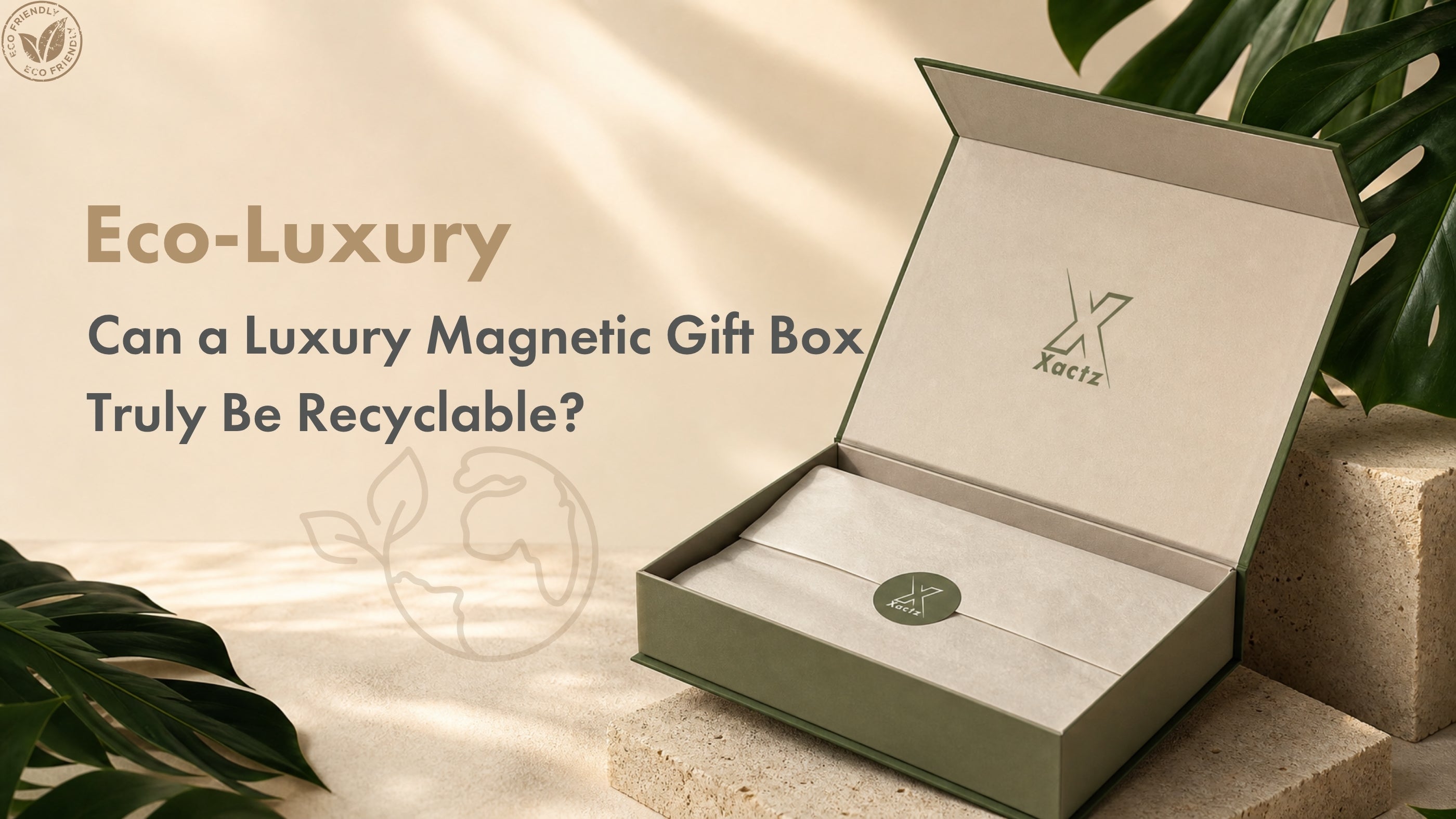
In a world where consumers demand sustainability but refuse to compromise on aesthetics, luxury brands face a defining paradox: how do you deliver a premium unboxing experience without leaving a massive environmental footprint?
For years, the sleek, ultra-smooth lamination on premium magnetic rigid boxes came with a hidden cost. It was virtually impossible to recycle. The same plastic film that gave the box its signature velvety finish was bonding paper fibres to polypropylene in a way that no standard recycling facility in the world could separate. Every box went to landfill. Every launch added to the liability.
In 2026, that equation is changing. A fundamental shift in materials science, manufacturing capability, and consumer expectation is proving that high-end packaging and planet-friendly design no longer have to be mutually exclusive. The eco-luxury magnetic gift box is not a compromise. It is the new benchmark.
This is the complete guide to how it is built, why it matters commercially, and what your brand needs to specify to get one made correctly.
Table of Contents
The Plastic Problem with Traditional Luxury Boxes
To understand why the eco-luxury shift matters, you first need to understand what made traditional luxury magnetic boxes so difficult to recycle.
The standard construction of a premium magnetic gift box relies on BOPP lamination, a thin layer of biaxially oriented polypropylene film, bonded to the outer paper wrap to create a smooth matte or gloss finish. BOPP lamination is applied because it is durable, moisture-resistant, and capable of carrying soft-touch and high-gloss effects that consumers associate with premium quality. It is also, from a recyclability standpoint, a catastrophic material choice.
Paper fibres bonded to polypropylene film cannot be separated at standard paper recycling facilities. The mixed-material composite defeats the mechanical and chemical processes that paper mills use to break down and repulp paper fibre. The entire outer wrap, the largest single material component of the box, goes to landfill or incineration. In most markets, the consumer has no alternative. There is no kerbside recycling stream that accepts BOPP-laminated paper.
The inner lining compounds the problem. Most traditional magnetic boxes are lined with flocked fabric, a synthetic velvet produced by electrostatically bonding nylon or polyester fibres to a paper or fabric substrate. Flocked linings cannot be recycled. The insert, typically a thermoformed PET tray or an EVA foam pad, adds two more petroleum-derived plastic components to the construction. The result is a box that looks and feels premium while being constructed almost entirely from materials that will not be recycled by the person who receives it.
In 2026, with the EU Packaging and Packaging Waste Regulation setting mandatory recyclability targets, Extended Producer Responsibility fees escalating across European markets, and consumer eco-consciousness at an all-time high, this construction profile is no longer commercially neutral. It is a compliance liability, a cost liability, and a reputational liability simultaneously.
Why BOPP Lamination Became the Industry Default
BOPP lamination became the default luxury packaging finish because it was the most cost-effective way to achieve a consistent, durable, premium surface at scale. The plastic film protected the printed surface from scuffing, moisture, and handling damage during transit and retail display. It also provided a stable base for soft-touch and gloss effects that paper coatings of ten years ago could not reliably replicate. The recyclability problem was known but commercially deprioritised. In 2026, that deprioritisation is no longer viable.
Enter Soft-Touch Water-Based Coatings
The breakthrough solution redefining eco-luxury packaging in 2026 is the transition from plastic lamination to water-based soft-touch coatings. This single material substitution resolves the primary recyclability barrier in the traditional luxury box construction without any compromise to the tactile or visual quality of the finished surface.
Instead of laminating the outer wrap with a plastic film, manufacturers apply an advanced water-based finish directly to the paper substrate. The coating penetrates the surface fibres of the paper and creates a matte, velvety texture that is indistinguishable from soft-touch BOPP lamination to the touch, while keeping the paper base fully recyclable in standard domestic paper streams. The coating itself, once dried and cured, does not constitute a recyclability barrier under EU PPWR assessment criteria.
The tactile quality of a well-applied water-based soft-touch coating is not merely equivalent to BOPP lamination. It is superior. BOPP soft-touch lamination creates a surface that sits on top of the paper, producing a slightly synthetic feel that experienced hands can detect. Water-based soft-touch coating integrates with the paper surface, producing a finish that feels more organic, more considered, and more genuinely premium. Luxury fragrance houses and premium cosmetics brands that have made the switch consistently report that their customers perceive the water-based finish as more expensive than the laminated finish it replaced.
Water-based coatings also perform differently on camera. They absorb light rather than reflecting it, which means they photograph without glare and film without hot spots. For brands producing unboxing content for social platforms, a water-based soft-touch exterior is a production advantage as well as a sustainability credential.
Spot UV Over Water-Based Coatings
Spot UV accents can be applied over a water-based base coat using UV-curable formulations that do not compromise the recyclability of the paper substrate. This means brands do not have to choose between a recyclable surface and a high-contrast spot UV logo treatment. The combination of a water-based soft-touch matte base with selective spot UV on the logo or key design elements is one of the most effective premium finishing combinations available in 2026 and is fully achievable within a sustainable material stack.
Why FSC-Certified Materials Are Non-Negotiable in 2026
Modern consumers look past the surface. They want to know where their packaging started, how the raw materials were sourced, and whether the supply chain behind the box can be verified. FSC certification is the mechanism that answers all three questions with a single, globally recognised credential.
FSC, the Forest Stewardship Council, certifies that the paper and board used in packaging production is sourced from responsibly managed forests. FSC certification covers the entire chain of custody from the forest through the mill, the converter, and the manufacturer. A product carrying the FSC mark can be traced back to a certified forest of origin. A product without the FSC mark cannot make that claim regardless of what the brand's marketing materials say.
For luxury brands selling into European markets in 2026, FSC certification on packaging materials is increasingly a retail channel requirement rather than a voluntary credential. Major department stores, travel retail operators, and online luxury platforms are including packaging sustainability specifications in their supplier agreements. FSC-certified board is the baseline expectation.
The structural core of a sustainable luxury magnetic gift box is FSC-certified rigid chipboard at 2mm or 3mm thickness. At Xactz, all FSC-certified board production is covered under certification SGSHK-COC-332603, which covers our Huizhou and Shenzhen manufacturing facilities. This certification number is verifiable through the FSC public certificate database at info.fsc.org and can be included in a brand's own sustainability reporting and supplier documentation.
Soy-Based and Water-Based Inks Complete the Traceable Stack
Coupling FSC-certified board with non-toxic soy-based or water-based inks completes the traceable, ethically sound material stack. Soy-based inks are derived from a renewable agricultural source, produce lower VOC emissions than petroleum-based inks during printing, and do not compromise the recyclability of the paper substrate. Water-based inks deliver equivalent colour fidelity across CMYK and Pantone references while meeting the most stringent EU and FDA requirements for ink composition in packaging applications.
The Aesthetics of Uncoated and Textured Papers
The most significant aesthetic shift in eco-luxury packaging in 2026 is the move away from smooth, uniform surfaces toward raw, tactile, and textured paper wraps. This shift is not a concession to sustainability. It is a design evolution producing packaging that looks and feels more premium than the laminated finishes it is replacing.
Uncoated and textured papers communicate luxury through touch alone. A linen-effect wrap with a visible woven texture signals craft, intentionality, and material quality in a way that a smooth laminated surface cannot. A debossed leatherette pattern creates a surface that invites repeated handling. An earthy pebble texture or a laid paper with visible fibre direction communicates that the brand has made a considered material choice rather than defaulting to a standard production finish.
These textured papers are available in a wide range of weights, colours, and surface effects. Laid papers with horizontal fibre lines. Linen-effect papers with a woven surface simulation. Micro-embossed papers with geometric or organic repeat patterns. Natural cotton papers with a soft, slightly irregular surface that no synthetic material can replicate. All of these options are fully recyclable, FSC-certifiable, and compatible with the full luxury finishing stack including hot foil stamping, embossing, debossing, and spot UV.
Why Textured Papers Outperform Smooth Laminates on Social Content
The premium textured paper wrap also solves a problem that smooth laminated surfaces create for social content. A smooth, uniform surface photographs beautifully in controlled studio lighting and looks flat and undifferentiated in natural light. A textured surface creates depth, shadow, and visual interest in every lighting condition. Unboxing content filmed with a textured eco-luxury box performs better on social platforms because the surface itself creates visual complexity that holds the viewer's attention throughout the reveal sequence.
The Economics of High-Quality Reusability
The sustainability case for eco-luxury magnetic gift boxes extends beyond recyclability. It includes the economic and environmental value of reusability, which is a dimension of sustainable packaging that EPR regulations and recyclability metrics do not fully capture but that consumers experience directly.
Unlike a folding carton or a standard rigid box, a custom magnetic gift box is built to last. The 2mm or 3mm greyboard construction, the precision-wrapped exterior, and the magnetic closure mechanism combine to produce a box that retains its structural integrity through years of daily handling. Recipients do not throw these boxes away. They repurpose them.
Vanity organisers. Jewellery storage. Stationery holders. Keepsake boxes. Desktop organisers. The secondary use cases for a well-made magnetic gift box are extensive, and every secondary use case extends the functional life of the packaging far beyond the initial unboxing moment. A box that is used daily for two years in a customer's home has a dramatically lower environmental impact per use than a box that is discarded on the day of receipt.
Reusability as a Brand Marketing Asset
Every time the customer uses the box in their daily life, the brand logo is displayed in their home. The box becomes a permanent brand touchpoint that continues to communicate quality and consideration long after the product inside has been consumed. For luxury brands where customer lifetime value and brand recall are commercial priorities, the reusability of a premium magnetic gift box is a return on investment that compounds over time.
The economics of reusability also affect the per-unit cost calculation. A magnetic gift box that is used for two years and then recycled has a lower cost per impression than a folding carton that is discarded on the day of receipt. When the full lifecycle cost is included in the packaging investment analysis, the premium magnetic gift box is frequently the more economical choice.
Making the Switch Without Losing Your Polish
The most common concern brands raise when considering a transition to sustainable luxury packaging is whether the premium finishing details they have built their packaging identity around are still achievable without plastic lamination and synthetic materials. The answer is yes, without qualification.
Hot foil stamping remains fully available in the sustainable luxury construction. The key specification is paper-backed foil rather than plastic-backed foil. Paper-backed foil transfers a metallic layer to the substrate without leaving a plastic carrier film on the surface. The visual result is identical to standard hot foil stamping. Gold, silver, rose gold, copper, and custom colour options in paper-backed foil cover the full range of luxury brand requirements. The construction is fully compatible with paper recycling streams.
Deep blind debossing and embossing are structural finishing techniques that require no additional materials beyond the paper substrate and the brass or magnesium die. They are inherently sustainable finishing options and produce some of the most premium tactile effects available in luxury packaging. A deep blind deboss of a brand monogram on an uncoated natural paper wrap communicates more craft and quality than the same monogram printed in gloss on a laminated surface.
The Sustainable Finishing Stack at a Glance
The complete sustainable luxury finishing stack available at Xactz includes water-based soft-touch coating, water-based gloss coating, spot UV over water-based base coat, paper-backed hot foil stamping in gold, silver, rose gold, and custom colours, soy-based CMYK and Pantone printing, embossing and debossing on FSC-certified board, and micro-embossed or textured paper wraps. Every option in this stack is compatible with paper recycling streams and none require BOPP or PET lamination.
The key to making the switch without losing polish is working with a manufacturer who has the technical capability to execute all of these finishing options on sustainable substrates and the quality control infrastructure to ensure consistency across the full production run. Asking for a Golden Sample before committing to production is the most reliable way to verify that your manufacturer can deliver.
Xactz: Eco-Luxury Magnetic Gift Boxes from 100 Units in 10 to 18 Days
At Xactz, we manufacture custom eco-luxury magnetic gift boxes from our 40,000 square metre facilities in Huizhou and Shenzhen. Every order, regardless of size, is produced to the same 18-point quality control standard and delivered with the same level of manufacturing transparency.
Our eco-luxury magnetic gift box capability includes FSC-certified board under certification SGSHK-COC-332603, water-based soft-touch and gloss coatings, paper-backed hot foil stamping, soy-based and water-based ink printing, moulded pulp and die-cut board inserts, and natural paper linings with no synthetic content. Every construction we produce is fully compliant with EU PPWR requirements, EU 94/62/EC packaging regulations, and FDA requirements for applicable categories.
We manufacture for brands in 60 plus countries across Europe, North America, Southeast Asia, and the Middle East. Our minimum order quantity starts at 100 units across all formats. Our production lead time is 10 to 18 days from Golden Sample approval. We are a real source factory, not a trading company. Every client receives weekly unedited footage from the production floor so you can see your order being made in real time.
Ready to elevate your unboxing experience while honouring your environmental values? Contact the Xactz design team to start engineering your custom sustainable unboxing solution today.
Contact the Xactz team at xactz.com/pages/contact-us
Frequently Asked Questions
What makes a magnetic gift box eco-luxury rather than just sustainable?
An eco-luxury magnetic gift box meets the same premium visual and tactile standards as a traditional luxury box while being constructed entirely from materials that are recyclable, FSC-certified, and free from petroleum-derived plastics. The distinction is that eco-luxury packaging does not ask the customer to accept a lower-quality experience in exchange for a lower environmental impact. The water-based soft-touch coating, the textured paper wrap, the paper-backed foil stamping, and the moulded pulp insert all deliver a premium experience that is equal to or higher than the traditional laminated construction they replace.
Can a fully recyclable magnetic gift box still have foil stamping and spot UV?
Yes. Paper-backed hot foil stamping delivers a metallic finish that is visually identical to standard foil stamping and is fully compatible with paper recycling streams. Spot UV can be applied over a water-based base coat using UV-curable formulations that do not compromise the recyclability of the paper substrate. Both finishing options are available across the full range of colours and coverage areas within the sustainable construction stack at Xactz.
What is the difference between water-based soft-touch coating and BOPP soft-touch lamination?
BOPP soft-touch lamination bonds a plastic polypropylene film to the paper surface to create a matte tactile finish. The plastic-paper bond cannot be separated at standard recycling facilities, making the entire outer wrap non-recyclable. Water-based soft-touch coating applies a water-based finish directly to the paper substrate without any plastic film. The paper remains fully recyclable in standard domestic paper streams. The tactile quality of a well-applied water-based coating is equal to or superior to BOPP lamination because it integrates with the paper surface rather than sitting on top of it.
Is FSC certification verifiable by the end consumer?
>
Yes. FSC certification numbers are publicly searchable through the FSC certificate database at info.fsc.org. Any brand or consumer can enter a manufacturer's FSC certification number and verify the scope, validity, and chain of custody coverage of the certificate. At Xactz, our FSC certification number is SGSHK-COC-332603 and covers our Huizhou and Shenzhen manufacturing facilities.
What is the minimum order quantity for eco-luxury magnetic gift boxes at Xactz?
The minimum order quantity at Xactz starts at 100 units across all formats including eco-luxury magnetic closure boxes. This applies to fully custom constructions with bespoke dimensions, FSC-certified board, water-based coatings, paper-backed foil stamping, and custom printed wraps. There is no requirement to order a standard size or a pre-existing format to access the 100-unit MOQ.
How does reusable packaging reduce a brand's EPR compliance costs?
Extended Producer Responsibility fees in EU markets are calculated based on the weight and material composition of packaging placed on the market. Packaging designed for reuse and that consumers demonstrably retain reduces the volume of packaging waste entering the waste stream per product sold. Some EU member states are beginning to introduce reusability credits within their EPR calculation frameworks. A magnetic gift box reused for two or more years generates a lower environmental impact per use than single-use packaging, which strengthens a brand's sustainability reporting metrics and reduces the carbon intensity of its packaging programme.
How long does production take for a custom eco-luxury magnetic gift box at Xactz?
The production lead time at Xactz is 10 to 18 days from Golden Sample approval. Golden Sample development typically takes 1 to 3 days for repeat formats and up to 5 days for entirely new constructions. The production clock starts from Golden Sample approval, not from order placement. For repeat clients using an existing structural template, dieline adaptation takes 24 hours and the full production cycle from brief to delivery can be completed in under three weeks.