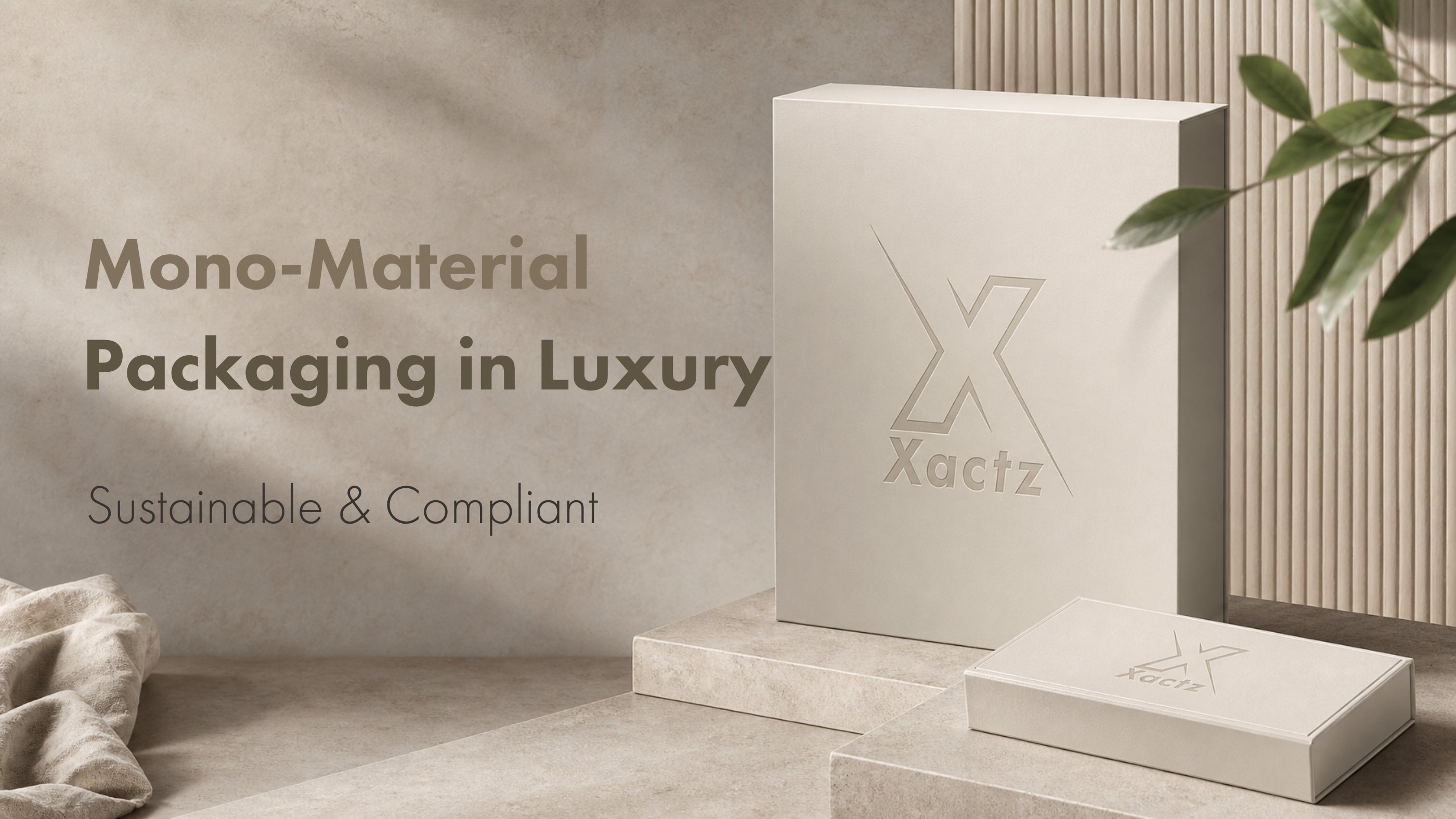
Mono-Material Packaging : The Sustainability Standard That Luxury Brands Are Moving Towards
Table of Contents
The Luxury Recycling Paradox : Why Beautiful Packaging Fails at End-of-Life
For decades, luxury packaging has been defined by complexity. A premium rigid box for a high-end fragrance, watch, or cosmetic product was traditionally a masterclass in mixed materials: a heavy greyboard core, wrapped in textured synthetic paper, lined with satin or velvet, holding a custom-molded plastic or EVA foam tray, and secured with hidden magnets.
To the consumer, this packaging communicates prestige, weight, and protection.
To a municipal recycling facility, however, this packaging is a nightmare.
Because these materials are bonded together with strong adhesives, they cannot be separated by standard sorting machinery. As a result, despite being made of potentially recyclable individual components (like paperboard), the entire multi-material structure is rejected and sent directly to landfill or incineration.
This is the luxury recycling paradox: the more complex and premium the packaging, the less likely it is to be recycled. As global brands face mounting regulatory pressure and shifting consumer expectations, this paradox is no longer sustainable. The industry is moving rapidly toward a new design standard: mono-material packaging.
What Is Mono-Material Packaging?
Mono-material packaging refers to a packaging structure constructed entirely from a single type of material, for example, 100% paperboard, 100% polypropylene (PP), or 100% polyethylene (PE).
By eliminating the mixing of different material classes (such as combining paper with plastic, metal, or foam), mono-material packaging can be disposed of in a single recycling bin and processed seamlessly by standard recycling facilities without requiring manual disassembly.
In luxury rigid packaging, the gold standard of mono-material design is 100% paper-based packaging. This means:
-
The Outer Shell: FSC-certified paperboard.
-
The Inner Core: Rigid greyboard (made from recycled paper pulp).
-
The Insert/Tray: Molded paper pulp, folded cardstock, or corrugated board instead of plastic, EVA, or EPE foam.
-
The Closures: Paper-based locks or friction-fit sleeves instead of metal magnets.
-
The Finishes: Water-based coatings and soy-based inks that do not contaminate the paper recycling stream.
By ensuring the entire package belongs to a single recycling stream, brands can guarantee their packaging is recyclable in practice, not just in theory.
The Regulatory Catalyst : EU PPWR and the Legal Mandate for Recyclability
The transition to mono-material packaging is no longer just a marketing choice; it is rapidly becoming a legal requirement.
The driving force behind this shift is the European Union's Packaging and Packaging Waste Regulation (PPWR).
The PPWR introduces strict eco-design mandates that reward brands acting early and penalize those relying on hard-to-recycle multi-material structures:
-
Mandatory Recyclability by 2030: All packaging placed on the EU market must be recyclable at scale by 2030. Multi-material packaging that cannot be easily separated will face heavy penalties, eco-modulation fees, or outright bans.
-
Harmonized Labeling: Packaging must feature clear, standardized sorting instructions to help consumers recycle correctly. Mono-material packaging simplifies this process entirely, requiring only a single sorting symbol.
-
Eco-Modulated Fees: Under Extended Producer Responsibility (EPR) schemes, brands will pay packaging fees based on the recyclability of their materials. Mono-material paperboard packaging will qualify for the lowest fee tiers, while mixed-material plastic-and-foam structures will face maximum financial penalties.
By transitioning to mono-material paperboard structures today, luxury brands can future-proof their supply chains against upcoming European regulations while establishing themselves as leaders in sustainable design.
Mono-Material vs. Multi-Material : The Technical Comparison
| Feature |
Mono-Material Paperboard Packaging |
Traditional Multi-Material Packaging |
| Primary Composition |
100% Paper/Cardboard |
Greyboard, plastic, foam, magnets, satin |
| Recycling Stream |
Single stream (Paper/Cardboard) |
Multiple streams (Requires manual separation) |
| Recyclability Rate |
~85% (Highly recyclable at scale) |
<5% (Usually rejected and landfilled) |
| Carbon Footprint |
Low (Fewer raw material types, lighter weight) |
High (Multiple material supply chains, heavier) |
| EPR Fees (EU PPWR) |
Lowest tier (Highly rewarded) |
Highest tier (Heavily penalized) |
| Insert Material |
Molded pulp, corrugated, or folded paper |
EVA foam, EPE foam, vacuum-formed plastic |
| Closure System |
Friction-fit, paper sleeves, paper locks |
Rare-earth magnets, metal snaps |
| Consumer Disposal |
100% in the paper bin (Zero hassle) |
Requires stripping foam/magnets before disposal |
Designing Mono-Material Paperboard Packaging : The Structural Engineering
Designing a luxury box without relying on plastic trays or magnets requires advanced structural engineering. The packaging must still deliver the satisfying "pop" of opening, the structural rigidity to protect high-value goods, and the clean lines expected of a premium brand.
Overcoming the Magnet Challenge
Traditional luxury boxes rely on hidden rare-earth magnets for closure. However, magnets contaminate the paper recycling stream and are incredibly difficult for recycling facilities to extract.
To replace magnets, packaging engineers use clever structural alternatives:
-
Friction-Fit Sleeves: Precision-engineered sleeves that slide over a rigid box, keeping it securely closed through exact tolerances.
-
Paper-Based Latches & Locks: Structural paper folds that click into place, providing a tactile and audible opening experience.
-
Exposed Neck / 3-Piece Rigid Boxes: A structural design where the lid fits tightly over an inner neck, creating a natural vacuum seal that holds the box closed securely without magnets.
The Challenge of Inserts : Moving from Plastic and Foam to Paper Pulp
The insert, the tray holding the product securely inside the box, is the most common source of multi-material contamination. Traditional luxury packaging relies heavily on EVA, EPE, or PU foam wrapped in velvet or silk.
To achieve a true mono-material standard, brands must transition to paper-based inserts:
[Traditional Insert: Foam + Velvet] ❌ (Landfill)
               ↓
[Mono-Material Insert: Molded Paper Pulp OR Precision-Folded Cardstock]  (100% Recyclable)
1. Molded Paper Pulp (Premium Wet-Press)
Once associated with rough egg cartons, modern wet-press molded pulp technology can produce incredibly smooth, high-definition, and geometrically precise inserts.
-
Aesthetics: Can be dyed to exact Pantone colors and finished with a soft-touch texture that mimics suede or velvet.
-
Protection: Offers exceptional shock absorption for fragile items like perfume bottles, glass jars, and luxury spirits.
2. Precision-Folded Cardstock (FSC-Certified)
Using high-gsm cardstock, engineers design intricate, single-sheet folded inserts with custom die-cuts.
-
Aesthetics: Clean, minimalist, and modern. The insert can be printed with matching soy-based inks and foil-stamped to match the outer box.
-
Best For: Cosmetics, jewelry, and lightweight luxury accessories.
Mono-Material in Cosmetics and Fragrance : The New Frontier
The cosmetics and fragrance sectors are leading the charge in mono-material adoption. Because these products often contain glass bottles, heavy caps, and delicate pumps, the packaging must be exceptionally robust.
The Fragrance Challenge
Fragrance bottles are heavy and fragile. Historically, brands insisted on dense foam inserts to prevent breakage during transit. Today, luxury fragrance brands are proving that molded paper pulp can cradle a heavy glass bottle just as securely as foam while elevating the brand’s eco-credentials.
The Cosmetic Revolution
From lipstick tubes to skincare jars, brands are switching to mono-material plastics (like 100% PP) for the primary containers, paired with 100% mono-material paperboard outer boxes. This ensures that both the primary container and secondary packaging can be recycled effortlessly in their respective streams.
Premium Aesthetics without Compromise : Finishing on Mono-Materials
A common misconception is that moving to mono-material packaging means sacrificing luxury finishes. This is entirely false. A 100% paperboard mono-material box can support almost all premium finishes without losing its recyclability:
-
Deep Embossing & Debossing: These processes rely on physical pressure to deform the paper fibers, creating stunning tactile textures without adding any foreign materials.
-
Hot & Cold Foil Stamping: Because the foil layer applied during stamping is micro-thin (less than 2.5 microns), it disperses completely during the paper repulping process and does not affect the recyclability of the board.
-
Water-Based Varnishes: Replacing plastic-based laminations with water-based matte or gloss coatings protects the print while keeping the paper 100% recyclable.
-
Soy-Based Inks: Using soy-based inks instead of petroleum-based inks ensures easy de-inking during recycling, resulting in cleaner recycled pulp.
The Circular Economy and Closed-Loop Systems
Mono-material packaging is the cornerstone of the circular economy, an economic model aimed at eliminating waste through the continual use of resources.
When a luxury brand uses a multi-material box, that material is permanently removed from the circular economy because it cannot be recovered.
When a brand uses a mono-material paperboard box:
-
Sourcing: The box is made from FSC-certified forests or recycled paper pulp.
-
Use: The consumer enjoys a premium unboxing experience.
-
Recycling: The consumer throws the entire box into the paper bin.
-
Recovery: The recycling facility easily repulps the paper fibers.
-
Regeneration: The recovered fibers are used to make new paperboard packaging, completing the loop.
This closed-loop system reduces the demand for virgin timber, lowers energy consumption, and minimizes greenhouse gas emissions.
Consumer Perception and the 72% Premium Willingness
Modern consumers are highly sensitive to "greenwashing." They can easily spot the contradiction when a brand claims to be eco-friendly but packages its products in heavy plastic trays and non-recyclable boxes.
Studies show that 72% of global consumers are willing to pay a premium for products packaged in verifiable, sustainable materials.
Mono-material packaging provides an immediate, intuitive sustainability signal. When a consumer opens a box and finds a beautifully folded paper insert instead of a plastic tray, they instantly recognize the brand's genuine commitment to the environment. This builds deep brand trust, drives customer loyalty, and justifies premium price points.
Developing a Mono-Material Brief : Step-by-Step
Transitioning to mono-material packaging requires a structured approach. Use this step-by-step framework to build your brief:
-
Define the Product Requirements: Identify the weight, dimensions, and fragility of the product to determine the required board thickness (GSM) and structural design.
-
Eliminate Non-Paper Components: Replace magnets with friction-fit or mechanical paper locks. Replace plastic/foam inserts with molded pulp or folded cardstock.
-
Select Sustainable Substrates: Specify FSC-certified SBS board, kraft paperboard, or high-content recycled greyboard.
-
Optimize the Print Stack: Specify soy-based inks and water-based coatings to ensure clean de-inking during recycling.
-
Test and Refine: Request physical white samples (unprinted structural mockups) to test the opening experience, product fit, and structural integrity.
What to Ask Your Manufacturer About Mono-Material Execution
To ensure your manufacturer can execute a true mono-material design to luxury standards, ask these critical questions:
- Do you have an in-house structural engineering team experienced in magnet-free rigid box designs?
- Can you source and dye premium wet-press molded pulp inserts to match our brand's Pantone colors?
- Are your adhesives, soy inks, and water-based coatings fully certified as compatible with paper recycling streams?
- Can you provide FSC™ certified paperboard with full chain-of-custody documentation?
- Do you offer low-MOQ physical sampling to test the structural integrity of the paper-based inserts?
How Xactz Engineers Mono-Material Luxury Packaging
At Xactz, we don't just manufacture boxes; we engineer sustainable luxury. Across our 40,000+ sqm facilities in Shenzhen and Huizhou, we have pioneered advanced structural techniques to make mono-material packaging the new standard for premium brands.
Our Mono-Material Capabilities:
-
Magnet-Free Closures: Our structural design team specializes in vacuum-fit, friction-lock, and custom sleeve closures that eliminate the need for rare-earth magnets while maintaining a premium opening feel.
-
High-Definition Molded Pulp: We operate advanced wet-press molded pulp lines, producing ultra-smooth, dyed-through, and custom-embossed inserts that replace plastic and EVA foam entirely.
-
FSC™ Certified Supply Chain: We hold full FSC™ certification (SGSHK-COC-332603), ensuring every fiber in your mono-material box is responsibly sourced.
-
The Sustainable Print Stack: We pair your mono-material structure with soy-based inks and water-based coatings as standard, ensuring maximum recyclability and compliance with EU PPWR standards.
-
18-Point In-House QC: Every mono-material box undergoes our rigorous 18-point quality control process to guarantee flawless structural alignment, clean folds, and perfect finishing.
MOQ, Sampling and Lead Times
| Stage |
Timeline |
| Structural Design & Dieline Creation |
1–2 business days |
| Physical White Sample (Structural) |
1–3 business days |
| Physical Printed Sample (Full Spec) |
3–5 business days |
| Mass Production (Fully/Semi-Automated) |
10–18 days from sample approval |
MOQ: From 100 units across all custom mono-material packaging formats.
Through our dedicated department for personalized small-order production, we support startup brands and enterprise micro-orders with the exact same high-end structural engineering, premium paper stocks, and 18-point QC as our high-volume runs.
Why Xactz
Xactz is a global leading packaging manufacturer consecutively ranked in the Top 5% for innovation, quality, and craftsmanship at major global exhibitions: Paris Packaging Week 2026, Packaging Innovations Birmingham 2026, and Packaging Première Milan 2026.
-
Real Source Factory: 40,000+ sqm of advanced manufacturing. No middlemen, no trading company markups, and zero hidden costs.
-
Advanced Automation: Equipped with both fully automated and semi-automated production lines for maximum precision and speed.
-
Global Delivery: Serving premium brands across 60+ countries in Europe, North America, Southeast Asia, and the Middle East.
Our Certifications:
- ✅ ISO 9001:2015 : International quality management certification
- ✅ FSC™ Certified : Responsible and sustainable sourcing (SGSHK-COC-332603)
- ✅ TÜV Rheinland Verified : Independent third-party factory audit
- ✅ FDA Compliant : Safe for food-contact and consumer use
- ✅ EU 94/62/EC Qualified : Compliant with European environmental packaging standards
Start Your Project
Ready to transition your packaging suite to a fully recyclable, EU PPWR-compliant mono-material standard? Let’s design it together.
Our structural engineering team will help you eliminate plastic, foam, and magnets, replacing them with elegant, high-performance paper alternatives that protect your product and elevate your brand.
- ✅ 100% Recyclable Mono-Material Paperboard Structures
- ✅ Premium Dyed Molded Pulp & Folded Paper Inserts
- ✅ Magnet-Free Structural Closures
- ✅ Soy-Based Inks & Water-Based Sustainable Coatings
- ✅ MOQ from 100 units
- ✅ 1–3 Day Sample Turnaround
- ✅ 10–18 Day Production Turnaround
- ✅ Global Delivery to 60+ Countries
👉 Start your mono-material packaging project with Xactz