Use less text on mobile!
EXACTLY WHAT YOU NEED
EVERYTHING CUSTOMIZABLE
Use less text on mobile!
FEEL THE LUXURY
CONTACT US TO GET A QUOTE AS YOU NEED
EXACTLY WHAT YOU NEED
EVERYTHING CUSTOMIZABLE
CONTACT US & GET YOUR QUOTE
FEEL THE LUXURY
By Xactz Packaging
Jun 2, 2026
Add a comment
When brands build a sustainable packaging strategy, they typically start with the substrate, FSC-certified board, recycled content, mono-material construction. Then they move to coatings, water-based varnishes, recyclable laminates. Then to structure, design for disassembly, lightweight optimisation.
Ink is almost always last. Or not considered at all.
This is a significant oversight. Every box, every carton, every printed insert is covered in ink. The ink is in direct contact with the substrate that will eventually enter the recycling stream. The ink is produced in a factory that emits VOCs into the air. The ink is made from a raw material, and that material is either petroleum, a finite fossil fuel, or soybean oil, a renewable crop that can be replanted every year.
The choice of ink is a sustainability decision, and for brands that are building a credible, comprehensive sustainability story, it is one that cannot be ignored.
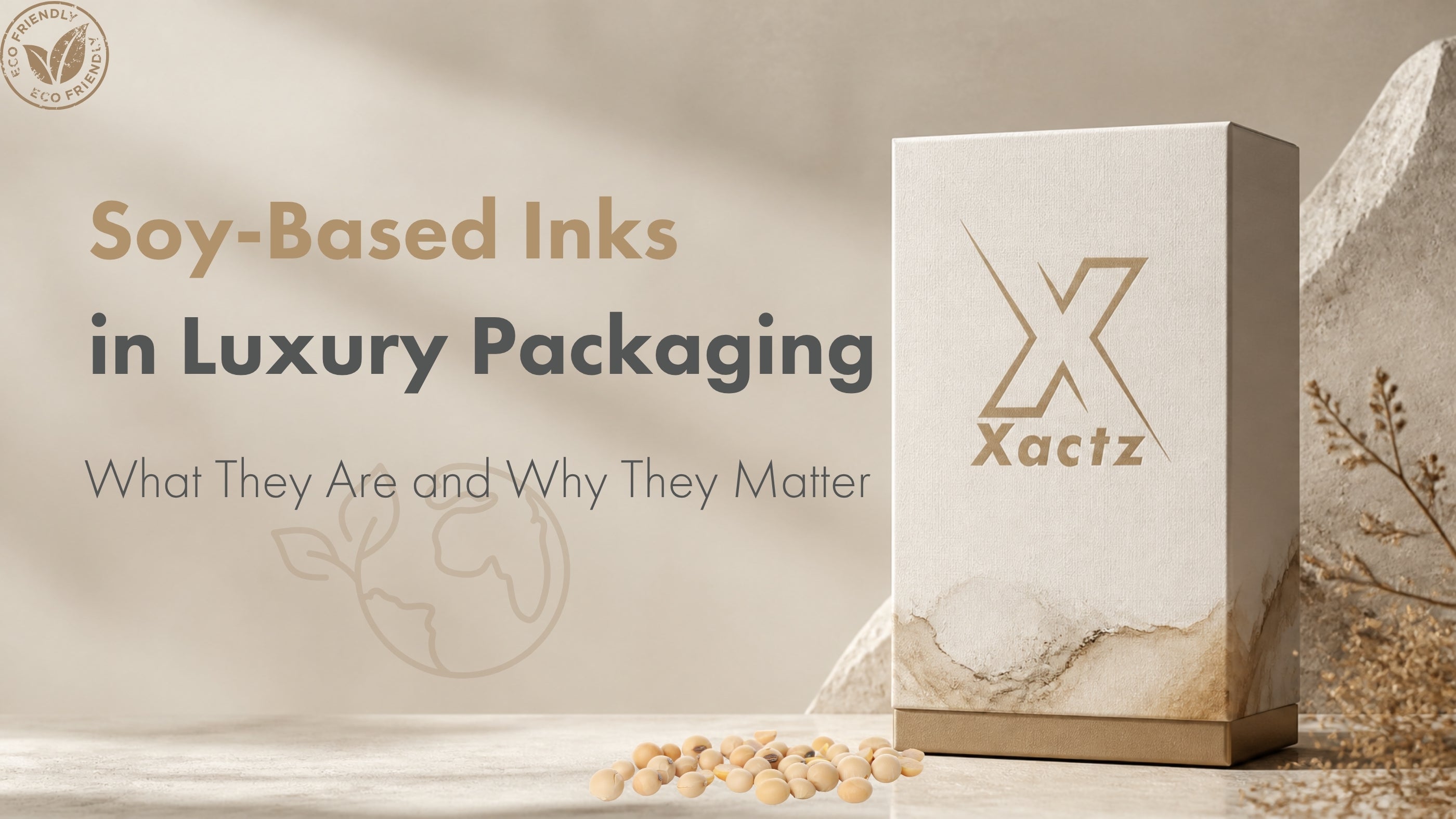
Soy-based ink is not a niche alternative. It is a mature, commercially proven printing technology that has been in active use since the 1970s, delivers print quality equivalent to or better than conventional petroleum inks, and is now specified by sustainability-conscious brands across luxury cosmetics, fragrance, beauty, food, and consumer goods. This guide explains everything you need to know about it.
Soy-based ink is a printing ink in which soybean oil replaces petroleum oil as the primary carrier for the pigment. In conventional petroleum-based inks, the carrier, the liquid component that holds the pigment in suspension and transfers it to the substrate, is derived from crude oil. In soy ink, that carrier is derived from soybeans.
The pigment itself, the component that provides colour, is the same in both soy and petroleum inks. What changes is the carrier, and with it, the environmental profile of the entire ink system.
Soybean oil is a natural, renewable, and biodegradable raw material. It is one of the most widely cultivated crops in the world, grown annually across North America, South America, and Asia. Unlike petroleum, it is not a finite resource, the supply can be replenished every growing season without depleting natural reserves.
Soy ink was first developed in the United States in the late 1970s, when the American Newspaper Publishers Association began researching petroleum alternatives in response to the oil crisis. The technology has been refined continuously since then and is now used across the full spectrum of commercial printing, from newspaper and publishing to premium packaging and luxury goods.
The production of soy-based ink begins with the extraction of oil from soybeans. The soybeans are cleaned, cracked, dehulled, and processed to extract the oil, a process that requires significantly less energy than the refining of petroleum into printing ink.
The extracted soybean oil is then refined and combined with pigments, resins, and other additives to produce an ink with the viscosity, tack, and drying characteristics required for the specific printing process, offset, flexographic, or digital.
The key production advantages of soy ink over petroleum ink:
| Property | Soy-Based Ink | Petroleum-Based Ink |
|---|---|---|
| Raw material | Soybean oil, renewable, annual crop | Petroleum, finite fossil fuel |
| VOC content | Less than 1% | Approximately 4.6% |
| Biodegradability | Biodegradable, breaks down naturally | Non-biodegradable, persists in environment |
| De-inking for recycling | Water-soluble, easier to remove from paper fibre | Difficult to remove, contaminates recycled pulp |
| Carbon footprint | Lower, renewable source, less energy to produce | Higher, fossil fuel extraction and refining |
| Colour vibrancy | Equivalent to or better than petroleum inks | Standard |
| Colour gamut | Wide, particularly strong on coated substrates | Standard |
| Drying time | Slightly slower on some substrates, process-dependent | Standard |
| Safety profile | Non-toxic, suitable for food-contact and children's product packaging | Contains petroleum derivatives, restricted in some food-contact applications |
| Regulatory compliance | FDA compliant, EU food-contact compatible | Restricted in some markets for food-contact use |
| Cost | Comparable to petroleum inks at commercial scale | Standard |
The VOC differential is the most significant environmental distinction. Soy ink contains less than 1% VOCs, compared to approximately 4.6% in conventional petroleum inks, a reduction of more than 75%. VOCs are the primary source of air pollution from printing operations, they contribute to smog formation, degrade indoor air quality in production facilities, and are subject to increasing regulatory restriction in the EU and other markets.
Volatile Organic Compounds are chemical compounds that vaporise at room temperature and react with other atmospheric elements to form ground-level ozone and smog. In printing, VOCs are released from the ink carrier during and after the printing process, as the ink dries and cures on the substrate.
Why VOC reduction matters for your factory: Lower VOC emissions mean better air quality in the production environment, reducing health risks for workers, reducing the need for expensive ventilation and extraction systems, and reducing the regulatory compliance burden on the manufacturing facility. For manufacturers operating in markets with strict environmental regulation, including the EU, lower VOC emissions are not just a sustainability preference, they are increasingly a legal requirement.
Why VOC reduction matters for your brand: Brands that specify soy-based inks can make a credible, verifiable claim about the VOC profile of their packaging production. This is not a vague sustainability statement, it is a specific, measurable reduction in harmful chemical emissions that can be communicated to consumers, included in sustainability reports, and verified by third-party auditors.
The regulatory direction: EU VOC regulations for printing operations have been tightening consistently for more than a decade. Brands sourcing packaging from manufacturers who use soy-based inks are better positioned for regulatory compliance in European markets, both now and as regulations continue to tighten.
The recyclability of printed packaging is one of the most important, and most technically complex, sustainability challenges in the packaging industry. And ink is at the centre of it.
When printed paper and board enters the recycling stream, it goes through a de-inking process, the removal of ink from the paper fibre so that the fibre can be repulped and reused. The efficiency of this process depends heavily on the type of ink used.
The problem with petroleum inks in recycling: Petroleum-based inks are difficult to remove from paper fibre during de-inking. They require aggressive chemical processes, generate more contaminated waste water, and can leave residual ink contamination in the recycled pulp, reducing the quality and value of the recycled material. In some cases, heavily printed board with petroleum inks is rejected from the recycling stream entirely.
The soy ink advantage: Soy-based inks are water-soluble and significantly easier to remove from paper fibre during the de-inking process. The result is cleaner recycled pulp, less chemical waste in the de-inking process, and higher-quality recycled material. Packaging printed with soy ink is more recyclable in practice, not just in theory.
For brands making recyclability claims about their packaging, particularly in EU markets where the Packaging and Packaging Waste Regulation is creating legal obligations around recyclability, the ink specification is part of the recyclability story. A box made from FSC-certified board with a water-based coating and soy-based ink is a more credible recyclability claim than the same box printed with petroleum ink.
Beyond recyclability, soy-based inks offer a significant advantage in end-of-life scenarios where packaging enters the waste stream rather than the recycling stream.
Soybean oil is a natural, organic compound, it biodegrades in the environment through the same biological processes that break down other organic materials. When packaging printed with soy ink ends up in landfill or composting conditions, the ink component breaks down more quickly and more completely than petroleum-based alternatives.
The biodegradability comparison: Petroleum-based inks contain synthetic polymer compounds that persist in the environment for extended periods, contributing to long-term soil and water contamination. Soy ink's organic carrier breaks down naturally, reducing the long-term environmental burden of packaging waste.
The composting compatibility: For brands developing compostable packaging formats, particularly in food, wellness, and clean beauty categories, soy-based ink is the only ink specification compatible with a genuine compostability claim. Petroleum ink on a compostable substrate creates a hybrid that cannot be certified as compostable. Soy ink on a compostable substrate can.
The most common objection to soy-based inks is the assumption that they compromise print quality. This is not supported by the evidence, and for many luxury packaging applications, soy ink delivers superior results.
Colour vibrancy: Soy ink delivers rich, vibrant colour, often with greater clarity and depth than petroleum inks on coated substrates. The soybean oil carrier has a high degree of transparency, which allows the pigment to express its full colour value without the slight dulling effect that can occur with petroleum carriers.
Colour consistency: Soy ink performs consistently across production runs, colour stability is equivalent to petroleum inks under standard offset printing conditions.
Fine detail reproduction: Soy ink performs well on fine typography, detailed brand marks, and intricate pattern work, the characteristics most critical in luxury packaging applications.
Drying time: Soy ink dries slightly more slowly than petroleum ink on some uncoated substrates, a consideration for high-speed production runs on uncoated or lightly coated board. On coated SBS board, the primary substrate for luxury packaging, drying performance is comparable.
The practical conclusion: For luxury packaging printed on coated SBS board, the primary substrate for premium cosmetics, fragrance, and beauty packaging, soy ink delivers equivalent or superior print quality to petroleum ink. The drying time consideration is relevant primarily for uncoated substrates at high production speeds, and is managed through standard press adjustment.
Soy ink performs across the full range of substrates used in luxury packaging, with some substrate-specific considerations.
SBS coated board (250–400 gsm): The optimal substrate for soy ink in luxury packaging. The coated surface provides an ideal printing base, the ink sits on the coating layer rather than absorbing into the fibre, producing sharp detail, vibrant colour, and consistent results. Soy ink on SBS coated board is indistinguishable from petroleum ink in finished print quality.
Kraft paperboard (200–400 gsm): Soy ink performs well on kraft, and the combination is one of the most powerful sustainability signals in packaging design. Natural kraft board with soy-based ink, water-based coating, and FSC certification creates a fully sustainable print stack that communicates authenticity and environmental responsibility at every level. The warm brown substrate affects colour reproduction, deep, rich tones and earth colours perform best.
Recycled content board: Soy ink is the preferred ink specification for recycled content board, because the de-inking advantage of soy ink is most valuable when the substrate itself is destined for recycling. The combination of recycled content board and soy ink creates a closed-loop material story: the board is made from recycled fibre, the ink supports the next recycling cycle, and the packaging can re-enter the recycling stream cleanly.
Uncoated board: Soy ink on uncoated board produces a softer, more absorbed print, appropriate for naturals, wellness, and artisan positioning where a raw, honest aesthetic is the design intent. The slightly slower drying time on uncoated substrates is a production consideration, managed through press speed and UV curing where required.
A critical question for luxury packaging brands: does soy ink perform correctly under the premium finishing processes that define the category?
The answer is yes, with standard pre-press and production management.
Lamination compatibility: Soy ink is fully compatible with matte lamination, gloss lamination, and soft-touch lamination. The ink must be fully dry and cured before lamination is applied, the same requirement as petroleum ink. No special process adjustment is required for standard lamination on soy-printed SBS board.
Foil stamping compatibility: Soy ink is compatible with hot foil stamping and cold foil. The foil adhesion process operates on the surface of the lamination or coating, not directly on the ink layer, so the ink specification does not affect foil performance.
Embossing and debossing compatibility: Embossing and debossing are structural processes that displace the board fibre, they are not affected by the ink specification. Soy ink performs identically to petroleum ink in embossed and debossed applications.
Spot UV compatibility: Spot UV is applied over the lamination layer, the ink specification does not affect spot UV performance.
Water-based coating compatibility: Soy ink is the natural partner for water-based coatings, both are low-VOC, both are recyclability-compatible, and both contribute to a fully sustainable print and finishing stack. The combination of soy ink and water-based coating is the baseline specification for any brand making a credible sustainability claim about their packaging.
The sustainability case for soy ink is clear. The brand case is equally compelling, and increasingly commercially significant.
Consumer willingness to pay: Data shows that 72% of global consumers are willing to pay a premium for products made with sustainable materials and processes. Soy ink is a verifiable, communicable sustainability credential, one that can be printed on the packaging itself, included in brand sustainability reports, and verified by third-party auditors.
The soy ink logo: The American Soybean Association's soy ink logo, a recognised certification mark, can be printed on packaging produced with certified soy-based inks. For brands selling in North American markets, this mark is an immediately legible sustainability signal that communicates responsible sourcing without requiring explanation.
The sustainability story stack: Soy ink does not stand alone as a sustainability credential, it is most powerful as part of a complete sustainable packaging story. A brand that can say "our packaging is made from FSC-certified board, printed with soy-based inks, finished with water-based coatings, and designed for recyclability" is making a comprehensive, verifiable claim, not a single-point greenwash.
The luxury positioning: In 2026, sustainability is not in conflict with luxury, it is a component of it. The most credible luxury brands are those that can demonstrate that their premium positioning extends to every material decision, including the ink on the box. Soy ink is the ink specification that allows a luxury brand to make that claim.
Soy-based inks offer significant regulatory advantages over petroleum inks, particularly for brands distributing in EU and food-contact markets.
EU VOC Directive: The EU Solvent Emissions Directive (2010/75/EU) and its successor regulations set strict limits on VOC emissions from printing operations. Soy ink's sub-1% VOC content positions manufacturers using soy ink well within compliance thresholds, reducing regulatory risk for both the manufacturer and the brand.
EU Packaging and Packaging Waste Regulation: The EU PPWR, coming into full effect across European markets, includes recyclability requirements that extend to the ink and coating specification of packaging. Soy ink's de-inking advantage directly supports compliance with recyclability requirements for paper and board packaging in EU markets.
FDA compliance: Soy-based inks are FDA compliant, safe for food-contact and consumer product applications. This makes soy ink the appropriate specification for packaging used in food, beverage, supplement, and personal care categories where FDA compliance is a procurement requirement.
Children's product packaging: The non-toxic profile of soy ink makes it the appropriate specification for packaging used in children's product categories, toys, educational products, and children's personal care, where the safety requirements for inks and coatings are most stringent.
Soy ink is most effective when specified as part of a complete sustainable packaging strategy, not as a standalone credential. The fully sustainable print stack for luxury packaging in 2026 looks like this:
| Layer | Sustainable Specification | What It Delivers |
|---|---|---|
| Substrate | FSC-certified SBS board or recycled content board | Responsibly sourced or recycled fibre, traceable supply chain |
| Ink | Soy-based ink | Renewable raw material, low VOC, recyclability-compatible, biodegradable |
| Coating | Water-based varnish or coating | Eliminates solvent-based chemistry, recyclability-compatible |
| Lamination | Recyclable matte or gloss lamination | Maintains recyclability of the substrate |
| Finishing | Water-based adhesives for foil and emboss | Eliminates solvent-based adhesives from the finishing process |
| Structure | Mono-material or design for disassembly | Enables single-stream recycling, EU PPWR compliant |
| Certification | FSC™ + third-party audit | Verifiable, audited sustainability claim, not a brand assertion |
Each layer of this stack is independently verifiable and independently communicable. Together, they create a packaging specification that can withstand scrutiny from consumers, regulators, and sustainability auditors, and that earns the trust of the growing segment of luxury consumers who make purchase decisions based on environmental responsibility.
These are the questions that confirm whether your manufacturer's soy ink specification is genuine, and whether it delivers the sustainability credentials you are claiming.
On ink specification:
On VOC performance:
On recyclability:
On finishing compatibility:
At Xactz, soy-based inks are available as a standard production specification, not a special-order process, across all packaging formats produced at our 40,000+ sqm facilities in Shenzhen and Huizhou.
Soy ink as part of the sustainable print stack: Xactz produces fully sustainable packaging specifications combining FSC-certified board (SGSHK-COC-332603), soy-based inks, and water-based coatings, available as a complete, certified sustainable package for brands making verifiable sustainability claims about their packaging.
Finishing compatibility: All 20+ premium finishing options available at Xactz, soft-touch lamination, matte lamination, gloss lamination, foil stamping, cold foil, embossing, debossing, spot UV, blind emboss, and pearlescent coating, are fully compatible with soy-based ink production.
Regulatory compliance: Xactz's soy ink production is FDA compliant and EU VOC Directive compliant, supporting brands distributing in North American, European, and global markets.
18-point in-house QC: Colour consistency and print quality are included in Xactz's 18-point in-house QC process, applied to every production run, including soy ink specifications. The approved physical sample is the golden standard against which every unit is checked.
Sampling: Physical samples at full soy ink specification produced in 1–3 business days from confirmed brief for existing structural formats, and 3–5 business days for new structural formats.
| Stage | Timeline |
|---|---|
| Brief confirmation and ink specification | 1–2 business days |
| Artwork preflight and digital proof | 2–3 business days from confirmed artwork |
| Physical sample, existing structural format | 1–3 business days from confirmed brief |
| Physical sample, new structural format | 3–5 business days from confirmed brief |
| Sample refinement round | 3–5 business days per round |
| Production run | 10–18 days from confirmed sample sign-off |
MOQ: from 100 units, all packaging formats, all ink specifications, all finishing combinations.
Xactz operates a dedicated department for personalised small-order production, meaning the startup brand ordering 100 units of a sustainable packaging specification, FSC board, soy ink, water-based coating, soft-touch lamination, receives the same print quality, the same finishing standard, and the same 18-point QC process as the global brand managing a multi-million-unit annual programme.
Quality does not scale down at Xactz. Every order. Every run. Every time.
Xactz is a global leading manufacturer specialising in high-end packaging, with 40,000+ sqm of fully automated and semi-automated production across Shenzhen and Huizhou, China.
| Capability | Detail |
|---|---|
| Total facility footprint | 40,000+ sqm across Shenzhen and Huizhou |
| Production lines | Fully automated + semi-automated |
| Quality control | 18-point in-house QC on every production run |
| Finishing options | 20+ premium finishing options |
| Sample turnaround | 1–3 business days from confirmed brief |
| Production turnaround | 10–18 days from sample approval |
| MOQ | From 100 units |
| Global delivery | 60+ countries |
Certifications:
✅ ISO 9001:2015 : International quality management certification
✅ FSC™ Certified : Responsible and sustainable sourcing Certification Code: SGSHK-COC-332603
✅ TÜV Rheinland Verified Supplier : Independent third-party factory audit
✅ FDA Compliant : Safe for food-contact and consumer use
✅ EU 94/62/EC Qualified : Export qualified for European and global markets
International exhibition recognition:
Xactz has been ranked in the top 5% at three consecutive international packaging exhibitions, Paris Packaging Week 2026, Packaging Innovations & Empack Birmingham 2026, and Packaging Première & PCD Milan 2026, recognised for innovation, quality, and craftsmanship.
Dedicated small-order production department:
As a global leading manufacturer specialising in high-end packaging, Xactz has established a dedicated department for personalised small-order production, committed to supporting the growth of startup companies and growing brands, and ensuring the seamless execution of micro-order solutions for large enterprises. Every order. Every run. Every time.
Whether you are building a fully sustainable packaging specification from scratch or adding soy-based inks to an existing packaging programme, the conversation starts here.
Tell us the format, the substrate, the finishing specification, and the sustainability requirements. Our pre-press and production team will confirm the correct ink specification, the full sustainable print stack, and take it from there.
By Xactz Packaging
Aug 16, 2026
By Xactz Packaging
Aug 13, 2026

By Xactz Packaging
Aug 12, 2026
