Use less text on mobile!
EXACTLY WHAT YOU NEED
EVERYTHING CUSTOMIZABLE
Use less text on mobile!
FEEL THE LUXURY
CONTACT US TO GET A QUOTE AS YOU NEED
EXACTLY WHAT YOU NEED
EVERYTHING CUSTOMIZABLE
CONTACT US & GET YOUR QUOTE
FEEL THE LUXURY
By Xactz Packaging
2026년 7월 27일
Add a comment
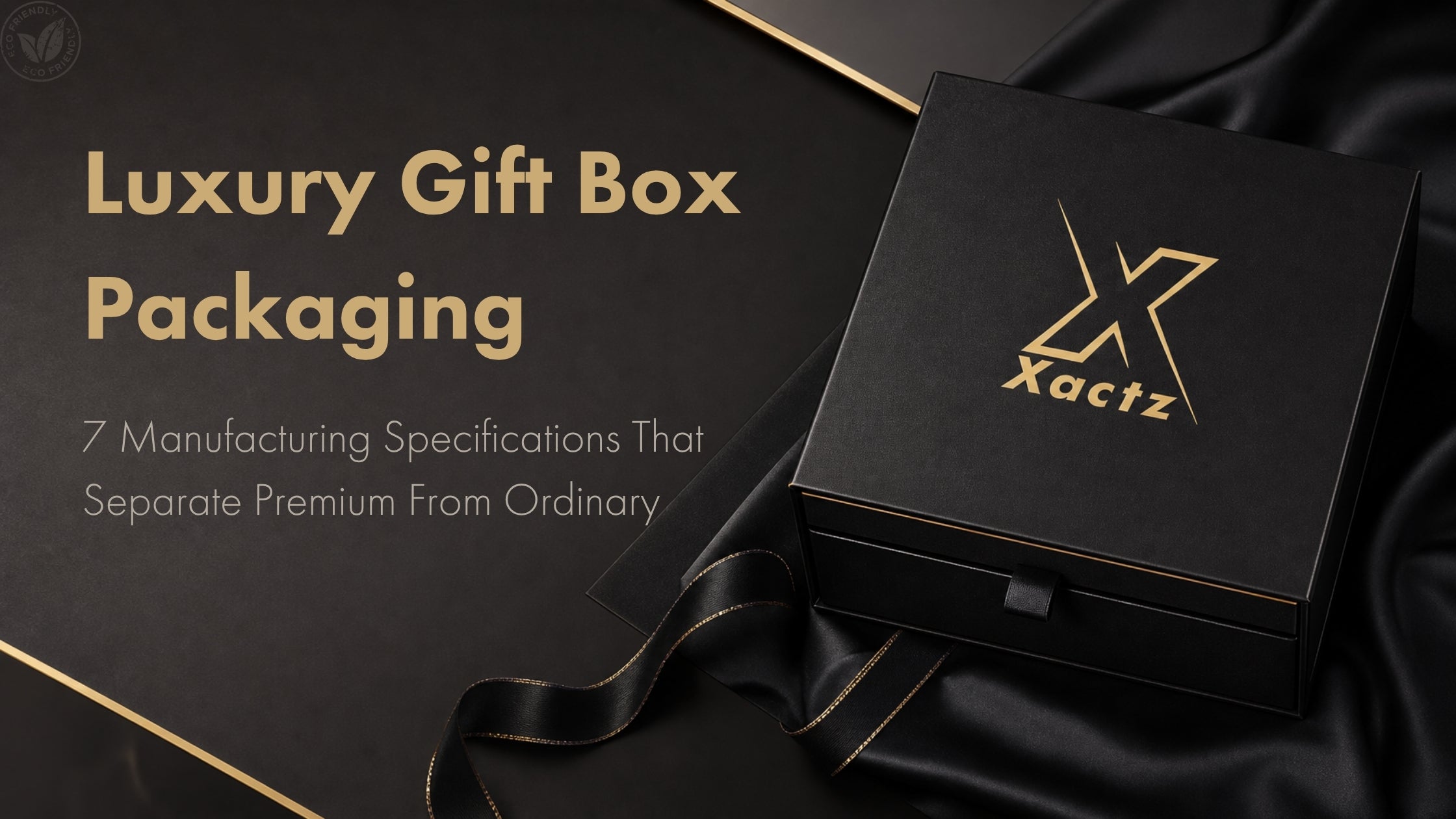
When a brand manager opens a brief for a new product launch, the word "luxury" appears in almost every paragraph. But luxury in packaging is not a feeling you choose from a mood board. It is an engineering outcome. It is the result of seven specific manufacturing decisions, each of which either reinforces or undermines the premium signal your product is trying to send.
The global luxury packaging market is projected to exceed $25 billion by 2027, driven by brands that understand one fundamental truth: the box is the first physical touchpoint a customer has with your product. Before they see the product, before they smell it, before they use it, they hold the box. The weight, the texture, the resistance of the lid, the sound of the closure are all manufactured specifications, not accidents.
This guide breaks down the seven manufacturing specifications that separate genuinely premium rigid box packaging from packaging that merely looks premium in a product photograph. Each section gives you the exact numbers, the sensory outcome, and the B2B sourcing decision you need to make.
The greyboard core is the structural skeleton of every rigid box. It is the compressed chipboard that gives the box its rigidity, its weight, and its resistance to deformation. Board weight is measured in grams per square meter (gsm), and the range relevant to luxury packaging runs from 800gsm at the entry level to 2,000gsm and above for ultra-premium applications.
An 800gsm to 1,200gsm board is appropriate for small jewelry boxes, single-product cosmetic boxes, and lightweight gift packaging where the product itself is light. The box will hold its shape under normal handling but will flex slightly under lateral pressure. For a brand manager, this means the box feels adequate but not substantial.
A 1,600gsm to 2,000gsm board is a different physical object entirely. The greyboard core is thick enough that the box holds its shape under pressure, does not flex, does not collapse, and does not deform under stacking in a retail or fulfillment environment. When a customer picks up a box built on 2,000gsm greyboard, the weight alone communicates value before a single visual element is processed. Standard rigid box thickness ranges from 1.5mm to 3mm, with ultra-premium applications reaching 4mm for larger or more fragile products.
For electronics gift boxes, premium spirits, high-end cosmetics, and any product where the unboxing is a brand moment, specify a minimum of 1,600gsm. For ultra-premium applications such as jewelry, watches, and limited-edition collectibles, specify 2,000gsm and confirm the greyboard supplier with your manufacturer. Not all greyboard is equal; density and compression consistency matter as much as the gsm number itself.
| Board Weight | Application | Tactile Signal |
|---|---|---|
| 800 to 1,200gsm | Small cosmetics, lightweight gifts | Adequate, functional |
| 1,200 to 1,500gsm | Mid-range gift boxes | Solid, professional |
| 1,500 to 2,000gsm | Electronics, spirits, premium gifts | Substantial, premium |
| 2,000gsm and above | Watches, jewelry, ultra-luxury | Architectural, exceptional |
At Xactz, our standard luxury rigid box specification begins at 1,600gsm greyboard, with 2,000gsm available for all premium product categories.
The wrap paper is the outer skin of the rigid box. It is laminated over the greyboard core and carries all of your brand's visual and tactile identity. Wrap paper weight is also measured in gsm, and the difference between 128gsm and 157gsm is not subtle. It is the difference between a box that looks premium and a box that feels premium.
Most rigid boxes use wrap paper in the 120gsm to 150gsm range as a standard specification. At 128gsm, wrap paper accepts print well, laminates cleanly, and produces a consistent result. However, at corners and edges, 128gsm wrap paper is more prone to micro-tearing during the wrapping process, and over time it is more susceptible to scuffing and surface wear. For a product that will be handled multiple times, 128gsm signals functional rather than exceptional.
At 157gsm, the wrap paper has a noticeably different hand feel. It is stiffer, more resistant to surface damage, and produces cleaner, sharper corners when wrapped over greyboard. Fashion and luxury box manufacturers commonly specify 250gsm to 300gsm specialty paper to deliver a premium tactile experience while reinforcing brand identity. For luxury rigid boxes, 157gsm is the practical minimum; 170gsm to 250gsm is the range for luxuriously finished paper with soft-touch, silk, velvet, and premium laminations.
Paper weight has a direct impact on the visual quality of luxury rigid boxes. Higher gsm wrap paper reduces ink bleeding and smudging, produces better results for foil stamping, and holds embossing and debossing detail more precisely. If your brand specification includes any premium print finishing, the wrap paper gsm is not a secondary decision. It is the foundation that determines whether your finishing looks handcrafted or mass-produced.
Specify 157gsm as your minimum for any luxury application. For ultra-premium packaging with heavy foil coverage or deep debossing, specify 180gsm or above. Always request a physical sample wrapped and finished to your specification before approving production.
Lamination is the protective and tactile film applied over the wrap paper after printing. It determines the surface feel, the sheen level, and the durability of the finished box. For luxury packaging, the lamination choice is one of the most powerful brand signals available and one of the most frequently misspecified.
Soft-touch lamination is the current benchmark for premium packaging across beauty, electronics, spirits, and lifestyle categories. It creates a velvety, almost suede-like surface that is immediately associated with high-end products. Soft-touch lamination costs roughly three times more than standard matte, but spread across a 3,000-unit order, that premium is less than $0.015 extra per box. Soft-touch is fingerprint-resistant, scuff-resistant, and photographs exceptionally well for e-commerce and social media content.
Gloss lamination produces a bright, reflective surface that makes colors appear more saturated and vivid. It is the correct choice for brands with bold, high-contrast graphics, youthful positioning, or products where visual impact at shelf is the primary objective. Gloss is more durable than matte in high-humidity environments and is easier to clean. However, for luxury positioning, gloss can read as commercial rather than premium, particularly in beauty and lifestyle categories where the market has moved decisively toward matte and soft-touch finishes.
Velvet lamination is the most tactile option available. It produces a surface that is genuinely fabric-like in feel, denser and more textured than soft-touch matte. It is the specification for ultra-luxury applications: high jewelry, limited-edition spirits, and collector's editions. Velvet lamination is more expensive than soft-touch and requires more careful handling in production to avoid surface marking.
| Lamination | Feel | Brand Signal | Best For |
|---|---|---|---|
| Gloss | Smooth, reflective | Bold, energetic | FMCG, youth brands |
| Matte | Flat, clean | Professional, modern | Mid-range premium |
| Soft-Touch Matte | Velvety, warm | Luxury, sophisticated | Beauty, electronics, spirits |
| Velvet | Fabric-like, dense | Ultra-luxury | Jewelry, watches, collectibles |
The closure mechanism is the moment of interaction. It is the physical gesture that begins the unboxing experience, and it communicates brand values more directly than almost any other specification. The closure is either the confirmation of the brand promise or its contradiction.
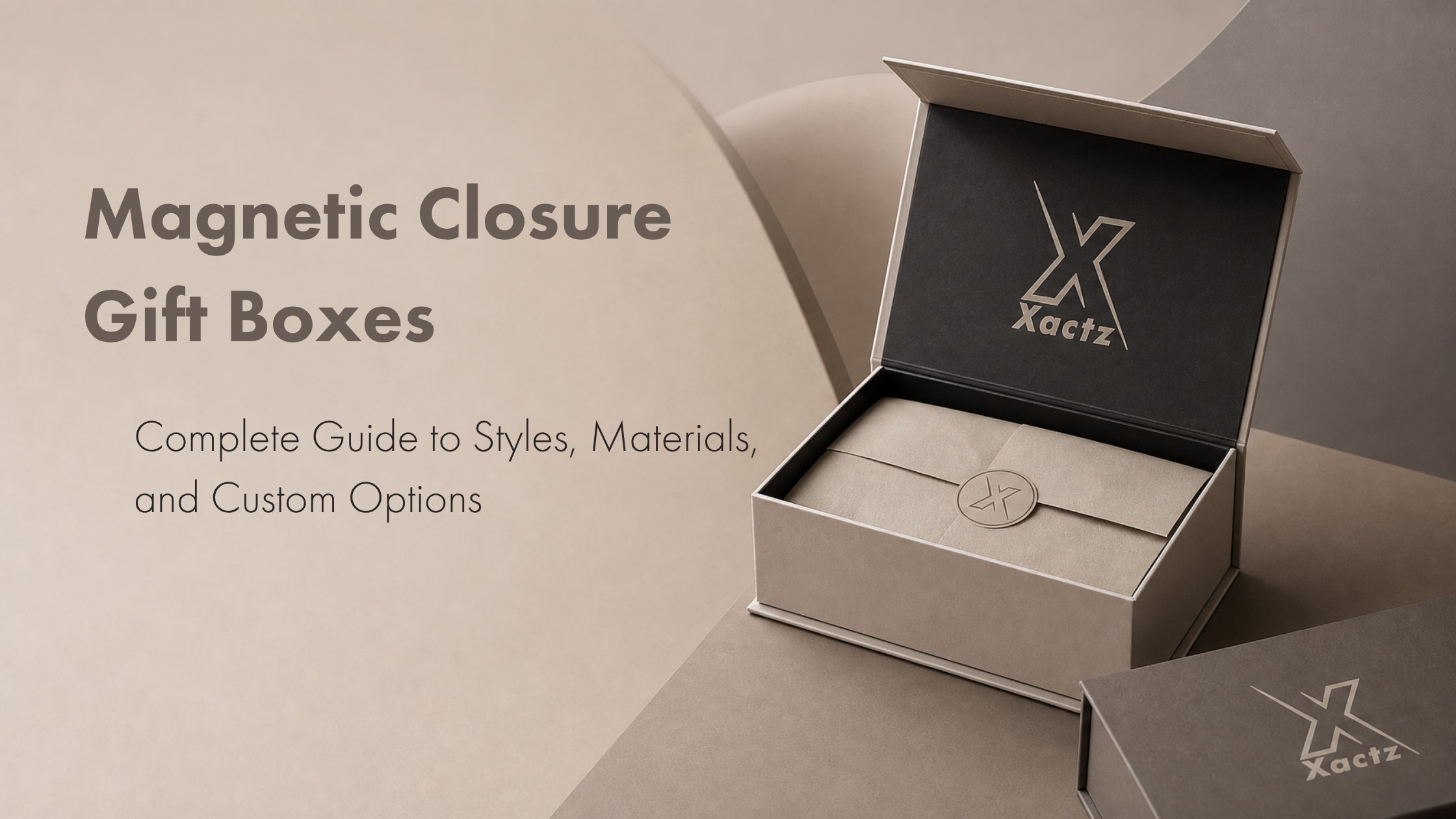
Concealed magnet closures are the gold standard for premium rigid boxes. The magnets are embedded inside the greyboard, invisible from the outside, and create a satisfying, controlled snap when the lid closes. A magnetic gift box offers both functionality and refinement, allowing easy, repeatable opening and closing that is critical for gift boxes recipients keep and reuse. The clean, seamless exterior that magnetic closure enables is a core part of the modern luxury aesthetic.
For B2B buyers, magnetic closure adds cost, typically $0.30 to $0.80 per unit depending on box size and magnet specification, but it is one of the highest-return investments in the luxury packaging specification. The unboxing moment is increasingly a social media event; a magnetic closure that opens smoothly and closes with a satisfying snap is a detail that appears in unboxing videos and product reviews.
Ribbon closures are the traditional luxury signal, associated with heritage brands in jewelry, confectionery, and fashion. A ribbon pull adds a ceremonial quality to the unboxing, the deliberate and slow reveal. Ribbon closures are appropriate for brands with a heritage or artisanal positioning and for gift packaging where the ritual of opening is part of the product experience. Collapsible gift boxes with magnetic closure and ribbon finish combine both signals for maximum presentation impact.
Tuck closures are functional and cost-effective. They are appropriate for secondary packaging, subscription boxes, and applications where the box is opened once and discarded. For any product positioned as premium or luxury, a tuck closure undermines the specification investment made in board weight, paper wrap, and lamination.
For luxury gift box packaging wholesale, specify magnetic closure as the default. Reserve ribbon closures for heritage or artisanal brand positioning. Eliminate tuck closures from any specification where the unboxing experience is a brand objective.
The insert is the interior architecture of the box. It positions the product, protects it during transit, and creates the visual presentation that the customer sees the moment the lid opens. Insert material selection is both a functional and an aesthetic decision and increasingly a regulatory decision.
EVA foam inserts are the precision specification for high-value, fragile, or irregularly shaped products. At densities of 33 to 70+ kg/m³, EVA foam provides superior shock absorption, vibration resistance, and product immobilization. For electronics, watches, perfume bottles, and precision instruments, EVA foam inserts provide precise support that thermoform and paper alternatives cannot match. The foam can be die-cut or CNC-routed to exact product dimensions, with tolerances of ±0.5mm achievable at quality manufacturers.
The limitation of EVA foam is sustainability. Standard EVA is not easily recyclable and does not meet EU Packaging and Packaging Waste Regulation (PPWR) monomaterial requirements coming into effect in August 2026. For brands selling into EU markets, EVA foam inserts require careful compliance review.
Thermoform inserts, vacuum-formed from PET or RPET sheet, offer superior visual presentation and geometric precision. The formed cavities follow product contours exactly, creating a display-quality presentation that EVA foam cannot replicate. At volumes above 3,000 units, thermoform becomes cost-competitive with high-density EVA foam while offering a cleaner, more contemporary aesthetic. RPET thermoform meets EU PPWR compliance requirements and is the specification of choice for brands with sustainability commitments.
Molded paper pulp inserts are the monomaterial, fully sustainable specification. They are produced from recycled paper fiber, are curbside recyclable, and meet EU PPWR requirements without exception. For brands where sustainability is a primary brand value and where that value needs to be visible to the customer, paper pulp inserts deliver both the compliance requirement and the brand story. The limitation is precision: paper pulp cannot achieve the tight tolerances of thermoform or the shock absorption of high-density EVA foam.
| Insert Type | Shock Protection | Sustainability | Visual Precision | EU PPWR |
|---|---|---|---|---|
| EVA Foam (33 to 70 kg/m³) | Excellent | Limited | Good | Review required |
| Thermoform (RPET) | Good | Strong | Excellent | Compliant |
| Paper Pulp | Moderate | Excellent | Moderate | Fully compliant |
Print finishing is where the brand identity is physically applied to the box. The choice of finishing method determines whether your logo reads as a detail or as a statement, and whether the box looks manufactured or crafted.
Foil stamping applies a metallic or pigmented foil to the surface using heat and pressure. The result is a reflective, precise impression that catches light and communicates premium value immediately. Gold and silver foil are the classic luxury specifications; rose gold, copper, and holographic foils are increasingly used for contemporary premium positioning. Foil stamping is most effective on soft-touch matte lamination, where the contrast between the matte surface and the reflective foil is maximized.
For B2B buyers, foil stamping requires a die, a one-time tooling cost typically ranging from $80 to $200 depending on artwork complexity. This cost is amortized across the production run and is negligible at volumes above 500 units.
Debossing presses the design into the surface of the wrap paper, creating a recessed impression. Embossing raises the design above the surface. Both techniques add a tactile dimension to the brand mark: the customer feels the logo as well as sees it. Debossing is the more contemporary specification for luxury packaging; embossing is associated with heritage and traditional luxury brands. Both can be combined with foil stamping for a foil-deboss finish that is the current benchmark for ultra-premium packaging.
Spot UV applies a high-gloss varnish to selected areas of the design, creating a contrast between the varnished and unvarnished surfaces. On a matte-laminated box, spot UV produces a striking visual effect where the design appears to emerge from the surface. Spot UV is particularly effective for brand marks, product names, and graphic elements where visual emphasis is required without the cost of foil tooling.
For luxury gift box packaging wholesale, the recommended specification is foil stamp combined with soft-touch matte lamination as the baseline. Add debossing for brand marks where tactile identity is a priority. Use spot UV as a cost-effective alternative to foil for secondary graphic elements.
ISO 9001:2015 is the international standard for quality management systems. In the context of rigid box manufacturing, it means that every dimension of every box, including length, width, height, lid fit, corner radius, and insert cavity depth, is produced to a documented tolerance and verified against that tolerance at defined inspection points.
For brand managers, dimensional consistency is not an abstract quality metric. It is the difference between a lid that closes with a smooth, controlled resistance and a lid that either falls shut or requires force to close. It is the difference between an insert that holds the product in precise position and an insert that allows the product to shift. It is the difference between a box that stacks perfectly in a retail display and a box that creates an uneven, unprofessional presentation.
At manufacturers without ISO 9001:2015 certification, dimensional tolerances can vary by ±3mm to ±5mm across a production run. At a certified manufacturer with documented process controls, tolerances of ±0.5mm to ±1mm are achievable and verified. For a luxury product, this difference is perceptible to the end customer, not as a measurement, but as a feeling of quality and precision.
When sourcing luxury gift box packaging wholesale, ask your manufacturer for their documented dimensional tolerance specification and their in-process inspection protocol. A manufacturer operating under ISO 9001:2015 will be able to provide both without hesitation. They will also be able to provide first-article inspection reports for your specific box specification, confirming that the production tooling and process are capable of holding the required tolerances before full production begins.
At Xactz, our ISO 9001:2015-certified manufacturing process includes an 18-point in-house quality control protocol applied at raw material intake, mid-production, and final inspection. Every box specification is documented, every tolerance is verified, and every production run is traceable.
Use this checklist when briefing your packaging manufacturer or evaluating supplier quotations.
Board and Structure
Greyboard weight: minimum 1,600gsm for premium, 2,000gsm for ultra-luxury
Dimensional tolerance: ±0.5mm to ±1mm, ISO 9001:2015 verified
Corner construction: fully wrapped, no exposed greyboard at corners
Wrap Paper and Surface
Wrap paper weight: minimum 157gsm
Lamination: soft-touch matte as baseline; velvet for ultra-luxury
Surface durability: scuff resistance confirmed by physical sample
Closure
Magnetic closure: concealed magnets, smooth open/close action confirmed by sample
Ribbon: satin, minimum 10mm width, securely anchored
Tuck: not recommended for luxury applications
Insert
EVA foam: specify density in kg/m³ (minimum 45 kg/m³ for product protection)
Thermoform: specify RPET for EU market compliance
Paper pulp: confirm EU PPWR monomaterial compliance
Print Finishing
Foil stamp: specify foil type, color reference, and die artwork
Deboss: specify depth and confirm on 157gsm and above wrap paper
Spot UV: specify coverage areas and contrast requirement
Compliance
ISO 9001:2015 certification: request certificate number
FSC certification: required for EU market paper-based packaging
EU PPWR compliance: confirm insert material and lamination type
Xactz is a verified luxury rigid box manufacturer with 40,000 sqm of production facilities in Huizhou and Shenzhen. We manufacture directly with no trading company intermediaries, no outsourced production, and no specification surprises.
Our manufacturing capabilities cover every specification in this guide: 1,200gsm to 2,000gsm greyboard, 128gsm to 180gsm wrap paper, soft-touch matte, gloss and velvet lamination, magnetic and ribbon closures, EVA foam, thermoform and paper pulp inserts, foil stamp, deboss and spot UV finishing, all produced under ISO 9001:2015 quality management with an 18-point in-house QC protocol.
Sample turnaround: 1 to 3 business days. Production lead time: 10 to 18 days. MOQ: flexible for B2B brand managers and procurement teams.
Ready to specify your luxury gift box packaging?
Visit https://xactz.com/pages/get-a-factory-direct-quote to submit your specification and receive a factory-direct quote.
Browse our full range of luxury rigid boxes at https://xactz.com/.
Read more B2B packaging sourcing guides at https://xactz.com/blogs/news.
By Xactz Packaging
2026년 8월 16일
By Xactz Packaging
2026년 8월 13일
By Xactz Packaging
2026년 8월 12일
