The packaging format you choose is not a production detail. It is a brand positioning decision.
A rigid box and a folding carton can hold the same product, carry the same logo, and be printed in the same colour. But they communicate entirely different things about the brand behind the product, and they do it before the customer has read a single word of copy.
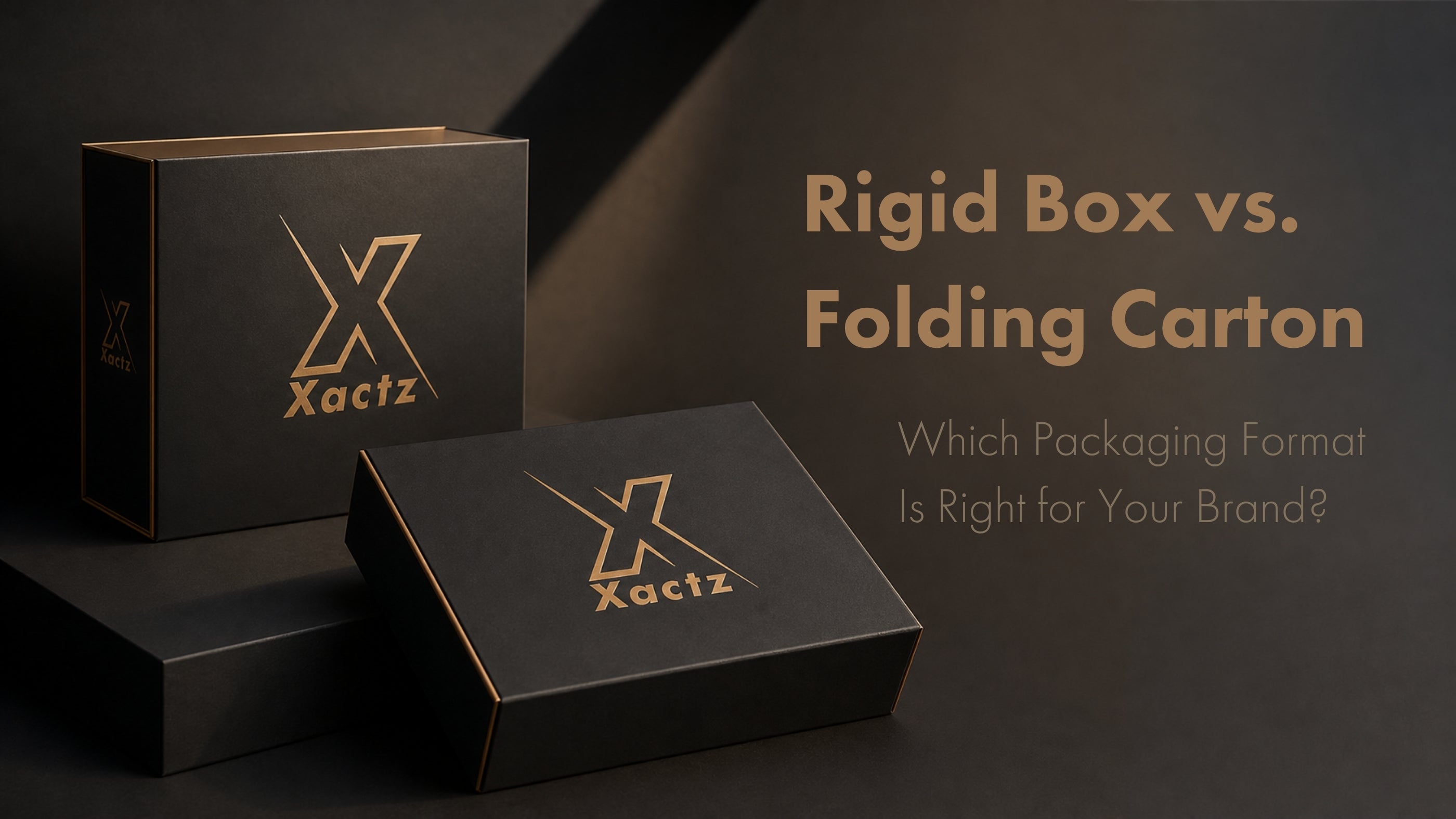
Pick up a rigid box. The weight of the greyboard panels. The resistance of the magnetic close. The way the lid lifts cleanly from the base. Every physical property of the box communicates quality, permanence, and value. Now pick up a folding carton. Lightweight, efficient, printable across every surface. A completely different set of signals, not inferior, but different, and right for a completely different set of brand contexts.
The decision between a rigid box and a folding carton is one of the most consequential packaging decisions a brand makes. It affects the customer's first impression, the unboxing experience, the logistics cost, the minimum order quantity, the per-unit cost, and the positioning signal the product sends at every point in the supply chain from factory to shelf to customer's hands.
This guide walks through every dimension of that decision so you can make the right call for your product, your customer, and your commercial model.
Table of Contents
What Is a Rigid Box?
A rigid box, also called a set-up box, is a permanently assembled paperboard box constructed from heavyweight greyboard, typically 1,500 to 3,000 gsm, wrapped in a brand-specified material. Unlike a folding carton, a rigid box does not fold flat. It is assembled at the factory and shipped in its finished three-dimensional form.
The defining characteristic of a rigid box is its structural permanence. The greyboard core is thick enough that the box holds its shape under pressure, does not flex, does not collapse, and does not deform under normal handling and stacking conditions. That structural permanence is what gives a rigid box its premium hand-feel and its ability to protect high-value products without an additional outer shipping carton in many applications.
Rigid boxes are available in a wide range of structural formats. The lid and base box, the most widely specified format, uses a separate lid that lifts cleanly from a base tray. The magnetic closure box uses a hinged lid held closed by embedded neodymium magnets. The drawer box uses a sliding inner tray that pulls out of an outer sleeve. The book-shaped box opens like a hardcover book on a spine hinge. And the shoulder box uses an internal shoulder tray that creates a stepped reveal when the lid is removed.
Each format delivers a different opening experience, a different interior configuration, and a different brand signal. But all rigid box formats share the same structural foundation: heavyweight greyboard, premium wrap material, and a construction quality that communicates permanence and value from the first moment of contact.
What Is a Folding Carton?
A folding carton is a paperboard box manufactured from a single flat sheet of lighter-weight board, typically 250 to 450 gsm, that is printed, die-cut, and scored before being shipped flat and assembled at the point of packing. Unlike a rigid box, a folding carton is not permanently assembled. It ships flat, which dramatically reduces freight volume and warehousing costs compared to a pre-assembled rigid box.
The defining characteristic of a folding carton is its versatility and logistics efficiency. The flat-pack format means a folding carton can be shipped and stored at a fraction of the volume of an equivalent rigid box, assembled quickly at the packing line, and produced at significantly lower per-unit cost across a wide range of volumes.
Folding cartons are the dominant packaging format in mass-market retail across food, beverage, personal care, pharmaceuticals, and consumer electronics. They are the format of choice when print fidelity, logistics efficiency, and cost-per-unit are the primary packaging requirements, and when the product's price point and market positioning do not require the structural premium of a rigid box.
Folding cartons are available in a wide range of structural formats including straight tuck end, reverse tuck end, auto-bottom, snap-lock bottom, sleeve, and tray and sleeve combinations. Each format offers different assembly characteristics, different structural performance under stacking loads, and different display options at point of sale.
The Structural Difference: What It Means in Practice
The structural difference between a rigid box and a folding carton is not simply a matter of board thickness. It is a difference in construction method, structural performance, and the physical experience the packaging delivers.
A rigid box is constructed by wrapping a pre-cut and scored greyboard core in a wrap material, with the wrap paper bonded to the greyboard surface and folded over the edges to create a continuous, seamless exterior surface. The result is a box with no visible seams on the exterior panels, a smooth, uninterrupted surface that accepts finishing treatments uniformly across its entire area, and a structural rigidity that does not depend on the box being sealed or closed.
A folding carton is constructed from a single flat sheet that is printed and die-cut before being folded and glued into its box form. The construction method means that folding cartons have visible fold lines at the corners, a structural rigidity that depends on the box being assembled and in some cases sealed, and a surface that is the printed face of the board rather than a separate wrap material applied over a core.
In practice, this structural difference translates into three tangible differences in the customer experience. The hand-feel of a rigid box is substantially heavier and more substantial than a folding carton of equivalent external dimensions. The surface quality of a rigid box, with its seamless wrap material, accepts finishing treatments including soft-touch matte lamination, foil stamping, and embossing at a quality level that is not achievable on a folding carton. And the structural permanence of a rigid box means it retains its shape and quality through multiple handling cycles, while a folding carton degrades in structural integrity with each handling cycle.
Brand Positioning: What Each Format Communicates
The format you choose sends a brand signal that operates independently of your logo, your colour palette, and your copy. It is a signal communicated entirely through physical properties, weight, rigidity, surface quality, and opening experience, and it is received by the customer before any conscious evaluation of the brand begins.
A rigid box communicates premium positioning, permanence, and considered quality. The weight of the box in the hand signals that the brand has invested in the packaging. The rigidity signals that the product inside is worth protecting. The seamless surface and premium finish signal that the brand has thought about every detail of the physical experience. These signals are particularly powerful in the luxury, premium gifting, skincare, cosmetics, fragrance, jewellery, and premium accessories categories, where the packaging is expected to match the quality of the product inside.
A folding carton communicates efficiency, accessibility, and print-forward brand identity. The lightweight format signals that the brand has prioritised the product over the packaging, which is the correct signal in many categories. The large printable surface area of a folding carton allows for rich, full-colour brand communication across every panel. And the familiar, accessible format of a folding carton communicates that the product is designed for everyday use rather than special occasion consumption.
Neither signal is inherently superior. The question is which signal is right for your product, your customer, and your price point. A premium skincare serum at a high price point in a folding carton sends a confused brand signal. A mass-market supplement in a rigid box sends an equally confused signal in the opposite direction. The format must match the positioning.
Cost Comparison: The Full Picture
The cost comparison between rigid boxes and folding cartons is more nuanced than a simple per-unit price comparison. The full cost picture includes per-unit production cost, tooling and setup cost, minimum order quantity, freight and warehousing cost, and the commercial value of the brand signal each format delivers.
Per-unit production cost for rigid boxes is higher than for folding cartons at equivalent volumes. A rigid box requires more material, more labour, and more production time than a folding carton of equivalent dimensions. At volumes below 500 units, rigid box per-unit costs can be significantly higher than folding carton equivalents. At volumes above 5,000 units, the per-unit cost differential narrows, and the logistics cost advantage of the folding carton's flat-pack format must be weighed against the brand value and customer retention advantages of the rigid box format.
Tooling and setup costs for rigid boxes are generally lower than for folding cartons at equivalent complexity levels. Rigid box construction does not require the precision die-cutting tooling that folding cartons require, which means the setup cost for a new rigid box specification is often lower than for an equivalent folding carton.
Freight and warehousing costs are where the folding carton's flat-pack format delivers its most significant commercial advantage. A folding carton ships flat and can be assembled at the packing line, which means freight and warehousing costs are calculated on the flat-pack volume rather than the assembled volume. A rigid box ships assembled and occupies its full three-dimensional volume in every freight movement and every warehouse bay. For brands managing high shipping volumes and international freight costs, this difference compounds significantly across every SKU and every shipment.
The foldable rigid box, a hybrid format that combines the structural quality of a rigid box with the flat-pack logistics efficiency of a folding carton, resolves this cost tension for many brands. It ships flat at approximately one-fifth of its assembled volume and assembles into a fully rigid, premium-quality luxury box at the point of packing. For brands that require rigid box brand quality but cannot absorb the logistics cost of a pre-assembled rigid box, the foldable rigid box is the most commercially intelligent format available.
MOQ Considerations: What to Expect at Each Volume Tier
Minimum order quantities for rigid boxes and folding cartons reflect the different production economics of each format.
Rigid boxes are typically available from 300 to 500 units per run at most manufacturers, with per-unit costs declining meaningfully as volume increases through 1,000, 2,500, and 5,000 unit thresholds. The production economics of rigid box manufacturing, which involves more manual labour than folding carton production, mean that the cost reduction curve is steeper at lower volumes and flattens at higher volumes.
Folding cartons are typically available from 1,000 to 2,000 units per run at most manufacturers, reflecting the higher tooling and setup costs of the die-cutting process. Per-unit costs decline steeply as volume increases, and folding cartons become significantly more cost-competitive than rigid boxes at volumes above 10,000 units per run.
For brands at early stages of growth, rigid boxes often offer a more accessible entry point in terms of MOQ, while folding cartons offer better economics at scale. For brands with established volume, the format decision should be driven by brand positioning and logistics economics rather than MOQ considerations.
Finishing Options: Where Rigid Boxes Have a Clear Advantage
The finishing options available on a rigid box are substantially broader and higher-quality than those available on a folding carton, and this difference is one of the most commercially significant factors in the format decision for premium brands.
Soft-touch matte lamination on a rigid box creates a velvety, tactile surface that communicates quality the moment the box is picked up. The same lamination applied to a folding carton creates a similar surface quality, but the lighter board weight and the visible fold lines at the corners mean the overall tactile experience is less substantial and less premium.
Hot foil stamping on a rigid box, applied to the seamless wrap material surface, delivers a precision and quality of finish that is not achievable on a folding carton. The seamless surface of the rigid box wrap material allows foil to be applied without interruption across panel edges, creating a continuous metallic finish that is one of the most powerful visual statements in luxury packaging.
Embossing and debossing on a rigid box create tactile depth in the wrap material surface that communicates craft and permanence. The same treatments applied to a folding carton create a shallower relief in the lighter board, with less tactile impact and less visual depth.
For brands where the finishing quality of the packaging is a primary brand communication tool, the rigid box format offers a clear and significant advantage over the folding carton at every finishing tier.
Which Format Is Right for Your Brand?
The format decision comes down to four factors considered together: brand positioning, product price point, logistics model, and volume.
A rigid box is the right format when the product is positioned at a premium or luxury price point, the packaging is expected to match the quality of the product, the unboxing experience is a brand differentiator, the customer is expected to retain the packaging, and the logistics model can absorb the freight cost of a pre-assembled rigid box or the brand is willing to specify a foldable rigid box to resolve the logistics cost tension.
A folding carton is the right format when the product is positioned at a mass-market or accessible price point, logistics efficiency and per-unit cost are the primary packaging requirements, the brand's primary packaging communication tool is print rather than structure and finish, and the volume is high enough to amortise the tooling and setup costs of the die-cutting process.
A foldable rigid box is the right format when the product requires rigid box brand quality but the logistics model cannot absorb the freight cost of a pre-assembled rigid box, the brand is scaling quickly and needs to manage warehousing costs efficiently, or the brand has a sustainability commitment that is served by the reduced freight emissions of the flat-pack format.
Why Xactz Manufactures Both
Xactz is a verified direct manufacturer of rigid boxes, foldable rigid boxes, and folding cartons, operating over 40,000 square metres of dedicated luxury packaging production space across two purpose-built facilities in Shenzhen and Huizhou, China.
Manufacturing both formats in-house means Xactz can advise on the format decision from a position of complete commercial neutrality, recommend the foldable rigid box hybrid where it resolves the cost tension between brand quality and logistics efficiency, and produce both formats to the same quality standard with the same finishing options, the same sampling process, and the same 10 to 18 day lead time from sample approval.
All finishing is in-house. All quality control is in-process. FSC certified. ISO 9001 certified. TUV Rheinland verified. Every new project begins with a structured briefing consultation that covers format selection, material specification, finishing options, and interior construction before a single sample is produced.
If you are at the format decision stage for a new product or a packaging refresh, contact Xactz at xactz.com to begin a briefing consultation.