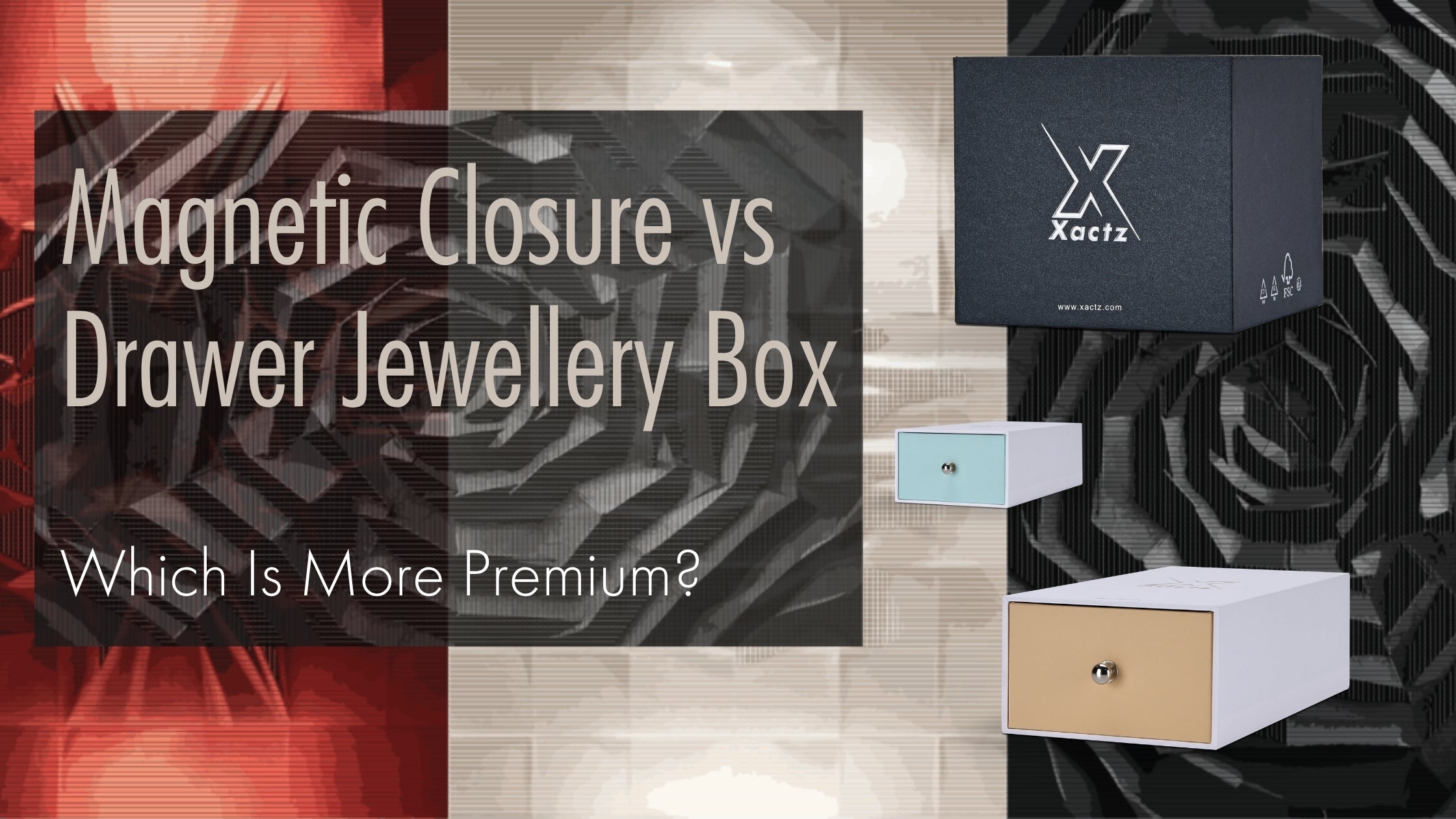
Magnetic Closure vs Drawer Jewellery Boxes, Which Feels More Premium?
Table of Contents
The Question Every Jewellery Brand Asks
At some point in the packaging development process, almost every jewellery brand arrives at the same crossroads.
Two formats. Both rigid. Both premium. Both widely used by some of the most respected jewellery brands in the world. And both capable of delivering a packaging experience that elevates the piece inside.
The magnetic closure box. And the drawer box.
The question is not which one is better in absolute terms, because the honest answer is that both formats, executed at the right quality level, are exceptional. The question is which one is better for your brand, your product, your customer, and the specific moment you are trying to create when that packaging is opened for the first time.
This guide answers that question, in full, and without shortcuts.
What Is a Magnetic Closure Jewellery Box?
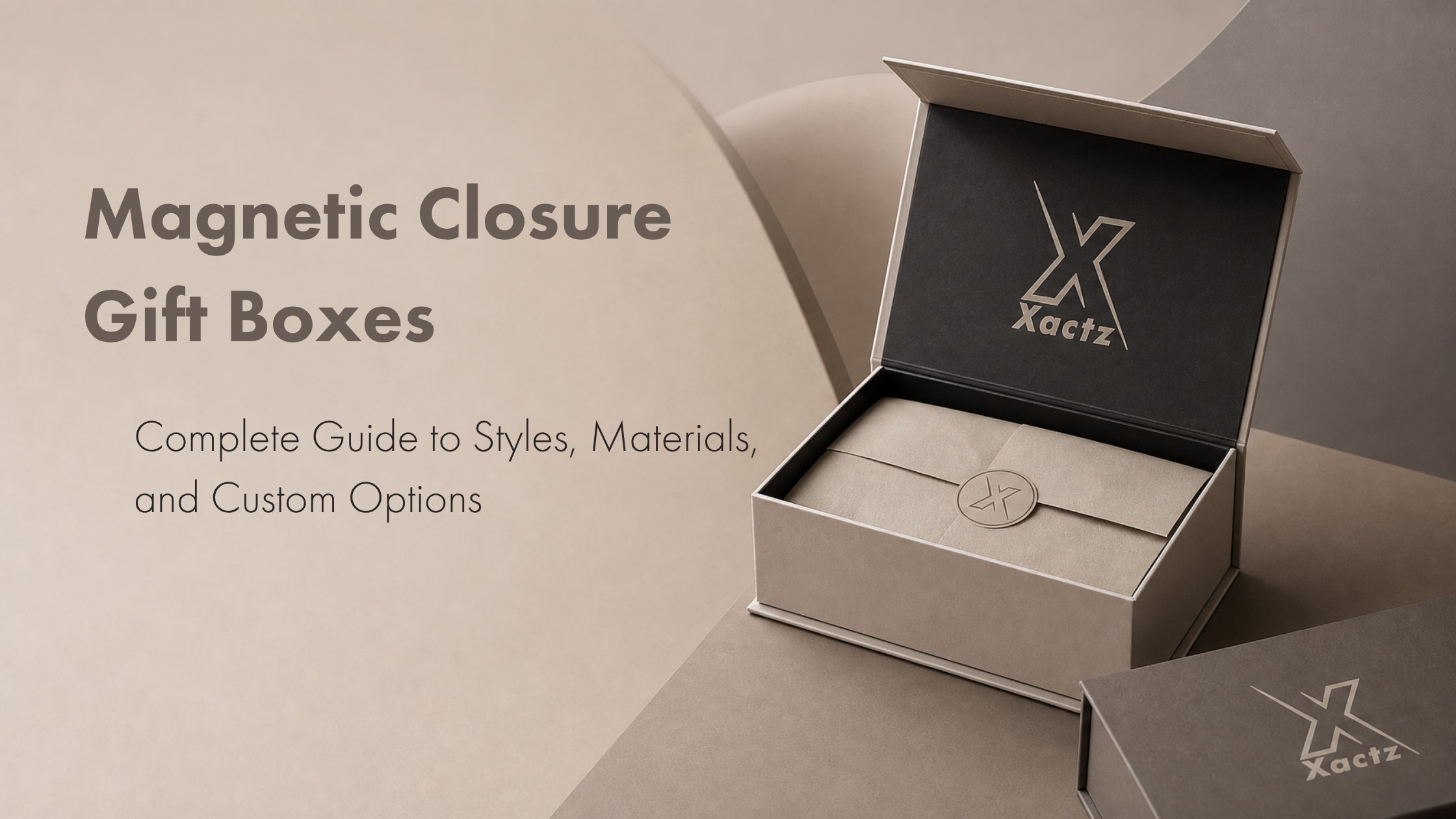
A magnetic closure jewellery box is a rigid box with a hinged or lift-off lid that is held closed by one or more concealed magnets embedded in the lid and base panels. When the lid is brought to the closed position, the magnets engage, creating a satisfying, tactile closure that communicates quality the moment it is felt.
The magnetic closure format is one of the most widely used structures in luxury jewellery packaging, and for good reason. The closure mechanism is intuitive. The opening gesture, lifting the lid, is natural and ceremonial. And the moment the lid opens to reveal the jewellery inside is clean, dramatic, and immediate.
Magnetic closure jewellery boxes are produced in a wide range of configurations, clamshell hinged lids, flat lift-off lids, angled presentation lids, and book-style openings, each creating a slightly different opening experience while sharing the same fundamental closure mechanism.
The magnet itself is typically a neodymium rare-earth magnet, small, powerful, and completely concealed within the board construction. The strength of the magnet is calibrated to the weight and size of the lid, strong enough to hold the box securely closed, gentle enough to open with a single finger.
What Is a Drawer Jewellery Box?
A drawer jewellery box, also known as a slide box or pull-out box, is a two-component rigid box structure in which an inner tray slides out from within a fixed outer sleeve. The jewellery is presented on the inner tray, which the customer pulls forward to reveal the piece inside.
The drawer format creates a fundamentally different opening experience from the magnetic closure box. Where the magnetic closure opens vertically, lid lifting away from base, the drawer opens horizontally, with the inner tray sliding forward in a smooth, controlled motion.
This horizontal reveal is the defining characteristic of the drawer box experience. The jewellery does not appear all at once, it emerges gradually as the tray slides forward, creating a moment of anticipation that many brands and customers find deeply satisfying.
Drawer jewellery boxes are produced with a ribbon pull, a fabric or satin ribbon attached to the front face of the inner tray that the customer uses to draw the tray forward. The ribbon is both functional and aesthetic, it adds a tactile element to the opening gesture and creates a visual detail on the front face of the box that signals the format before the box is even touched.
The Unboxing Experience, Side by Side
The unboxing experience is where the magnetic closure and drawer formats diverge most significantly, and where the choice between them has the greatest impact on how the customer feels about the brand in the moment that matters most.
Magnetic Closure, The Reveal
The magnetic closure box opens with a single upward gesture. The lid lifts. The magnets release with a subtle resistance that communicates quality. And the jewellery is revealed in a single, immediate moment, the full piece visible from the instant the lid clears the base.
This is a clean, confident reveal. There is no ambiguity, no delay, no build-up. The piece is simply there, presented in its interior, framed by the lining, lit from above. It is the format that rewards a well-designed interior construction most directly, because the interior is the first thing the customer sees.
The magnetic closure unboxing is well suited to gifting contexts, where the box is handed to the recipient and opened in front of the giver. The gesture is natural, the reveal is immediate, and the emotional impact is concentrated in a single moment.
Drawer Box, The Reveal
The drawer box opens with a forward pull. The ribbon is grasped. The tray slides forward, smoothly, with a controlled resistance that communicates the quality of the construction. And the jewellery emerges gradually, the front of the piece appearing first, then the full piece as the tray reaches its fully extended position.
This is a slower, more theatrical reveal. The anticipation builds as the tray slides forward. The moment the full piece is visible is earned, it follows a gesture, a motion, a small ceremony. And that ceremony is part of the experience.
The drawer box unboxing is well suited to self-purchase contexts, where the customer is opening the box alone, taking their time, and experiencing the packaging as an extension of the product itself. It is also exceptionally well suited to video content, the sliding motion and the gradual reveal are among the most-shared unboxing formats on social media.
Side-by-Side Comparison
| Experience Factor |
Magnetic Closure |
Drawer Box |
| Opening gesture |
Lift, vertical, immediate |
Pull, horizontal, progressive |
| Reveal speed |
Instant |
Gradual |
| Anticipation |
Low to medium |
High |
| Ceremony |
Clean and confident |
Theatrical and deliberate |
| Best gifting context |
In-person gifting |
Self-purchase and e-commerce |
| Social media performance |
Strong |
Exceptional |
| Perceived formality |
High |
High |
| Ease of opening |
Intuitive |
Intuitive |
Structural Construction, How Each Box Is Built
Understanding how each format is constructed helps brands make better decisions about materials, finishing, and interior design, because the construction determines what is possible at every subsequent stage.
Magnetic Closure Construction
A magnetic closure jewellery box is built from a greyboard core, typically 2mm to 3mm board for jewellery applications, wrapped in the specified outer material. The lid and base are constructed as separate components, joined by a hinge, either a fabric hinge bonded to the interior, or a living hinge formed in the greyboard itself.
The magnets are embedded in the greyboard during the assembly stage, positioned precisely so that the lid and base magnets align when the box is closed. The magnet positions are concealed beneath the wrapping material and the interior lining, leaving no visible hardware on the finished box.
The interior is constructed separately, a lining material applied to all interior surfaces, with the jewellery insert positioned in the base.
Drawer Box Construction
A drawer jewellery box is built from two separate components, the outer sleeve and the inner tray, each constructed independently from greyboard and wrapped in their respective materials.
The outer sleeve is a rigid tube, open at the front and closed at the back, through which the inner tray slides. The inner tray is sized to slide within the sleeve with a controlled, consistent resistance, tight enough to hold its position when the box is upright, free enough to slide smoothly when pulled.
The ribbon is attached to the front face of the inner tray during the assembly stage, typically threaded through a small slot in the front panel and secured on the interior face.
The dimensional relationship between the sleeve and the tray is the most critical engineering specification in a drawer box, the tolerance between the two components determines the quality of the sliding action, and it must be held consistently across the entire production run.
Materials and Finishing, Where the Premium Feel Comes From
Both formats support the full range of luxury rigid box materials and finishing options. The choice of material and finish has as much impact on the perceived premium quality of the packaging as the structural format itself.
Outer Materials
| Material |
Effect |
Both Formats |
| Soft-touch paper |
Velvet-like matte surface, the most tactile outer material in luxury packaging |
✅ |
| Linen / book-binding cloth |
Textured, artisanal surface, communicates craft and heritage |
✅ |
| Leatherette / PU leather |
Structured, premium surface, strong association with high jewellery |
✅ |
| Metallic paper |
High-reflectivity surface, bold, modern luxury aesthetic |
✅ |
| Uncoated textured paper |
Natural, tactile surface, suited to sustainable luxury positioning |
✅ |
| Silk / satin fabric |
Soft, lustrous surface, the most elevated outer material option |
✅ |
Finishing Options
| Finishing |
Effect |
| Foil stamping |
Metallic brand mark, gold, silver, rose gold, or custom colour |
| Embossing |
Raised surface relief, logo, pattern, or texture |
| Debossing |
Recessed surface impression, understated, tactile brand mark |
| Soft-touch lamination |
Full-surface velvet matte finish |
| UV spot coating |
Selective high-gloss contrast against matte surface |
| Screen printing |
Direct colour application, illustration, pattern, or full-surface colour |
| Hot stamping |
Fine-line metallic application, small text, intricate marks |
Both the magnetic closure and drawer formats support all finishing combinations, including the most complex multi-finish specifications such as soft-touch lamination with UV spot and foil stamping.
Interior Inserts, Presenting the Jewellery
The interior of a jewellery box is where the packaging transitions from impressive to extraordinary, and where the choice of insert has the greatest direct impact on how the piece is presented.
Both formats support the full range of jewellery insert options. The format choice does not constrain the interior specification, it shapes it.
Insert Options
Foam inserts. Custom-cut EVA or polyurethane foam, the most versatile interior option. Foam inserts can be cut to the exact profile of any jewellery piece, ring, necklace, bracelet, earrings, or multi-piece set, and covered in any lining material. The foam holds the piece securely in position and presents it at the correct angle and height.
Pillow inserts. A fabric-covered foam pillow, the classic jewellery box insert for rings, pendants, and small pieces. The pillow presents the piece elevated above the base of the box, creating a sense of display rather than storage.
Finger roll inserts. A cylindrical foam roll covered in fabric, used for rings, specifically. The ring is placed over the roll, which holds it upright and presents the face of the ring directly to the customer when the box is opened.
Velvet-lined cavities. A moulded or cut cavity in the base of the box, lined in velvet, used for bracelets, watches, and larger pieces. The cavity holds the piece in a fixed position without visible hardware or clips.
Multi-compartment inserts. Custom-engineered inserts with multiple cavities, used for sets, collections, and multi-piece gifting. Each cavity is sized and lined for a specific piece in the set.
Satin ribbon cradles. A fabric ribbon stretched across the base of the box, used for pendants and necklaces. The ribbon holds the chain in a clean line and presents the pendant centred and elevated.
Insert and Format Pairing
| Insert Type |
Magnetic Closure |
Drawer Box |
| Foam insert |
✅ Ideal |
✅ Ideal |
| Pillow insert |
✅ Ideal |
✅ Works well |
| Finger roll |
✅ Classic pairing |
✅ Works well |
| Velvet-lined cavity |
✅ Ideal |
✅ Ideal |
| Multi-compartment |
✅ Works well |
✅ Ideal, full tray visibility |
| Satin ribbon cradle |
✅ Works well |
✅ Ideal, gradual reveal enhances effect |
Which Format Works Best for Which Jewellery Category
The magnetic closure and drawer formats each have natural affinities with specific jewellery categories, shaped by the geometry of the piece, the context of the purchase, and the experience the brand wants to create.
Rings. Both formats work exceptionally well for rings. The magnetic closure with a finger roll insert is the classic fine jewellery format, clean, formal, and immediately recognisable. The drawer box with a finger roll creates a more theatrical reveal, the ring emerging as the tray slides forward. For engagement rings and proposal contexts, the magnetic closure is the more established format. For fashion rings and self-purchase, the drawer box creates a stronger social media moment.
Necklaces and pendants. The drawer box has a natural advantage for necklaces, the horizontal format of the tray allows the chain to be laid flat and the pendant to be centred, creating a clean, gallery-style presentation. The magnetic closure works well for shorter necklaces and pendants but can be more challenging for longer chains in terms of interior layout.
Bracelets. Both formats work well for bracelets. The magnetic closure with a velvet-lined cavity presents a bracelet with a clean, formal elegance. The drawer box allows the bracelet to be presented on a full-width tray, particularly effective for bangles and cuffs.
Earrings. The magnetic closure is the more natural format for earrings, the vertical reveal presents the pair symmetrically and immediately. The drawer box works well for larger statement earrings where the horizontal tray allows the full piece to be displayed.
Sets and collections. The drawer box has a significant advantage for multi-piece sets, the full-width tray allows all pieces to be presented simultaneously in a single, gallery-style reveal. The magnetic closure works well for two-piece sets but becomes more complex for three or more pieces.
Watches. The magnetic closure is the dominant format in watch packaging, the lid-lift reveal is the established convention for watch presentation. The drawer format is used in watch packaging but is less common at the fine watch level.
Cost Considerations, What Affects the Price
Both formats are premium rigid box structures, and both carry a higher unit cost than folding carton or standard gift box formats. The cost difference between a magnetic closure and a drawer box at equivalent quality levels is smaller than most brands expect.
The factors that have the greatest impact on unit cost are consistent across both formats.
Board grade and thickness. Heavier, higher-grade greyboard costs more, but delivers a noticeably superior feel that justifies the investment at the luxury level.
Outer material. Soft-touch paper, leatherette, and fabric outer materials carry a premium over standard coated papers, but the tactile impact on the customer experience is significant.
Finishing complexity. A single foil stamp is a modest cost addition. Soft-touch lamination with UV spot and foil stamping is a more significant investment, but it is also the finishing combination that most consistently elevates a box from premium to extraordinary.
Interior insert specification. Custom-cut foam inserts, velvet-lined cavities, and multi-compartment constructions all add cost, but the interior is where the jewellery lives, and an insert that presents the piece poorly undermines everything the exterior achieves.
Order volume. Unit cost decreases with volume, the tooling and setup costs are spread across a larger number of units. At MOQ of 100 units, the unit cost is higher than at 1,000 or 10,000 units, but the quality standard is identical at every volume.
The most important cost consideration is not the unit cost of the box in isolation, it is the unit cost relative to the value of the piece inside and the price the customer is paying. For a jewellery brand selling at £500 and above, a packaging investment of £4–£12 per unit is not a cost, it is a brand investment that directly supports the perceived value of the piece.
MOQ, Lead Times and Sampling
| Stage |
Timeline (Example) |
| Structural drawing from confirmed brief |
2–5 business days |
| Digital 3D render |
1–2 business days from confirmed drawing |
| First physical sample |
3–5 business days from confirmed drawing |
| Sample refinement round |
3–5 business days per round |
| Production run |
10–18 days from confirmed sample |
MOQ: from 100 units, magnetic closure and drawer formats.
Xactz operates a dedicated department for personalised small-order production, meaning the jewellery brand ordering 100 boxes receives the same structural engineering precision, the same certified materials, and the same 18-point QC standard as the enterprise managing a multi-million-unit annual programme.
Both formats are available from MOQ 100 units. Both formats are available with the full finishing and insert specification range from the same minimum order quantity.
Can You Have Both? Hybrid and Bespoke Options
The magnetic closure and drawer formats are not mutually exclusive, and some of the most distinctive jewellery packaging in the market combines elements of both.
Magnetic drawer boxes. A drawer box with a magnetic closure on the front face of the sleeve, holding the tray in the closed position with a magnet rather than relying solely on friction. This adds the tactile engagement of the magnetic closure to the theatrical reveal of the drawer format.
Nested formats. A magnetic closure outer box containing a drawer inner box, used for high-value multi-piece sets and limited-edition collections. The customer opens the outer magnetic closure box to find the drawer box inside, two opening experiences in a single packaging structure.
Bespoke geometries. Both formats are available in custom shaped configurations, hexagonal drawer boxes, arch-topped magnetic closure boxes, cylindrical magnetic closure formats. The structural engineering complexity increases with the departure from the standard rectangular format, but both formats support custom geometry at Xactz's manufacturing capability level.
If the standard formats do not fully serve the brand's brief, the answer is not to compromise. The answer is to brief for something that does.
Which One Should You Choose?
There is no universal answer. But there is a framework for arriving at the right answer for your brand.
Choose the magnetic closure box if:
- The primary purchase context is in-person gifting, where the immediate, clean reveal creates the strongest emotional impact
- The jewellery category is rings, earrings, or watches, where the vertical reveal is the established convention
- The brand aesthetic is formal, restrained, and classic, where the clean geometry of the magnetic closure format is the stronger expression
- The interior insert is a pillow, finger roll, or single-cavity construction, where the magnetic closure presents the piece most directly
Choose the drawer box if:
- The primary purchase context is self-purchase or e-commerce, where the theatrical reveal creates a stronger personal experience and a more shareable social media moment
- The jewellery category is necklaces, sets, or multi-piece collections, where the horizontal tray format presents the pieces most effectively
- The brand aesthetic is modern, editorial, and experience-led, where the drawer format's ceremony and motion are a stronger brand expression
- Social media and unboxing content are a significant part of the brand's marketing strategy, the drawer reveal is one of the most-shared packaging formats online
Choose both if:
- The brand has multiple product categories that are better served by different formats
- The brand wants a signature format for hero pieces and a secondary format for entry-level or gifting lines
- The brief calls for something that neither standard format fully delivers, in which case, a hybrid or bespoke solution is the right conversation to have
Why Xactz
Xactz is a global leading manufacturer specialising in high-end packaging boxes, with 40,000+ sqm of fully automated and semi-automated production across Shenzhen and Huizhou, China.
Both the magnetic closure and drawer jewellery box formats are produced in-house, with full structural engineering, sampling, finishing, and insert construction capability under one roof.
| Capability |
Detail |
| Total facility footprint |
40,000+ sqm across Shenzhen and Huizhou |
| Production lines |
Fully automated + semi-automated |
| Quality control |
18-point in-house QC on every production run |
| Finishing options |
20+ premium finishing options |
| Sample turnaround |
1–3 business days from confirmed brief |
| Production turnaround |
10–18 days from sample approval |
| MOQ |
From 100 units |
| Global delivery |
60+ countries |
Certifications:
✅ ISO 9001:2015 : International quality management certification
✅ FSC™ Certified : Responsible and sustainable sourcing Certification Code: SGSHK-COC-332603
✅ TÜV Rheinland Verified Supplier : Independent third-party factory audit
✅ FDA Compliant : Safe for food-contact and consumer use
✅ EU 94/62/EC Qualified : Export qualified for European and global markets
International exhibition recognition:
Xactz has been ranked in the top 5% at three consecutive international packaging exhibitions, Paris Packaging Week 2026, Packaging Innovations & Empack 2026, and Packaging Première & PCD Milan 2026, recognised for innovation, quality, and craftsmanship.
Dedicated small-order production department:
As a global leading manufacturer specialising in high-end packaging boxes, Xactz has established a dedicated department for personalised small-order production, committed to supporting the growth of small companies and ensuring the seamless execution of micro-order solutions for large enterprises. Every order. Every run. Every time.
Start Your Jewellery Packaging Project
Whether you have a clear brief or a question you have not yet been able to answer, the conversation starts here.
Tell us the format, the jewellery category, the brand aesthetic, and the experience you want to create. Our structural engineering and production team will take it from there.
- ✅ Magnetic closure and drawer formats : both available from 100 units
- ✅ Full finishing range : foil, embossing, soft-touch, UV spot, and more
- ✅ Custom interior inserts : foam, velvet, pillow, ribbon, multi-compartment
- ✅ Sample in 3–5 business days
- ✅ Production in 10–18 days from sample approval
- ✅ Served across 60+ countries
- ✅ Full certification stack ; ISO, FSC™, TÜV, FDA, EU 94/62/EC
👉 Start your jewellery packaging project with Xactz