Most packaging projects do not fail because of bad design. They fail because of a bad brief.
A vague brief produces vague samples. A vague sample produces rounds of costly revisions. Rounds of costly revisions push back launch dates, inflate budgets, and erode the confidence of everyone involved in the project. By the time the final product arrives, the original vision has been compromised by a process that could have been avoided entirely with a clear, structured brief from day one.
This guide covers everything a brand manager, procurement lead, or creative director needs to know to brief a luxury packaging manufacturer correctly the first time. From dieline requirements and artwork file formats through material specification language, MOQ conversations, and the sampling workflow, this is the complete reference for brands that want to get luxury packaging right without the guesswork.
In This Guide
What a Luxury Packaging Brief Actually Needs to Cover
A luxury packaging brief is not a mood board and a logo file. It is a technical and creative document that gives a manufacturer everything they need to produce a sample that matches your vision without requiring them to make assumptions on your behalf.
A complete brief covers six areas. Every area matters. Missing any one of them will create a gap that the manufacturer will fill with their own judgement, which may or may not align with yours.
The six areas are structural specification, material specification, finish and surface treatment specification, branding and artwork requirements, quantity and commercial parameters, and timeline requirements.
Each is covered in detail below.
Structural Specification: Dimensions, Format, and Construction
The structural specification defines what the box physically is.
Start with the internal dimensions of the box, not the external dimensions. Internal dimensions are what matter for product fit. External dimensions are a result of the structural construction, the board weight, and the material thickness, all of which the manufacturer will calculate from the internal spec. Providing external dimensions as your starting point creates ambiguity that leads to product fit problems at the sample stage.
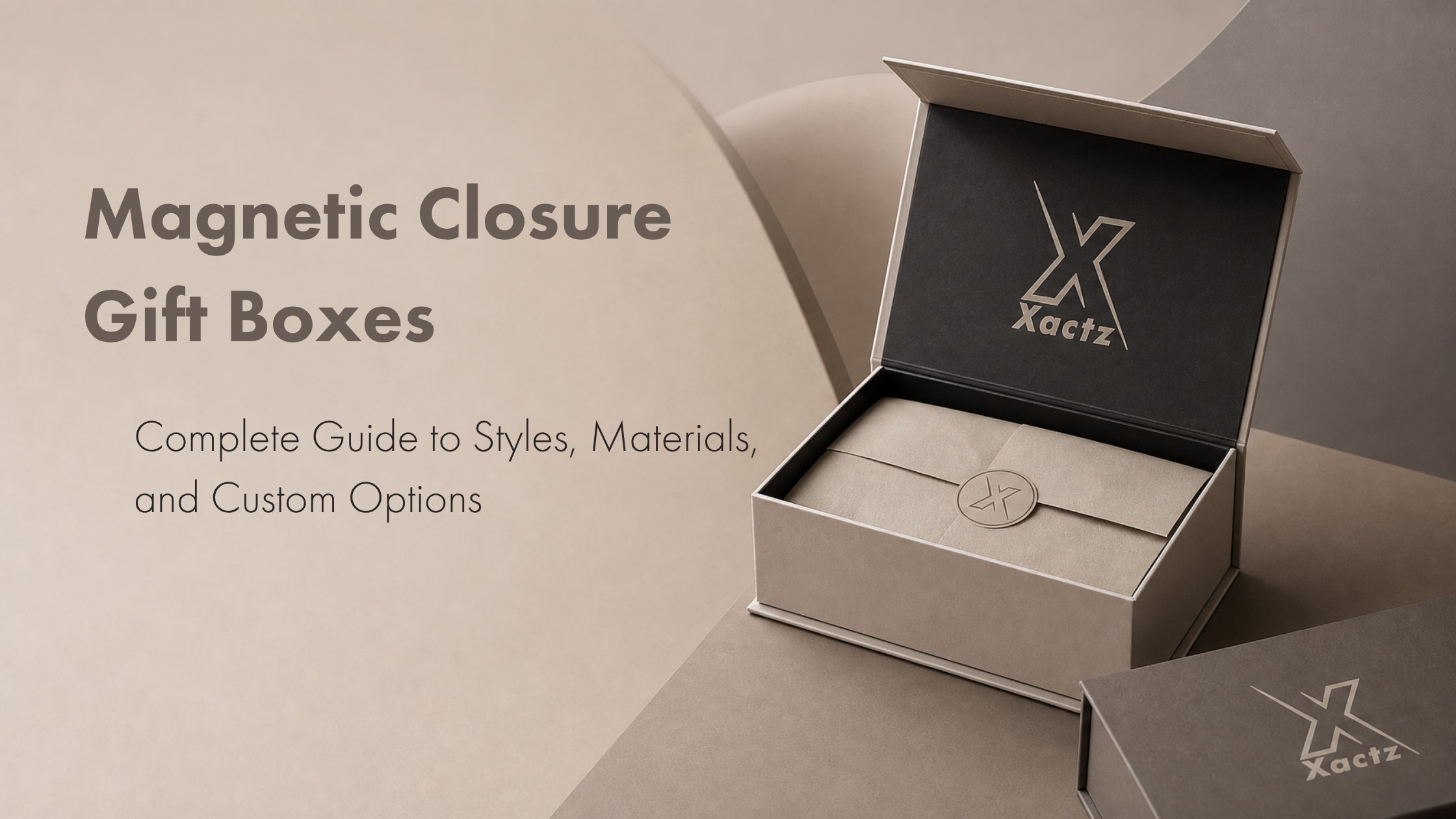
Specify the box format clearly. Rigid lid and base. Magnetic closure rigid box. Drawer box. Clamshell. Hinged lid. Shoulder neck construction. Each format has distinct structural engineering requirements, distinct cost implications, and distinct unboxing characteristics. If you are not certain which format is right for your product, ask the manufacturer for a format recommendation based on your product dimensions, weight, and brand positioning. A good manufacturer will guide you.
Include the construction components in the brief. Outer box only. Outer box with inner tray. Full set including brand card, tissue wrap, ribbon pull, and carrier bag. The more complete your component list, the more accurate the initial quote and the fewer surprises at the sampling stage.
Dieline Requirements: The Blueprint of Your Packaging
A dieline is the foundational blueprint of custom packaging. It is a two-dimensional vector file that defines the three-dimensional structure of the final package, showing exactly where every fold, cut, score, and glue point sits in relation to the flat sheet before construction.
Every luxury packaging project requires a dieline before artwork can be applied. If you are providing your own artwork, you need the manufacturer's dieline file before your designer begins work. Applying artwork to the wrong dieline is one of the most common and most costly mistakes in packaging production, resulting in artwork that does not align with folds, bleeds that fall in the wrong place, and logo positions that shift when the box is constructed.
Request the dieline file from your manufacturer at the start of the project, before any design work begins. The dieline should be provided as a vector file, typically in AI or layered PDF format, with clearly labelled layers separating the cut lines, fold lines, glue zones, and safe artwork areas.
When you receive the dieline, check three things before passing it to your designer. Confirm the internal dimensions match your product specification. Confirm the fold directions are labelled correctly. And confirm the safe zone boundaries are clearly marked so your designer knows where critical brand elements must sit to survive the fold and trim process without being cut or obscured.
Material Specification: Speaking the Language of Luxury Packaging
Material specification is where most brands lose precision in their brief. Describing a material as "premium" or "luxury feel" gives a manufacturer nothing to work with. Every material in a luxury packaging factory is premium relative to a standard corrugated box. You need to be specific.
A complete material specification covers four elements: the outer covering paper, the structural board weight, the inner lining or tray material, and any secondary materials for inserts or components.
For the outer covering paper, specify by name or by category where possible. Specialty papers including linen texture, onion skin, star rain texture, soft-touch matte, and embossed grain each produce distinct tactile and visual results that communicate different brand signals. If you have a reference sample from a competitor or a previous project, share it. Physical references are far more precise than written descriptions.
For structural board weight, specify in grams per square metre. Luxury rigid boxes typically use board weights between 1,200g and 2,000g depending on the box size, the product weight, and the structural rigidity required. A manufacturer can recommend the appropriate board weight for your dimensions and product weight if you provide those parameters.
For inner tray and lining materials, specify the material type, the colour, and whether the surface finish needs to match or complement the outer box. A white card tray in a black outer box is a deliberate contrast. A matching black tray is a deliberate continuation. Both are valid choices. Neither is a default. Specify which you want.
Finish and Surface Treatment Specification
Surface finish is where luxury packaging earns its premium positioning. It is also where briefs most commonly lack the precision needed to produce the right result first time.
A complete finish specification covers the base lamination, any foil stamping details, embossing or debossing requirements, spot UV or gloss treatments, and any special effect finishes.
For foil stamping, specify the foil colour by reference number where possible. Gold foils vary significantly across manufacturers. Gloss gold, matte gold, antique gold, and champagne gold are four distinct finishes that communicate four distinct brand personalities. Specifying "gold foil" without a reference leaves the choice to the manufacturer. Specifying by foil reference number, such as YF-6876 bright silver or 157M Chenghui purple gold, ensures the result matches your brand standard precisely.
For embossing and debossing, specify whether the treatment is applied to the foil stamp, to the paper surface directly, or to both. Embossed foil and blind emboss are different processes with different tooling requirements and different visual results. Be explicit about which you require.
For lamination, specify soft-touch matte, gloss, or satin. Soft-touch matte lamination is the dominant finish in luxury packaging in 2026 because it communicates restraint and tactile quality simultaneously. Gloss lamination communicates vibrancy and colour depth. The choice should be driven by your brand positioning, not by cost or default.
Branding and Artwork Requirements
Your artwork file is the single most important document you will send to a manufacturer after the brief itself. A poorly prepared artwork file is the most common cause of production delays, reprints, and quality failures in luxury packaging production.
Provide artwork in vector format. AI or PDF files with all fonts outlined and all linked images embedded at a minimum of 300 DPI at final print size. RGB colour profiles must be converted to CMYK before submission. Pantone colour references should be specified for any brand colours that require precise colour matching across production runs.
Apply your artwork to the manufacturer's dieline file, not to a generic template or a previous project's dieline. Every structural specification produces a unique dieline. Using the wrong dieline produces artwork that does not align with the physical box.
Include a clear brand mark-up with your artwork file specifying which elements require foil stamping, which require embossing, which are printed in CMYK, and which are spot UV. If your artwork file contains all of these treatments, each treatment should be on a separate clearly labelled layer so the prepress team can separate them correctly for plate and tool making.
MOQ, Quantity, and Commercial Parameters
Minimum order quantities in luxury rigid box manufacturing are driven by the tooling and setup costs associated with custom die-cutting, foil stamping plates, and embossing tools. These are fixed costs that are amortised across the production run, which is why unit costs decrease significantly as quantities increase.
When briefing a manufacturer on quantity, provide your realistic order quantity for the first production run and your anticipated annual volume. The first figure determines the unit price. The second figure determines whether the manufacturer will invest in the relationship and how they will structure tooling cost recovery across future orders.
Be honest about your volume. Overstating quantities to secure a lower unit price creates commercial problems when the actual order is placed and damages the trust that a long-term manufacturing partnership depends on.
Ask the manufacturer to provide pricing at three quantity tiers: your minimum requirement, your expected volume, and a higher volume that reflects your growth ambition. This gives you a clear picture of the cost curve and helps you make informed decisions about inventory strategy and order frequency.
The Sampling Workflow: What to Expect and How to Manage It
The sampling process for luxury packaging typically runs through three stages. Understanding what each stage is for prevents the most common mistake brands make, which is approving a sample at the wrong stage for the wrong reasons.
The first stage is the white mockup or structural prototype. This is an unfinished, unprinted sample produced in plain white or grey board to the exact structural specification of the brief. Its purpose is to confirm dimensions, construction, and product fit. Approve the white mockup only on structural grounds. Do not reject a white mockup because the finish looks wrong. There is no finish at this stage. That is intentional.
The second stage is the printed proof or colour sample. This is a sample produced with the specified covering paper, lamination, and print, but typically without the foil stamping and embossing tools, which are produced separately and at additional cost. Its purpose is to confirm material selection, colour accuracy, and print quality. Review the printed proof against your Pantone references and material specification. Approve it only when the colour and material are correct.
The third stage is the production sample or golden sample. This is a fully finished sample produced with all foil stamping, embossing, and surface treatments applied, constructed to the final production specification. This is the sample you approve as the quality benchmark for the full production run. Every unit in the production run will be measured against this sample. Review it with the same rigour you would apply to the final product, because it is the final product standard.
Do not rush the sampling process. Each stage exists for a specific purpose. Skipping a stage or approving a sample without thorough review is the fastest route to a production run that does not meet your quality standard.
The Brief Checklist
Before sending a brief to a luxury packaging manufacturer, confirm you have covered every item on this list.
Internal dimensions of the box confirmed against product measurements. Box format specified by name. Construction components listed in full. Dieline requested from the manufacturer before artwork begins. Outer covering paper specified by name or physical reference. Board weight specified in grams per square metre. Inner tray material, colour, and finish specified. Foil colour specified by reference number. Embossing and debossing treatment type specified. Lamination type specified. Artwork file prepared in vector format with CMYK colour profile and Pantone references. Artwork applied to the correct manufacturer dieline with treatments on separate layers. Order quantity and annual volume provided honestly. Timeline requirements including sample approval deadlines and production delivery date specified.
A brief that covers every item on this list gives a luxury packaging manufacturer everything they need to produce a first sample that is close to your vision. It eliminates the assumptions that cause revisions. It compresses the timeline from brief to approved production sample. And it establishes the working relationship on a foundation of clarity and mutual understanding that makes every subsequent order faster, smoother, and better.
Work With a Manufacturer That Removes the Guesswork
The best luxury packaging manufacturers do not just receive briefs. They help brands build them.
At Xactz, every new client project begins with a structured briefing consultation. Our team of 300 plus specialists works with brands to define the structural specification, recommend materials and finishes aligned with brand positioning, prepare dieline files to the correct specification, and guide the sampling process from white mockup through to golden sample approval.
We manufacture luxury custom packaging for brands in 60 plus countries across beauty, skincare, jewellery, fashion, fragrance, and premium gifting. Our 40,000 square metre facilities in Shenzhen and Huizhou produce rigid boxes, specialty paper finishes, foil stamping, embossing, and full packaging systems to the same quality standard regardless of order volume.
If you are ready to brief your next luxury packaging project, contact the Xactz team. We will make sure the brief is right before a single sample is produced.