You have selected your box format. You have confirmed your board grade, your surface finish, and your logo application method. Now comes the specification decision that determines whether your product arrives intact, presents beautifully, and justifies the premium your packaging is meant to communicate.
The insert.
Most B2B buyers treat the insert as an afterthought. They specify the box in detail and leave the interior vague, assuming the manufacturer will figure it out. This is where unboxing experiences fail, products shift in transit, and reorder costs accumulate. Insert specification is not a finishing detail. It is a structural decision that must be made with the same precision as the box itself.
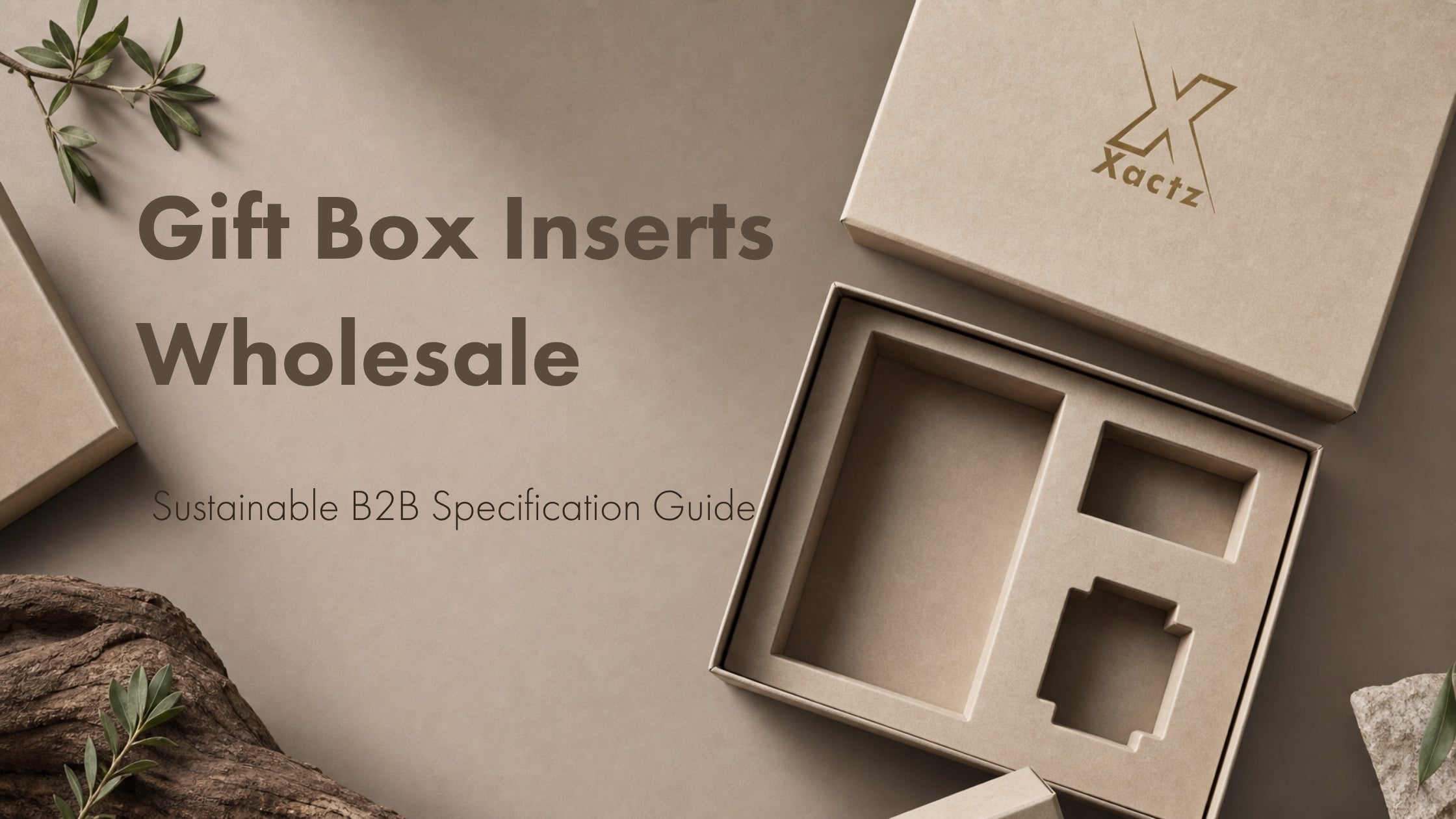
This guide covers every insert material available for custom gift box packaging at wholesale volume, the technical specifications that determine performance, the MOQ and cost implications of each format, and how to derive your insert dimensions directly from your product measurements. Every insert type covered in this guide is available from Xactz, with insert specification included in every quote.
Table of Contents
Why Insert Specification Matters More Than Most Buyers Realise
The insert is the first thing your customer touches when they open the box. Before they see the product clearly, before they read any copy, before they form a conscious opinion about your brand, their hand makes contact with the interior of your packaging. That tactile moment communicates quality, care, and value faster than any visual element.
Beyond the unboxing experience, the insert performs a structural function that the box alone cannot. A rigid gift box holds its shape. The insert holds the product. Without a correctly specified insert, even the most premium box exterior cannot prevent product movement during transit, surface scratching from contact with the box walls, or the visual disappointment of a product sitting loosely in an oversized cavity.
For B2B buyers sourcing at wholesale volume, insert specification also has direct cost implications. The wrong insert material for a given product weight or fragility level results in damage claims, replacement costs, and reputational exposure. The right insert, specified correctly at the brief stage, eliminates these costs entirely.
EVA Foam Inserts: Density Grades, Colour Options and Die-Cut Specifications
EVA foam, ethylene-vinyl acetate, is the most widely used insert material in premium gift box packaging. Its combination of flexibility, durability, closed-cell structure, and die-cut precision makes it the default choice for electronics, luxury goods, cosmetics, tools, and any product requiring a form-fitting cavity.
Density Grades
EVA foam is specified by density, measured in kilograms per cubic metre. The density grade determines the foam's firmness, shock absorption capacity, and surface finish quality.
30 to 40 kg per cubic metre is the entry-level density range. This grade is appropriate for lightweight retail items where the primary function of the insert is presentation rather than impact protection. It compresses easily and is not suitable for products above 500 grams or for transit packaging.
45 to 60 kg per cubic metre is the mid-range grade used for electronics, tools, and products requiring genuine impact absorption. This is the most commonly specified density range for B2B gift box inserts at wholesale volume. It holds die-cut cavity walls firmly, resists compression under product weight, and maintains its shape through repeated handling.
70 kg per cubic metre and above is the high-density grade for heavy or high-value products requiring maximum protection. Medical instruments, precision tools, high-end watches, and products shipped internationally in conditions where transit shock is a known risk are specified at this density. The firmer structure provides superior cavity wall integrity and significantly higher impact resistance.
Colour Options
EVA foam is available in a full colour range. Standard production colours include black, white, grey, navy, and cream. Custom colours are available with a minimum order quantity of 500 units and require a colour match sample approval before production. Black is the most common specification for luxury and electronics packaging. White and cream are standard for cosmetics and jewellery. Custom brand colours are increasingly used by premium brands as a brand consistency measure across the full interior presentation.
Die-Cut Specifications
Die-cut EVA foam inserts are produced using steel-rule dies that cut the cavity shape from a foam sheet. The die is created from your product dimensions and must account for three variables: cavity depth, cavity wall thickness, and surface tolerance.
Cavity depth should be 80 to 90 percent of the product height. A cavity that is too deep buries the product and makes extraction difficult. A cavity that is too shallow allows the product to protrude and shift.
Cavity wall thickness should be a minimum of 8mm on all sides for products up to 500 grams. Products above 500 grams require a minimum 12mm wall to prevent cavity collapse under product weight.
Surface tolerance is the gap between the product and the cavity wall. A tolerance of 0.5mm to 1mm on each side is standard for a secure fit. A tolerance above 2mm on any side will allow product movement and is not acceptable for transit packaging.
Multi-cavity inserts for gift sets require a minimum 10mm foam bridge between each cavity to maintain structural integrity.
Thermoform Inserts: When to Use Them and Minimum Order Implications
Thermoform inserts are produced by heating a plastic sheet and vacuum-forming it over a mould to create a rigid tray with precisely shaped product cavities. They are the standard interior format for cosmetics, electronics retail packaging, and multi-component gift sets where visual product display through the insert is a requirement.
When to Use Thermoform Inserts
Thermoform inserts are the correct specification when the product must be visible within the insert cavity, when the insert must hold multiple components at different heights simultaneously, or when the brand requires a high-gloss interior finish that foam cannot replicate.
They are also the correct choice when the product has an irregular geometry that cannot be accurately reproduced in a die-cut foam cavity. Thermoforming follows the exact contour of the mould, producing a cavity that matches the product surface precisely.
Flocked thermoform inserts, where a velvet-like fibre coating is applied to the plastic surface, combine the structural precision of thermoforming with the tactile premium of fabric. This format is widely used in jewellery, watch, and luxury cosmetics packaging.
Minimum Order Implications
Thermoform inserts require a mould, which is a one-time tooling cost that is amortised across the production run. Mould costs typically range from 300 to 800 USD depending on cavity complexity and the number of cavities per sheet. This tooling cost makes thermoform inserts economically viable from approximately 500 units. Below 500 units, the per-unit tooling cost makes thermoforming significantly more expensive than EVA foam die-cutting, which requires no mould investment.
For brands ordering at 1,000 units and above, thermoform inserts become cost-competitive with high-density EVA foam while offering superior visual presentation and geometric precision.
Paper Pulp Inserts: Sustainability Credentials and Structural Limitations
Moulded paper pulp inserts are produced by forming recycled paper fibre into a three-dimensional tray shape using a mould and a drying process. They are the most sustainable insert format available and are increasingly specified by brands with EU PPWR compliance requirements and ESG reporting obligations.
Sustainability Credentials
Paper pulp inserts are made from recycled paper fibre, are fully recyclable in standard paper waste streams, are compostable, and contain no plastics or synthetic compounds. They are compatible with FSC-certified supply chains and can be documented as part of a monomaterial packaging system when paired with a paper and board box structure.
For brands placing packaging on the EU market from August 2026, paper pulp inserts are one of the most defensible insert formats under PPWR recyclability requirements. A gift box with a paper pulp insert, paper ribbon, and paper-based closure can be declared as a single-material packaging unit, which significantly simplifies EPR registration and recyclability documentation.
Structural Limitations
Paper pulp inserts have meaningful structural limitations that must be understood before specification. They are not suitable for products above approximately 1.5 kilograms because the moulded fibre structure does not provide the same compression resistance as high-density EVA foam. They also cannot replicate the surface precision of thermoform inserts, making them unsuitable for products with tight geometric tolerances or highly irregular shapes.
The surface texture of paper pulp is inherently matte and slightly rough. For luxury brands where the insert surface will be in direct contact with a polished or delicate product surface, a tissue paper or fabric layer between the product and the pulp insert is recommended.
Lead times for paper pulp inserts are longer than foam or cardstock alternatives because the moulding and drying process requires additional production time. Budget a minimum of 5 additional working days over standard foam insert lead times.
Velvet and Fabric Tray Inserts for Jewellery and Cosmetics
Velvet and fabric tray inserts are the standard interior specification for jewellery packaging, watch boxes, high-end cosmetics, and any product category where the tactile quality of the insert surface is a direct component of the perceived product value.
Velvet Inserts
Velvet inserts are produced by applying a flocked velvet surface to a foam or cardboard base tray. The flocking process bonds short fibre strands to the base material using adhesive and an electrostatic charge, creating a uniform, soft surface that protects polished metal, glass, and delicate finishes from scratching.
Standard velvet colours for jewellery packaging are black, white, ivory, navy, and burgundy. Custom colours are available with a minimum order of 500 units. The velvet surface also functions as a grip layer, preventing lightweight items such as rings, earrings, and pendants from shifting within the cavity.
For jewellery packaging specifically, velvet inserts are available in slot configurations for rings, bar configurations for bracelets and bangles, and pad configurations for necklaces and pendants. Each configuration must be specified with the jewellery dimensions to ensure correct slot width and depth.
Fabric Tray Inserts
Fabric tray inserts use a wrapped construction where a fabric layer, typically satin, silk, or microfibre, is stretched over a foam or greyboard base and secured at the underside. This construction is used for cosmetics sets, premium skincare, and gift sets where the brand requires a specific fabric texture or colour that standard velvet flocking cannot replicate.
Satin fabric inserts are the most common specification for cosmetics packaging. The smooth, reflective surface of satin complements product photography and creates a high-contrast visual presentation against dark box exteriors. Microfibre inserts are specified for products with polished surfaces where even the fine texture of satin could cause micro-scratching.
Cardstock and Paper Tray Inserts: The Cost-Effective Middle Ground
Cardstock inserts are die-cut and folded from 350gsm to 400gsm coated or uncoated board to create a tray structure that organises products within the box without the cost of foam or thermoform tooling.
They are the correct specification for lightweight gift sets, product bundles, candles, small leather goods, and any application where the primary function of the insert is organisation and presentation rather than impact protection.
Cardstock inserts require no tooling investment. The die-cut pattern is produced digitally, making them viable from MOQ 100 units and cost-effective at all volume tiers. They can be printed, foil-stamped, or embossed to match the exterior box specification, creating a fully branded interior at a fraction of the cost of foam or thermoform alternatives.
The structural limitation of cardstock inserts is load-bearing capacity. A folded cardstock tray will not support products above approximately 800 grams without deformation. For heavier products, a greyboard-reinforced cardstock insert, where a 1,200gsm greyboard core is wrapped in printed or fabric-covered paper, provides significantly greater structural rigidity while maintaining the cost advantage of a paper-based construction.
EPE Foam Inserts: Lightweight Protection for Fragile Products
Expanded polyethylene foam, EPE, is a lightweight, closed-cell foam used primarily for fragile products requiring shock absorption without the weight penalty of high-density EVA foam. It is the standard insert material for glassware, ceramics, candles, and fragile decorative items shipped in gift boxes.
EPE foam has a lower density than EVA foam, typically 15 to 30 kg per cubic metre, which makes it significantly lighter but also less precise in die-cut applications. Cavity walls in EPE foam compress more easily than EVA, which means EPE is not suitable for products with sharp edges or heavy components that could deform the cavity wall under load.
EPE foam is recyclable in polyethylene waste streams, which gives it a sustainability advantage over non-recyclable foam alternatives. However, it is not compatible with paper recycling streams, which means a gift box with an EPE insert cannot be declared as a monomaterial paper packaging unit for EU PPWR purposes.
How to Specify Insert Dimensions from Your Product Dimensions
Insert specification begins with accurate product measurement. The three dimensions required are length, width, and height, measured at the widest point of the product in each axis. For irregular products, measure the bounding box, the smallest rectangular volume that fully contains the product.
The Specification Formula
Insert outer dimensions must match the internal dimensions of your box exactly. Measure the internal length, width, and depth of your box after production of the golden sample. Do not use nominal box dimensions. Internal dimensions vary by up to 3mm from nominal depending on board grade and construction method.
Cavity length and width should be the product length and width plus 1mm on each side. This gives a 1mm tolerance per wall, which is sufficient for a secure fit without making extraction difficult.
Cavity depth should be 80 to 90 percent of the product height. For a product 50mm tall, specify a cavity depth of 40 to 45mm.
Foam sheet thickness must be at least cavity depth plus 8mm to maintain a solid base beneath the cavity. For a 40mm cavity depth, specify a minimum 48mm foam sheet, rounded up to the nearest standard thickness of 50mm.
For multi-product inserts, add 10mm between each cavity as a minimum bridge width. Bridges narrower than 10mm will compress and allow cavities to merge under product weight.
Providing Dimensions to Your Manufacturer
The most accurate method is to provide a physical product sample alongside your insert brief. The manufacturer's structural engineer will measure the product directly and produce a dieline for approval before cutting the die. If a physical sample is not available, provide a dimensioned technical drawing in PDF or DXF format with all measurements in millimetres. Do not provide dimensions in inches unless your manufacturer confirms they work in imperial units.
Always request a foam sample cut before approving full production. A single die-cut sample costs significantly less than a full production run of incorrectly specified inserts.
Insert Material Comparison: Choosing the Right Format for Your Product
EVA Foam is the best choice for electronics, tools, luxury goods, and any product requiring a precise die-cut cavity with genuine impact protection. Specify at 45 to 60 kg per cubic metre for most B2B applications. No tooling cost. Viable from MOQ 100.
Thermoform is the best choice for cosmetics, multi-component sets, and products requiring high-gloss cavity surfaces or irregular geometries. Requires mould tooling. Economically viable from MOQ 500.
Paper Pulp is the best choice for sustainability-first brands with EU PPWR compliance requirements. Fully recyclable and monomaterial-compatible. Not suitable for products above 1.5 kg. Longer lead times than foam.
Velvet and Fabric Trays are the best choice for jewellery, watches, and premium cosmetics where the insert surface is in direct contact with a polished or delicate product. Available in slot, bar, and pad configurations. MOQ 100 for standard colours.
Cardstock Trays are the best choice for lightweight gift sets, product bundles, and candles where organisation is the primary function. No tooling cost. Printable and brandable. Viable from MOQ 100. Not suitable for products above 800 grams.
EPE Foam is the best choice for fragile items such as glassware, ceramics, and candles requiring lightweight shock absorption. Lower precision than EVA. Not monomaterial-compatible for EU PPWR purposes.
Xactz Insert Specification: Included in Every Quote
At Xactz, insert specification is not a separate service or an additional cost. It is included in every quote as standard.
When you request a quote for a custom gift box from Xactz, our structural engineering team reviews your product dimensions, your box format, your finish specification, and your intended use case, and recommends the correct insert material, density grade, cavity specification, and construction method as part of the initial quote response.
You do not need to arrive at your brief with insert specifications already resolved. That is our job. What you need to provide is your product dimensions, your target MOQ, your surface finish preference, and your sustainability requirements if EU PPWR compliance is a factor.
Xactz manufactures all six insert formats covered in this guide from our 40,000 sqm facilities in Huizhou and Shenzhen. FSC-certified substrates, PFAS-free laminations, and full compliance documentation are available across all paper-based insert formats. EVA foam, EPE foam, thermoform, velvet, and fabric inserts are all produced in-house, with no third-party subcontracting on insert manufacturing.
Every order includes a golden sample with the insert fitted to your product before mass production is approved. Insert fit is verified against your product sample at the golden sample stage, not after a full production run.
If you are ready to specify your gift box insert or want a quote that covers both the box and the interior in a single brief, contact the Xactz team at https://xactz.com/pages/contact-us or browse the full gift box range at https://xactz.com