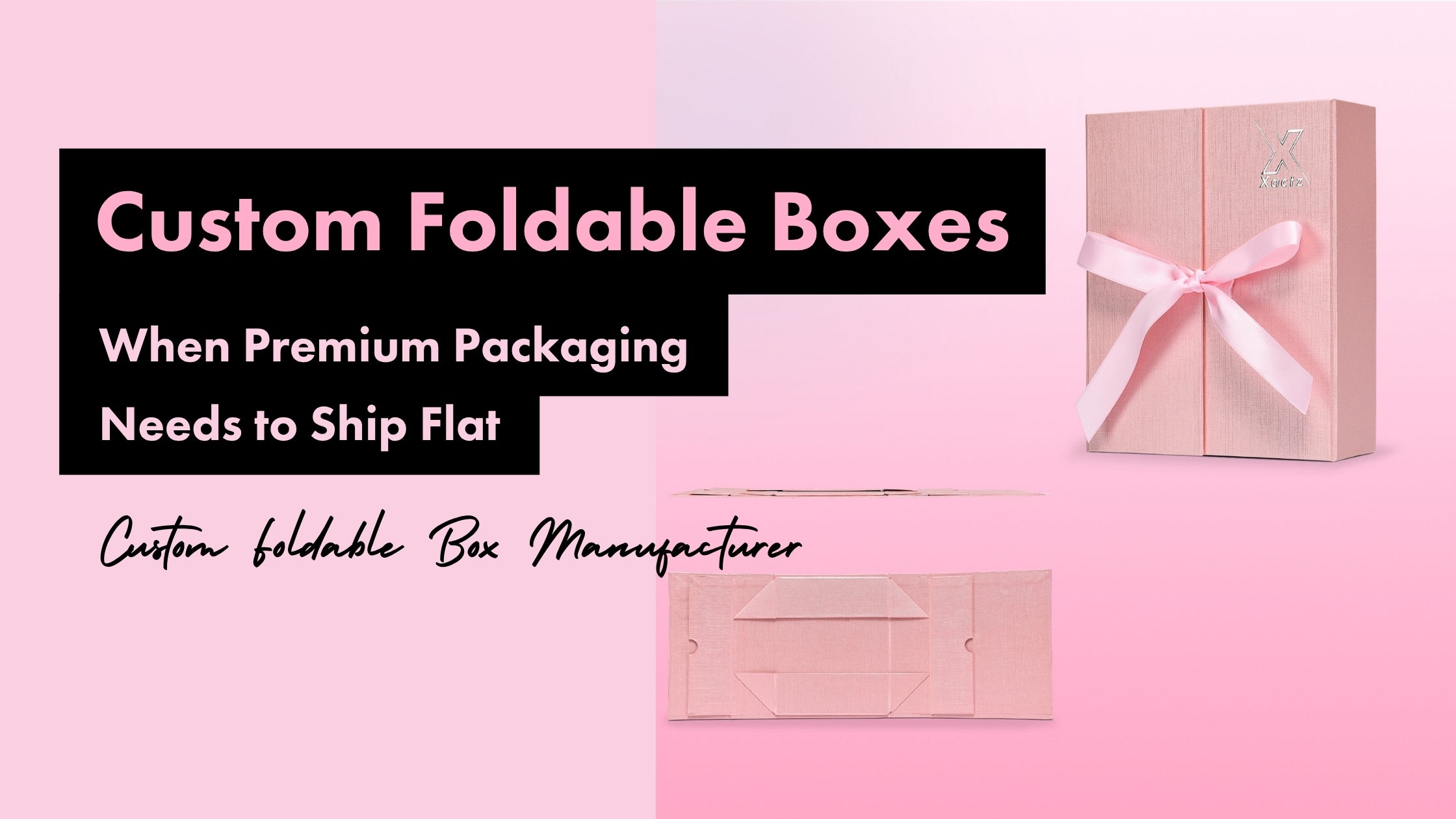
Custom Foldable Boxes, When Premium Packaging Needs to Ship Flat
There is a tension at the heart of premium packaging for DTC and e-commerce brands. On one side: the expectation of a luxury unboxing experience, rigid structure, substantial hand-feel, a presentation that communicates brand value the moment it is held. On the other side: the commercial reality of shipping volume, warehousing costs, and logistics economics that make traditional rigid boxes expensive to store and move before they ever reach a customer.
The foldable box resolves this tension. It ships and stores flat, reducing freight volume by up to 70% compared to a pre-assembled rigid box, and assembles into a fully rigid, premium structure at the point of use. It delivers the brand experience of a set-up box at a fraction of the logistics cost. For DTC brands, subscription services, e-commerce retailers, and any brand managing high shipping volume with strong brand standards, it is one of the most commercially intelligent packaging formats available.
This guide covers everything a serious buyer needs to know: formats, structural mechanics, materials, finishing options, interior construction, assembly methods, pricing, and how to brief a manufacturer correctly.
What Is a Foldable Box?
A foldable box, also called a collapsible rigid box, a flat-pack rigid box, or a foldable set-up box, is a rigid paperboard box engineered with scored fold lines that allow it to collapse flat for shipping and storage, then assemble into a fully rigid three-dimensional structure at the destination.
The key distinction from a standard folding carton is structural: a foldable box uses the same rigid greyboard construction as a traditional set-up box, typically 1,200–2,000 gsm, wrapped in brand-specified material. It is not a thin-wall carton. It is a genuine rigid box that happens to fold flat.
The core structure consists of:
-
Rigid greyboard panels the structural walls, typically 1.5mm–2.0mm, scored at the corners to enable folding
-
Hinge points precision-scored fold lines engineered to fold and unfold repeatedly without cracking or delaminating
-
Closure mechanism magnetic closure (most common), tuck-in flap, ribbon tie, or snap lock
-
Wrap material art paper, textured wrap, leatherette, or specialty paper applied over the greyboard panels
-
Interior lining foam insert, flocked surface, satin lining, or branded paper lining
The fold-flat mechanism is the defining technical variable of this format. Hinge points must be scored precisely enough to fold cleanly without cracking the wrap material, and must be engineered to withstand repeated assembly and disassembly without structural degradation. This is the specification most often under-engineered by lower-quality manufacturers.
Why DTC and E-Commerce Brands Choose Foldable Boxes
1. Freight Volume Reduction of Up to 70%
A pre-assembled rigid box ships as a three-dimensional object, occupying its full volume in every carton, on every pallet, across every freight movement. A foldable box ships flat. The volumetric difference is significant: flat-pack rigid boxes can reduce shipping volume by up to 70% compared to equivalent pre-assembled rigid boxes, directly reducing freight costs, carton counts, and pallet space.
For brands shipping internationally, or managing large seasonal inventory builds, this reduction compounds across every SKU, every shipment, and every storage cycle.
2. Warehousing Efficiency
Flat-pack boxes stack efficiently and occupy a fraction of the warehouse footprint of pre-assembled rigid boxes. For brands managing high SKU counts or seasonal volume spikes, this translates directly into lower warehousing costs and simpler inventory management.
3. No Compromise on Brand Experience
When assembled, a foldable box is structurally indistinguishable from a traditional rigid set-up box. The greyboard construction delivers the same substantial hand-feel. The wrap material carries the same finishing options, soft-touch matte, foil stamping, embossing, spot UV. The interior construction delivers the same premium presentation. The customer receives a luxury unboxing experience. The brand absorbs none of the logistics penalty of a pre-assembled rigid box.
4. Customer Self-Assembly Is Part of the Brand Experience
For subscription and DTC brands, the assembly moment, the customer unfolding the box before placing the product inside, or receiving a flat-packed box that snaps into shape, can itself become a brand touchpoint. The tactile engagement of assembling a well-engineered foldable box communicates craft and precision in a way that a pre-assembled box cannot.
5. Sustainability Credentials
Flat-pack construction reduces the carbon footprint of every freight movement, fewer trucks, fewer flights, fewer emissions per unit delivered. Combined with FSC-certified board and recyclable wrap materials, the foldable box is one of the most sustainability-aligned rigid packaging formats available to premium brands.
Foldable Box Formats, Which Structure Is Right for Your Product?
The most widely specified foldable format. Four rigid panels connected by scored hinge points, with a magnetic closure mechanism integrated into the top flap. Ships completely flat. Assembles by folding the four panels into a rectangular box and engaging the magnets. The magnetic closure delivers a satisfying, premium close that communicates quality at the moment of sealing.
The most popular format across DTC beauty, skincare, wellness, fashion accessories, and premium gifting. The combination of flat-pack logistics efficiency and magnetic closure premium feel makes this the default foldable format for brands entering the rigid box category for the first time.
A two-piece foldable structure, a foldable lid and a foldable base, that ships as two flat panels and assembles into a traditional lid and base box format. Delivers the visual language and brand experience of a classic set-up box with the logistics advantages of flat-pack construction.
Particularly effective for brands that have an established lid and base box identity and want to migrate to flat-pack logistics without changing their exterior brand presentation.
A foldable version of the drawer box format, the outer sleeve and inner tray both fold flat for shipping. The sliding drawer mechanism is engineered into the fold structure. More complex to manufacture than the standard foldable magnetic closure box, but delivers the distinctive drawer-reveal experience in a flat-pack format.
A foldable version of the book-shaped rigid box engineered with a spine hinge that collapses flat for shipping and opens like a hardcover book at the point of use. The two-panel reveal is preserved in the flat-pack format, making this the preferred foldable variant for brands in premium gifting, fashion, and collectibles where the book-open reveal is a non-negotiable brand moment. The spine hinge requires additional engineering precision to maintain fold integrity across repeated open-and-close cycles.
Foldable construction is not limited to rectangular formats. Custom geometric foldable boxes, including triangular, trapezoidal, and brand-specific silhouettes, are engineered with multiple scored hinge points to enable flat-pack collapse of non-standard structures. Particularly popular in premium confectionery, limited edition collections, and brand-identity-led packaging programs where a distinctive silhouette is a core brand asset.
Materials, What Your Foldable Box Is Made From
Greyboard Core
The structural foundation of every foldable box panel. Common thicknesses for foldable construction are 1.5mm and 2.0mm, slightly thinner than standard set-up box construction to allow clean folding at the hinge points without cracking. The hinge points themselves are scored rather than cut, the board fibres are compressed rather than severed, maintaining structural integrity across repeated fold cycles.
Wrap Materials
| Wrap Material |
Character |
Foldable Suitability |
Best For |
| Art Paper |
Smooth, printable, cost-effective |
✅ Excellent |
Full-colour DTC, subscription boxes |
| Textured Wrap |
Tactile grain, premium hand-feel |
✅ Excellent |
Skincare, beauty, wellness |
| Leatherette |
Rich, structured, durable |
✅ Good |
Jewellery, accessories, spirits |
| Linen / Fabric |
Natural, artisanal, warm |
✅ Good |
Candles, lifestyle, gifting |
| Kraft Paper |
Natural, uncoated, sustainable |
✅ Excellent |
Eco-positioned DTC brands |
| Specialty Paper |
Pearlescent, metallic, duplex |
✅ Good |
Limited editions, fashion |
| Velvet |
Ultra-premium, soft |
⚠️ Limited |
Not recommended for hinge points |
Note: Wrap material selection for foldable boxes must account for behaviour at the hinge point. Thicker, less flexible wrap materials (velvet, heavy leatherette) require wider score channels at the hinge to prevent cracking. This must be confirmed at the sample approval stage.
Finishing Options, Where Brand Identity Is Expressed
The foldable box exterior carries the same finishing options as a traditional rigid set-up box. The flat-pack construction does not limit finishing capability, it only requires that finishing is applied in a way that accounts for the fold behaviour at the hinge points.
Surface Lamination
-
Soft-Touch Matte The defining finish of premium DTC packaging. Velvety, tactile, and immediately communicates quality. The most requested finish across prestige DTC brands globally. Performs well at hinge points when applied correctly.
-
Gloss Lamination High-impact, reflective. Effective for bold, fashion-forward brands. Requires careful application at hinge points to prevent cracking on fold.
-
Silk Lamination A refined mid-point between matte and gloss. Clean, smooth, highly printable.
Foil Stamping
-
Gold Foil Prestige, heritage, warmth. The signature finish of luxury gifting and premium DTC.
-
Silver Foil Modern, clinical, precise. Popular in science-led and dermatology-positioned brands.
-
Rose Gold Foil The signature finish of the wellness and beauty-adjacent segment.
-
Holographic Foil For limited editions and design-forward collections.
-
Blind Foil Tone-on-tone brand mark that rewards close inspection.
Embossing and Debossing
Raises or recesses your logo or brand mark into the surface of the box. Particularly effective on soft-touch matte and textured wrap surfaces. The combination of soft-touch matte lamination with a blind debossed logo is one of the most requested finishing combinations in premium DTC packaging.
Spot UV Coating
High-gloss varnish applied selectively over specific design elements, creating a contrast between matte and gloss on the same surface. Must be applied away from hinge points to prevent interference with fold performance.
Full-Wrap CMYK Print
Full-colour printing applied directly to the wrap paper before lamination, enabling photographic imagery, complex pattern work, and full-surface brand expression. The most cost-effective route to high-impact visual design on a foldable box.
Closure Mechanisms, How Your Foldable Box Seals
The closure mechanism is the moment the foldable box transitions from open to sealed, the tactile punctuation mark at the end of the packing sequence. It must be satisfying, reliable, and consistent across thousands of assembly cycles.
| Closure Type |
Feel |
Reliability |
Best For |
| Magnetic Closure |
Premium, satisfying snap |
✅ Excellent |
DTC, gifting, subscription |
| Tuck-In Flap |
Clean, minimal |
✅ Good |
High-volume, cost-sensitive |
| Ribbon Tie |
Artisanal, ceremonial |
✅ Good |
Premium gifting, fashion |
| Snap Lock |
Secure, functional |
✅ Good |
Heavier products, retail |
| Velcro Dot |
Discreet, reusable |
⚠️ Limited |
Reusable packaging programs |
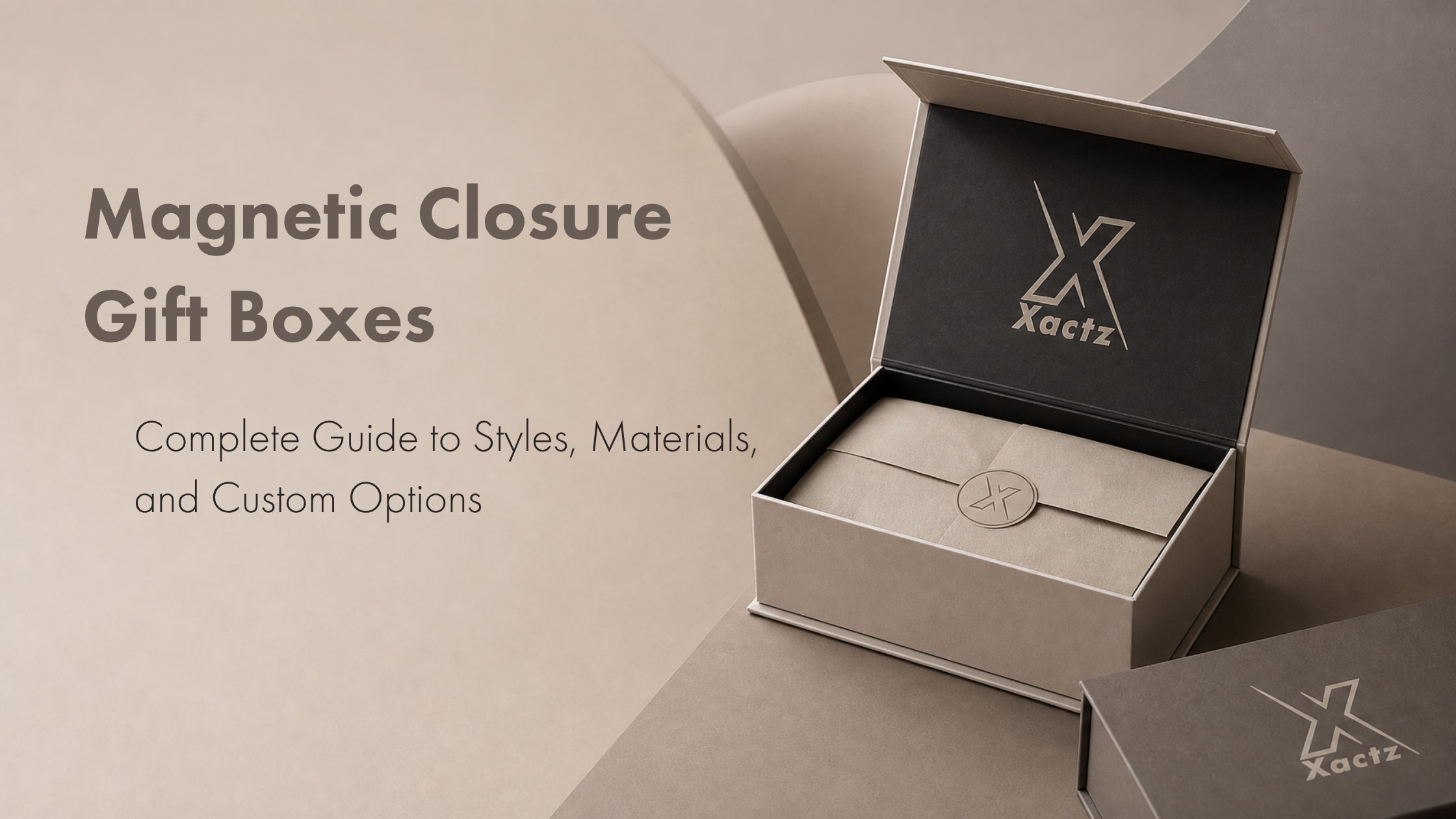
The magnetic closure is the most requested closure mechanism for premium foldable boxes, the neodymium magnets are embedded within the greyboard panels during construction, invisible from the exterior, delivering a clean close with a tactile snap that communicates precision engineering.
Interior Construction, The Moment of Reveal
The interior of a foldable box must hold the product precisely, present it deliberately, and reinforce the brand experience established by the exterior. Interior construction options for foldable boxes are identical to those available for traditional rigid set-up boxes.
| Interior Option |
Function |
Best For |
| Custom Foam Insert |
Precision-cut to product shape, zero movement |
Electronics, jewellery, fragrance |
| Rigid Card Tray |
Structured compartments, clean lines |
Multi-piece sets, gift collections |
| Paper Pulp Tray |
Sustainable, mouldable, FSC-compatible |
Eco-positioned DTC brands |
| Flocked Lining |
Velvet-texture interior, premium hand-feel |
Jewellery, accessories, watches |
| Satin Lining |
Soft, draped interior surface |
Fragrance, fashion, gifting |
| Tissue Paper Layer |
Soft wrap layer, adds reveal sequence |
Fashion, lifestyle, subscription |
| Branded Insert Card |
Brand story, care instructions, QR code |
All DTC categories |
| Ribbon Lift Tab |
Assists product removal from deep base |
All premium categories |
| Divider Tray |
Multi-compartment organisation |
Confectionery, sets, collections |
The DTC Shipping Stack, How Foldable Boxes Fit Into Your Logistics
For DTC and e-commerce brands, the foldable box sits at a specific point in the fulfilment stack, between the brand packaging layer and the outer shipping carton. Understanding how it integrates into your logistics workflow is essential before specifying.
Typical DTC fulfilment sequence with foldable box:
-
Flat-pack foldable boxes arrive at fulfilment centre in flat stacks, maximum density, minimum footprint
-
Fulfilment team assembles the foldable box at the packing station, typically 10–20 seconds per unit for a standard magnetic closure foldable box
-
Product is placed into the assembled box with interior insert
-
Box is sealed magnetic closure engages, ribbon is tied, or flap is tucked
-
Assembled box is placed into outer shipping carton with void fill or tissue
-
Outer carton is sealed and dispatched
The assembly time per unit is the critical operational variable. A well-engineered foldable box assembles in under 20 seconds. A poorly engineered one, with stiff hinge points, misaligned panels, or magnets that require repositioning, adds time and friction to every packing cycle. At volume, this compounds into significant operational cost.
How to Brief a Foldable Box Manufacturer
Getting a foldable box right starts with a complete, precise brief. The hinge point engineering and closure mechanism integration are the most technically demanding variables, and the ones most often under-specified by buyers. Here is what your manufacturer needs before sampling begins:
| Requirement |
Detail to Provide |
| Product Dimensions |
Height, width, depth, and weight, exact measurements with tolerances |
| Format Variant |
Magnetic closure, lid and base, drawer, book-shaped, custom shape |
| Board Thickness |
Typically 1.5mm–2.0mm for foldable construction |
| Closure Mechanism |
Magnetic, tuck-in flap, ribbon tie, snap lock, specify preference |
| Magnet Specification |
Neodymium grade and placement if magnetic closure is specified |
| Wrap Material |
Art paper, textured wrap, leatherette, linen, kraft |
| Finish Requirements |
Soft-touch, foil, emboss, deboss, spot UV, specify per surface |
| Hinge Point Behaviour |
Confirm wrap material suitability for fold performance at sample stage |
| Interior Requirements |
Foam insert, flocked lining, divider tray, ribbon lift, insert card |
| Assembly Time Target |
Specify if operational assembly speed is a constraint |
| Quantity |
MOQ and expected annual volume |
| Sustainability Requirements |
FSC certification, recyclable materials, plastic-free construction |
| Brand Files |
AI or PDF with bleed, fonts embedded, Pantone references |
At Xactz, our MOQ starts at 100 units making premium foldable box packaging accessible to independent DTC brands and scaling labels without requiring high-volume commitments upfront.
What Separates Good Foldable Packaging From Great Foldable Packaging
| Good Foldable Packaging |
Great Foldable Packaging |
| Folds flat for shipping |
Folds flat and assembles in under 20 seconds |
| Standard art paper wrap |
Specialty textured or leatherette wrap matched to brand language |
| Tuck-in flap closure |
Neodymium magnetic closure with calibrated snap feel |
| Hinge points that fold |
Hinge points engineered for 500+ fold cycles without cracking |
| Plain interior |
Custom foam insert, flocked lining, branded insert card |
| Functional flat-pack |
Flat-pack that reduces freight volume by up to 70% |
| Single surface finish |
Layered finish, soft-touch matte with foil and spot UV |
| Standard recyclable materials |
FSC-certified, reusable, zero plastic construction |
Industries That Use Custom Foldable Box Packaging
| Industry |
Common Application |
| DTC Beauty and Skincare |
Hero product launches, subscription boxes, seasonal gift sets |
| Fashion and Accessories |
Scarves, wallets, jewellery, sunglasses, silk ties |
| Premium Confectionery |
Chocolate collections, truffle sets, seasonal gifting |
| Electronics and Wearables |
Earbuds, smartwatches, premium accessories |
| Subscription Boxes |
Monthly product curation, loyalty gifting, welcome kits |
| Corporate Gifting |
Executive gift sets, branded merchandise, event gifting |
| Fragrance and Wellness |
Single product launches, discovery sets, travel collections |
| Jewellery and Watches |
Single piece presentations, collection sets |
| Food and Beverage |
Premium spirits miniatures, artisan food gifting |
Foldable vs Traditional Rigid Box, When to Choose Each
This is the question every DTC and e-commerce brand faces when entering the rigid box category. The answer depends on your logistics model, your brand experience requirements, and your volume profile.
| Factor |
Foldable Box |
Traditional Rigid Box |
| Shipping volume |
Up to 70% less than rigid |
Full volumetric shipping cost |
| Warehousing footprint |
Minimal, flat stacks efficiently |
Significant, pre-assembled volume |
| Brand experience |
Identical to rigid when assembled |
Identical to foldable when assembled |
| Assembly requirement |
Yes, 10–20 seconds per unit |
None, ships pre-assembled |
| Unit cost |
Slightly higher than equivalent rigid |
Slightly lower than equivalent foldable |
| Finishing options |
Full range, identical to rigid |
Full range |
| Interior options |
Full range, identical to rigid |
Full range |
| Best for |
DTC, e-commerce, subscription, high volume |
Retail, wholesale, gifting, low volume |
The rule of thumb: if your product ships direct to consumer and you are managing more than 500 units per month, the logistics savings of a foldable box will outweigh the small unit cost premium within the first shipment cycle.
Frequently Asked Questions
What is the minimum order quantity for custom foldable boxes? At Xactz, our MOQ starts at 100 units. This makes premium foldable box packaging accessible to independent DTC brands and scaling labels without requiring high-volume commitments upfront.
How long does a foldable box take to assemble? A well-engineered foldable magnetic closure box assembles in 10–20 seconds. Assembly time is a function of hinge point precision and closure mechanism design, both of which are confirmed at the sample approval stage.
How many times can a foldable box be assembled and disassembled? A correctly engineered foldable box should withstand 500+ fold cycles without structural degradation or wrap cracking at the hinge points. This specification must be confirmed at the sample approval stage.
Can foldable boxes carry the same finishes as traditional rigid boxes? Yes. Foldable boxes support the full range of rigid box finishing options, soft-touch matte lamination, gloss lamination, hot foil stamping, embossing, debossing, spot UV, and full-wrap CMYK print. Finishing application at hinge points requires specific engineering attention, confirmed at sample stage.
What is the freight volume saving of a foldable box vs a traditional rigid box? Flat-pack foldable boxes can reduce shipping volume by up to 70% compared to equivalent pre-assembled rigid boxes. The exact saving depends on box dimensions and packing configuration.
Are your foldable boxes FSC certified? Yes. Xactz holds FSC™ Chain-of-Custody certification (SGSHK-COC-332603, valid to 2030). FSC-certified foldable boxes are available across all formats and specifications.
Can I get a sample before committing to a full order? Yes. We produce pre-production samples for approval before any full production run begins. Sample lead times and costs are discussed at the briefing stage.
What finishing options are available? We offer 20+ in-house finishing options including soft-touch matte lamination, gloss lamination, hot foil stamping (gold, silver, rose gold, holographic, blind), embossing, debossing, spot UV coating, and full-wrap CMYK print, all applied in-house without outsourcing.
Why Brands Choose Xactz for Custom Foldable Box Packaging
At Xactz, we manufacture custom foldable boxes for DTC brands, e-commerce retailers, and luxury labels across 60+ countries. Our capabilities include:
-
40,000+ sqm across two fully automated facilities in Shenzhen and Huizhou, China
-
300+ specialists including structural engineers, hinge point technicians, and dedicated QC teams
-
20+ in-house finishing options no outsourcing, no quality gaps, no lead time extensions
-
FSC™ Certified (SGSHK-COC-332603, valid to 2030) and ISO 9001:2015 quality management
-
TÜV Rheinland Verified Supplier independently audited and certified
-
10–18 day production turnaround from sample approval, rush orders available
- Scalable from 100 to 1,000,000+ units
-
Global delivery to 60+ countries with full export documentation
Every foldable box we manufacture passes through a dedicated QC process, checking hinge point integrity, fold cycle performance, closure mechanism function, finish quality, and interior insert precision before it leaves our facility.
Final Thoughts
The foldable box is not a compromise. It is not a budget alternative to a traditional rigid set-up box. It is a structurally engineered solution to a specific commercial problem, the problem of delivering a luxury brand experience through a logistics channel that penalises volume and rewards density.
For DTC and e-commerce brands managing high shipping volume with strong brand standards, it is one of the most commercially intelligent packaging decisions available. It reduces freight cost. It reduces warehousing cost. It delivers an identical brand experience to the customer. And when engineered correctly, with precision hinge points, calibrated magnetic closure, and a premium finish that performs across hundreds of fold cycles, it is a packaging format that earns its place in any brand's packaging strategy.
Get the hinge points right. Specify the closure mechanism with precision. Choose the wrap and finish that reflects your brand language. Brief your manufacturer with the assembly time and fold cycle requirements your fulfilment operation demands. And work with a partner who understands that in premium DTC packaging, the moment the box snaps shut is the moment your brand either earns or loses the customer's trust.
Ready to develop your custom foldable box packaging? Contact the Xactz team for a no-obligation consultation and sample quote.
👉 Get in Touch with Xactz