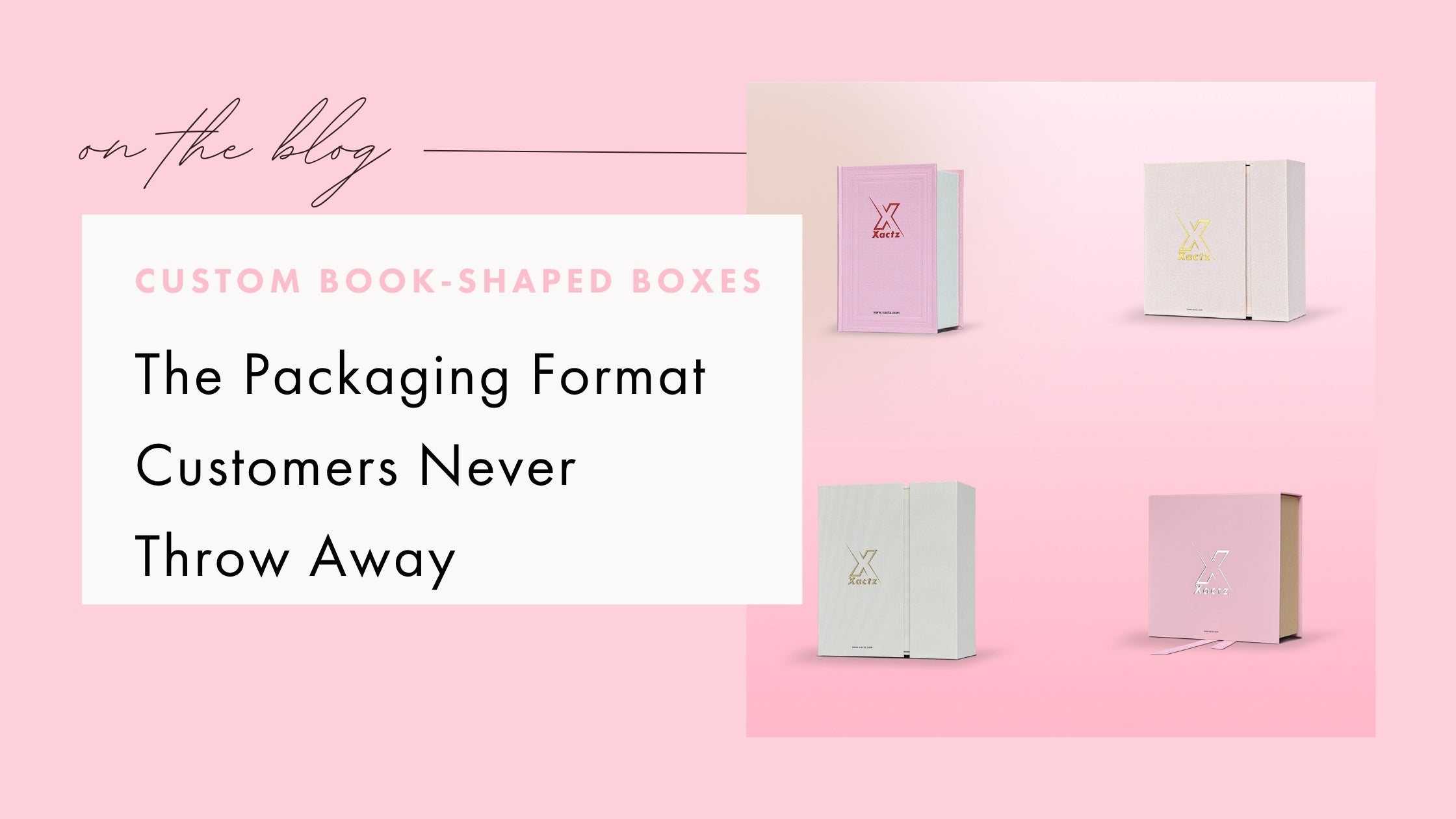
Custom Book-Shaped Boxes, The Packaging Format Customers Never Throw Away
Most packaging gets thrown away. The outer carton goes into recycling. The tissue paper gets bundled up. The insert card gets set aside. The box itself, if it is a standard folding carton or a plain rigid box, gets broken down and discarded within minutes of the product being removed.
The book-shaped box does not get thrown away.
It gets placed on a shelf. It gets repurposed as a keepsake box, a jewellery organiser, a desk accessory, a storage piece. It gets photographed and shared. It gets kept because it is too well-made, too beautiful, and too structurally satisfying to discard. In a category where most packaging is a cost centre, the book-shaped box is one of the few formats that generates ongoing brand exposure long after the purchase is made, sitting on a customer's shelf, in their home, in their workspace, continuing to communicate your brand identity every day it remains in use.
This is the defining commercial advantage of the book-shaped box: it is the packaging format with the highest retention rate in luxury packaging. And for brands that understand the lifetime value of a customer relationship, that retention is not a nice-to-have, it is a measurable brand asset.
This guide covers everything a serious buyer needs to know: structure, formats, materials, finishing, interior construction, the reusability engineering that separates a book-shaped box customers keep from one they discard, pricing, and how to brief a manufacturer correctly.
What Is a Book-Shaped Box?
A book-shaped box, also called a clamshell book box, a hardcover gift box, or a book-style rigid box, is a rigid paperboard box engineered to open like a hardcover book. The two panels, front cover and back cover, are connected by a fabric or paper-wrapped spine hinge, and the interior reveals a full-depth base cavity when opened. The opening motion is a single, deliberate rotation, the same physical gesture as opening a book, that creates a moment of anticipation and reveal that no other packaging format replicates.
The structure consists of:
-
Two rigid greyboard panels front cover and back cover, typically 2.0mm–2.5mm greyboard, wrapped in brand-specified material
-
Spine hinge a fabric, paper, or ribbon-wrapped hinge connecting the two panels, engineered to open and close repeatedly without cracking or delaminating
-
Interior base cavity a full-depth rigid tray, lined in foam, flocked material, satin, or branded paper, holding the product precisely
-
Closure mechanism magnetic closure (most common), ribbon tie, elastic band, or clasp
-
Interior lining foam insert, flocked surface, satin lining, or branded paper lining
The spine hinge is the defining technical variable of this format. It must be engineered to open smoothly, hold its position at 90 and 180 degrees, and withstand hundreds of open-and-close cycles without structural degradation. A book-shaped box that hinges stiffly, closes unevenly, or cracks at the spine after a dozen uses is not a book-shaped box customers keep, it is one they discard.
Why Customers Keep Book-Shaped Boxes
1. Structural Utility, It Functions as a Storage Object
A book-shaped box, when closed, is a rigid, stackable, shelf-ready object with a defined interior cavity. It functions naturally as a storage box for jewellery, keepsakes, letters, small accessories, or any personal item the customer values. The interior, particularly when lined with flocked material or satin, is inherently suitable for storing delicate objects. The customer does not need to repurpose it. It is already a storage object.
2. Aesthetic Value, It Belongs on a Shelf
The book-shaped box is the only packaging format that is visually at home on a bookshelf. Its proportions, its spine, its cover, all communicate the language of a cherished object rather than a disposable container. A well-finished book-shaped box with a foil-stamped cover, a textured wrap, and a branded spine is indistinguishable from a premium hardcover edition. It belongs in a home. It belongs on display.
3. The Psychology of the Book Format
Books are culturally coded as objects of value, objects that are kept, collected, and displayed. When a brand delivers its product in a book-shaped box, it inherits that cultural coding. The customer's instinct is not to discard it. The instinct is to keep it. This is not a marketing claim, it is a documented behavioural pattern across premium gifting, fashion, beauty, and collectibles categories globally.
4. Social Sharing and UGC Generation
The book-open reveal is one of the most photographed unboxing moments in premium DTC packaging. The single-motion reveal, cover opens, product is presented, is visually clean, cinematically satisfying, and inherently shareable. Brands using book-shaped boxes consistently report higher rates of unboxing content creation and social sharing compared to standard rigid box formats.
Book-Shaped Box Formats, Which Structure Is Right for Your Product?
Standard Single-Panel Book Box
The foundational format. A single front cover opens on a spine hinge to reveal the full interior base cavity. Clean, minimal, and structurally elegant. The most widely specified book-shaped box format across premium beauty, fashion, jewellery, and gifting. The interior depth can be engineered to accommodate products from 10mm to 120mm deep.
Double-Panel Book Box
Two front panels open simultaneously from a central spine, like a gatefold album cover or a double-door reveal. The opening motion is symmetrical, ceremonial, and dramatically more impactful than a single-panel open. Particularly effective for multi-piece gift sets, collection launches, and brand moments where the reveal itself is a core part of the brand experience.
Book Box with Ribbon
A standard book-shaped box with a ribbon integrated into the spine, the ribbon functions as both a decorative element and a structural reinforcement of the hinge. Particularly popular in premium gifting, fashion, and wedding-adjacent categories where the ribbon tie adds a ceremonial quality to the opening sequence.
Foldable Book-Shaped Box (Flat-Pack)
A book-shaped box engineered with a collapsible spine hinge that allows the structure to fold flat for shipping and storage, then assemble into a fully rigid book-shaped box at the point of use. Delivers the book-open reveal experience with the logistics advantages of flat-pack construction, up to 70% reduction in shipping volume compared to a pre-assembled book box. The spine hinge requires additional engineering precision to maintain fold integrity across repeated open-and-close cycles. For a full breakdown of flat-pack rigid box logistics, see our guide to Custom Foldable Boxes.
Oversized Book Box (Coffee Table Format)
A large-format book-shaped box engineered at coffee table book proportions, typically 300mm × 250mm or larger. Used for premium brand anthologies, limited edition collections, corporate gifting programs, and brand experience packaging where the physical scale of the box is itself a brand statement. The greyboard thickness for oversized formats is typically 2.5mm–3.0mm to maintain structural rigidity at scale.
Book Box with Interior Compartments
A book-shaped box with a structured interior, rigid card dividers, custom foam inserts, or multi-tier tray systems, that organises multiple products within the single book-open reveal. Particularly effective for discovery sets, collection launches, and multi-SKU gift packaging where the interior layout is as deliberate as the exterior presentation.
Materials, What Your Book-Shaped Box Is Made From
Greyboard Core
The structural foundation of every book-shaped box panel. Standard thickness for book-shaped boxes is 2.0mm–2.5mm, heavier than standard rigid box construction to deliver the substantial hand-feel and structural rigidity that communicates premium quality. The spine hinge uses a thinner, more flexible board section, typically 0.5mm–1.0mm, to enable smooth, controlled opening without cracking.
Wrap Materials
| Wrap Material |
Character |
Spine Suitability |
Best For |
| Art Paper |
Smooth, printable, cost-effective |
✅ Excellent |
Full-colour DTC, beauty, wellness |
| Textured Wrap |
Tactile grain, premium hand-feel |
✅ Excellent |
Skincare, fashion, gifting |
| Leatherette |
Rich, structured, durable |
✅ Good |
Jewellery, accessories, spirits |
| Linen / Fabric |
Natural, artisanal, warm |
✅ Excellent |
Candles, lifestyle, gifting |
| Velvet |
Ultra-premium, soft |
⚠️ Spine only |
Jewellery, watches, high-end gifting |
| Kraft Paper |
Natural, uncoated, sustainable |
✅ Excellent |
Eco-positioned DTC brands |
| Specialty Paper |
Pearlescent, metallic, duplex |
✅ Good |
Limited editions, fashion |
Note: The spine wrap must be flexible enough to accommodate repeated open-and-close cycles without cracking or delaminating. Wrap material selection for the spine must be confirmed at the sample approval stage, particularly for leatherette and specialty paper variants.
Finishing Options, Where Brand Identity Is Expressed
The book-shaped box exterior, front cover, back cover, and spine, is a canvas for brand expression. The cover proportions and the deliberate, book-like presentation make finishing choices more visible and more impactful on a book-shaped box than on almost any other rigid box format.
Surface Lamination
-
Soft-Touch Matte The defining finish of premium DTC packaging. Velvety, tactile, and immediately communicates quality. Particularly effective on book-shaped boxes where the cover is held and handled repeatedly. The most requested finish across prestige DTC brands globally.
-
Gloss Lamination High-impact, reflective. Effective for bold, fashion-forward brands. Creates a visual contrast with foil stamping that reads as confident and premium.
-
Silk Lamination A refined mid-point between matte and gloss. Clean, smooth, highly printable.
Foil Stamping
-
Gold Foil Prestige, heritage, warmth. The signature finish of luxury gifting and premium DTC. On a book-shaped box cover, gold foil stamping reads as a publisher's mark, communicating craft and permanence.
-
Silver Foil Modern, clinical, precise. Popular in science-led and dermatology-positioned brands.
-
Rose Gold Foil The signature finish of the wellness and beauty-adjacent segment.
-
Holographic Foil For limited editions and design-forward collections.
-
Blind Foil Tone-on-tone brand mark that rewards close inspection. The most sophisticated foil option for brands with strong typographic identity.
Embossing and Debossing
Raises or recesses your logo or brand mark into the surface of the cover. On a book-shaped box, embossing and debossing carry particular visual weight, the cover proportions make the raised or recessed mark read as a publisher's imprint or a hallmark. The combination of soft-touch matte lamination with a blind debossed logo is one of the most requested finishing combinations in premium book-shaped box packaging.
Spine Title Printing
One of the most distinctive finishing options unique to the book-shaped box format. Brand name, product name, or collection title printed or foil-stamped along the spine, exactly as a book title appears on a hardcover spine. When the box is placed on a shelf with the spine facing outward, the brand mark is visible and legible from across the room. This is the finishing detail that most directly drives the shelf-retention behaviour that defines this format.
Spot UV Coating
High-gloss varnish applied selectively over specific design elements, creating a contrast between matte and gloss on the same surface. Particularly effective on book-shaped box covers where the contrast reads as a design-forward, editorial choice.
Full-Wrap CMYK Print
Full-colour printing applied directly to the wrap paper before lamination, enabling photographic imagery, complex pattern work, and full-surface brand expression across the front cover, back cover, and spine. The most cost-effective route to high-impact visual design on a book-shaped box.
Closure Mechanisms, The Moment the Book Seals
The closure mechanism of a book-shaped box is the tactile punctuation mark at the end of the opening sequence, and the first physical interaction the customer has with the box before the reveal. It must be satisfying, reliable, and consistent across hundreds of open-and-close cycles.
| Closure Type |
Feel |
Reliability |
Best For |
| Magnetic Closure |
Premium, satisfying snap |
✅ Excellent |
DTC, gifting, subscription |
| Ribbon Tie |
Artisanal, ceremonial |
✅ Good |
Premium gifting, fashion, wedding |
| Elastic Band |
Minimal, editorial |
✅ Good |
Fashion, lifestyle, stationery-adjacent |
| Clasp / Latch |
Mechanical, precise |
✅ Good |
Jewellery, watches, collectibles |
| Tuck-In Flap |
Clean, minimal |
✅ Good |
High-volume, cost-sensitive |
The magnetic closure is the most requested closure mechanism for premium book-shaped boxes, neodymium magnets embedded within the cover panels deliver a clean, invisible close with a tactile snap that communicates precision engineering. The magnets are positioned to align precisely when the cover closes, ensuring a flush, gap-free seal across hundreds of open-and-close cycles.
Interior Construction, The Moment of Reveal
The interior of a book-shaped box is the stage on which the product is presented. It must hold the product precisely, present it deliberately, and reinforce the brand experience established by the exterior. The book-open reveal creates a single, unified moment of presentation, the entire interior is visible in one motion, which means interior construction decisions carry more visual weight than in any other rigid box format.
| Interior Option |
Function |
Best For |
| Custom Foam Insert |
Precision-cut to product shape, zero movement |
Electronics, jewellery, fragrance, watches |
| Flocked Lining |
Velvet-texture interior, premium hand-feel |
Jewellery, accessories, watches, collectibles |
| Satin Lining |
Soft, draped interior surface |
Fragrance, fashion, gifting |
| Rigid Card Tray |
Structured compartments, clean lines |
Multi-piece sets, gift collections |
| Paper Pulp Tray |
Sustainable, mouldable, FSC-compatible |
Eco-positioned DTC brands |
| Tissue Paper Layer |
Soft wrap layer, adds reveal sequence |
Fashion, lifestyle, subscription |
| Branded Insert Card |
Brand story, care instructions, QR code |
All DTC categories |
| Ribbon Lift Tab |
Assists product removal from deep base |
All premium categories |
| Divider Tray |
Multi-compartment organisation |
Confectionery, sets, collections |
| Mirror Insert |
Functional interior surface |
Beauty, cosmetics, accessories |
The interior lining material is the first surface the customer sees when the book opens. It sets the emotional register of the reveal before the product is even visible. A flocked black interior communicates jewellery-grade precision. A cream satin interior communicates bridal softness. A white foam insert communicates clinical, technology-grade care. Choose the interior lining with the same intentionality as the exterior finish.
Engineering the Reusability, What Makes a Book Box Worth Keeping
The retention rate of the book-shaped box is not guaranteed by the format alone. It is earned by the engineering decisions that determine whether the box functions as a durable, beautiful object after the product has been removed. These are the specifications that separate a book-shaped box customers keep from one they discard.
Spine Hinge Durability
The spine hinge must be engineered to withstand 500+ open-and-close cycles without cracking, delaminating, or losing its smooth opening motion. This requires the correct combination of hinge board thickness, wrap material flexibility, and adhesive specification. A spine that cracks after 20 uses destroys the retention value of the format entirely. Confirm hinge cycle performance at the sample approval stage.
Cover Rigidity
The greyboard panels must be thick enough, typically 2.0mm–2.5mm, to maintain their shape and rigidity after the product has been removed and the box is repurposed for storage. A cover that warps, bows, or loses its flat profile after a few weeks of use communicates poor manufacturing quality and accelerates discard.
Closure Precision
The magnetic closure must align precisely every time the cover closes, flush panels, no gap, consistent snap force across hundreds of cycles. Magnets that misalign, weaken over time, or require repositioning to engage destroy the premium feel of the format. Neodymium magnet grade and placement must be confirmed at the sample approval stage.
Interior Lining Durability
The interior lining, particularly flocked and satin surfaces, must maintain its appearance and texture after repeated use as a storage surface. Flocking that pills, satin that frays, or foam that compresses permanently after first use eliminates the functional utility that drives retention. Lining material and adhesive specification must be confirmed at the sample approval stage.
Spine Title and Cover Finish Durability
The spine title and cover finish must resist scuffing, fading, and wear across the handling cycles of a retained object. Soft-touch matte lamination with foil stamping is the most durable combination for a book-shaped box intended for long-term retention, the lamination protects the print surface and the foil resists wear better than standard CMYK ink.
The Reusability Angle, Why It Matters for Your Brand
Every day a customer keeps your book-shaped box on their shelf is a day your brand is present in their home. Every time they open it to retrieve a piece of jewellery, store a keepsake, or show it to a visitor, your brand mark, on the cover, on the spine, is seen and registered. This is not passive brand exposure. It is active, repeated, high-quality brand presence in the most intimate space a customer occupies.
The commercial implications are significant:
-
Brand recall Repeated exposure to your brand mark in a domestic setting drives recall at the next purchase decision
-
Social proof A book-shaped box on a shelf is visible to every visitor to that home, a physical word-of-mouth touchpoint
-
UGC generation Customers who keep and display your packaging create organic content that reaches their networks without any media spend
-
Perceived value elevation A brand whose packaging is worth keeping is perceived as a brand whose products are worth buying again
No other packaging format delivers this combination of retention, visibility, and brand presence at the unit economics of a rigid box. The book-shaped box is not a packaging cost. It is a brand investment with a measurable return.
How to Brief a Book-Shaped Box Manufacturer
Getting a book-shaped box right starts with a complete, precise brief. The spine hinge engineering, closure mechanism integration, and interior lining specification are the most technically demanding variables, and the ones most often under-specified by buyers. Here is what your manufacturer needs before sampling begins:
| Requirement |
Detail to Provide |
| Product Dimensions |
Height, width, depth, and weight, exact measurements with tolerances |
| Format Variant |
Single-panel, gatefold, ribbon spine, foldable, oversized, compartmented |
| Cover Board Thickness |
Typically 2.0mm–2.5mm for standard book-shaped boxes |
| Spine Hinge Specification |
Wrap material, hinge board thickness, open angle requirement |
| Closure Mechanism |
Magnetic, ribbon tie, elastic band, clasp, specify preference |
| Magnet Specification |
Neodymium grade and placement if magnetic closure is specified |
| Wrap Material |
Art paper, textured wrap, leatherette, linen, kraft, specify per surface |
| Finish Requirements |
Soft-touch, foil, emboss, deboss, spot UV, specify per surface |
| Spine Title |
Text, font, and finish for spine title printing if required |
| Interior Lining |
Foam insert, flocked lining, satin, divider tray, ribbon lift, insert card |
| Hinge Cycle Requirement |
Specify minimum open-and-close cycle performance for retention use case |
| Quantity |
MOQ and expected annual volume |
| Sustainability Requirements |
FSC certification, recyclable materials, plastic-free construction |
| Brand Files |
AI or PDF with bleed, fonts embedded, Pantone references |
At Xactz, our MOQ starts at 100 units, making premium book-shaped box packaging accessible to independent DTC brands and scaling labels without requiring high-volume commitments upfront.
What Separates Good Book-Shaped Packaging From Great Book-Shaped Packaging
| Good Book-Shaped Packaging |
Great Book-Shaped Packaging |
| Opens like a book |
Opens smoothly with calibrated spine resistance, holds at 90° and 180° |
| Standard art paper wrap |
Specialty textured or linen wrap matched to brand language |
| Tuck-in flap closure |
Neodymium magnetic closure with calibrated snap feel |
| Spine that opens |
Spine engineered for 500+ open-and-close cycles without cracking |
| Plain interior |
Flocked lining, custom foam insert, branded insert card |
| Cover with logo |
Spine title printed or foil-stamped for shelf-facing brand visibility |
| Single surface finish |
Layered finish, soft-touch matte with foil and blind deboss |
| Standard recyclable materials |
FSC-certified, reusable, zero plastic construction |
Industries That Use Custom Book-Shaped Box Packaging
| Industry |
Common Application |
| Jewellery and Watches |
Single piece presentations, collection sets, anniversary editions |
| Premium Beauty and Skincare |
Hero product launches, discovery sets, seasonal gift collections |
| Fashion and Accessories |
Scarves, silk ties, wallets, sunglasses, limited edition pieces |
| Fragrance and Perfumery |
Single bottle presentations, discovery collections |
| Premium Confectionery |
Chocolate collections, truffle sets, seasonal gifting |
| Corporate Gifting |
Executive gift sets, branded merchandise, event gifting, brand anthologies |
| Collectibles and Limited Editions |
Brand anniversary editions, artist collaborations, numbered collections |
| Wedding and Bridal |
Invitation suites, gift packaging, keepsake boxes |
| Spirits and Wine |
Premium bottle presentations, tasting collections |
| Publishing and Media |
Brand books, lookbooks, press kits in book format |
Frequently Asked Questions
What is the minimum order quantity for custom book-shaped boxes? At Xactz, our MOQ starts at 100 units. This makes premium book-shaped box packaging accessible to independent DTC brands and scaling labels without requiring high-volume commitments upfront.
How many times can a book-shaped box be opened and closed? A correctly engineered book-shaped box should withstand 500+ open-and-close cycles without spine cracking, delamination, or loss of smooth opening motion. This specification must be confirmed at the sample approval stage.
Can a book-shaped box be used as a storage box after the product is removed? Yes, and this is the defining commercial advantage of the format. A well-engineered book-shaped box with a flocked or satin interior is structurally and aesthetically suited for use as a keepsake box, jewellery organiser, or storage piece. This retention behaviour drives ongoing brand exposure long after the initial purchase.
What finishing options are available for book-shaped boxes? We offer 20+ in-house finishing options including soft-touch matte lamination, gloss lamination, hot foil stamping (gold, silver, rose gold, holographic, blind), embossing, debossing, spot UV coating, spine title printing, and full-wrap CMYK print, all applied in-house without outsourcing.
Can the spine have a printed title like a real book? Yes. Spine title printing, brand name, product name, or collection title printed or foil-stamped along the spine, is one of the most distinctive finishing options available for book-shaped boxes. It is the detail most directly responsible for the shelf-retention behaviour that defines this format.
Are your book-shaped boxes FSC certified? Yes. Xactz holds FSC™ Chain-of-Custody certification (SGSHK-COC-332603, valid to 2030). FSC-certified book-shaped boxes are available across all formats and specifications.
Can I get a sample before committing to a full order? Yes. We produce pre-production samples for approval before any full production run begins. Sample lead times and costs are discussed at the briefing stage.
What is the difference between a book-shaped box and a clamshell box? A book-shaped box opens on a spine hinge, one panel rotates away from the other in a single, book-like motion. A clamshell box opens on a hinge at the base, the top half lifts away from the bottom half. The book-shaped box delivers a more deliberate, ceremonial reveal and a more shelf-friendly closed profile.
Why Brands Choose Xactz for Custom Book-Shaped Box Packaging
At Xactz, we manufacture custom book-shaped boxes for DTC brands, luxury labels, and corporate gifting programs across 60+ countries. Our capabilities include:
-
40,000+ sqm across two fully automated facilities in Shenzhen and Huizhou, China
-
300+ specialists including structural engineers, spine hinge technicians, and dedicated QC teams
-
20+ in-house finishing options no outsourcing, no quality gaps, no lead time extensions
-
FSC™ Certified (SGSHK-COC-332603, valid to 2030) and ISO 9001:2015 quality management
-
TÜV Rheinland Verified Supplier independently audited and certified
-
10–18 day production turnaround from sample approval, rush orders available
- Scalable from 100 to 1,000,000+ units
-
Global delivery to 60+ countries with full export documentation
Every book-shaped box we manufacture passes through a dedicated QC process, checking spine hinge integrity, open-and-close cycle performance, closure mechanism function, finish quality, and interior insert precision before it leaves our facility.
Final Thoughts
The book-shaped box earns its place in a brand's packaging strategy not because it is the most technically complex rigid box format, though the spine hinge engineering demands genuine precision, but because it is the format most aligned with the long-term economics of brand building.
Packaging that gets thrown away delivers its brand value once, at the moment of unboxing, and then disappears. Packaging that gets kept delivers its brand value every day it remains in use, on a shelf, in a home, in a workspace, in the peripheral vision of the customer and everyone who visits them.
The book-shaped box is the packaging format customers never throw away. That is not a marketing claim. It is an engineering outcome, the result of a spine that opens smoothly, a cover that holds its shape, a closure that snaps with precision, and an interior that functions as a storage surface worth using. Get those specifications right, and your packaging becomes a permanent fixture in your customer's life.
That is the return on investment no media budget can replicate.
Ready to develop your custom book-shaped box packaging? Contact the Xactz team for a no-obligation consultation and sample quote.
👉 Get in Touch with Xactz