Use less text on mobile!
EXACTLY WHAT YOU NEED
EVERYTHING CUSTOMIZABLE
Use less text on mobile!
FEEL THE LUXURY
CONTACT US TO GET A QUOTE AS YOU NEED
EXACTLY WHAT YOU NEED
EVERYTHING CUSTOMIZABLE
CONTACT US & GET YOUR QUOTE
FEEL THE LUXURY
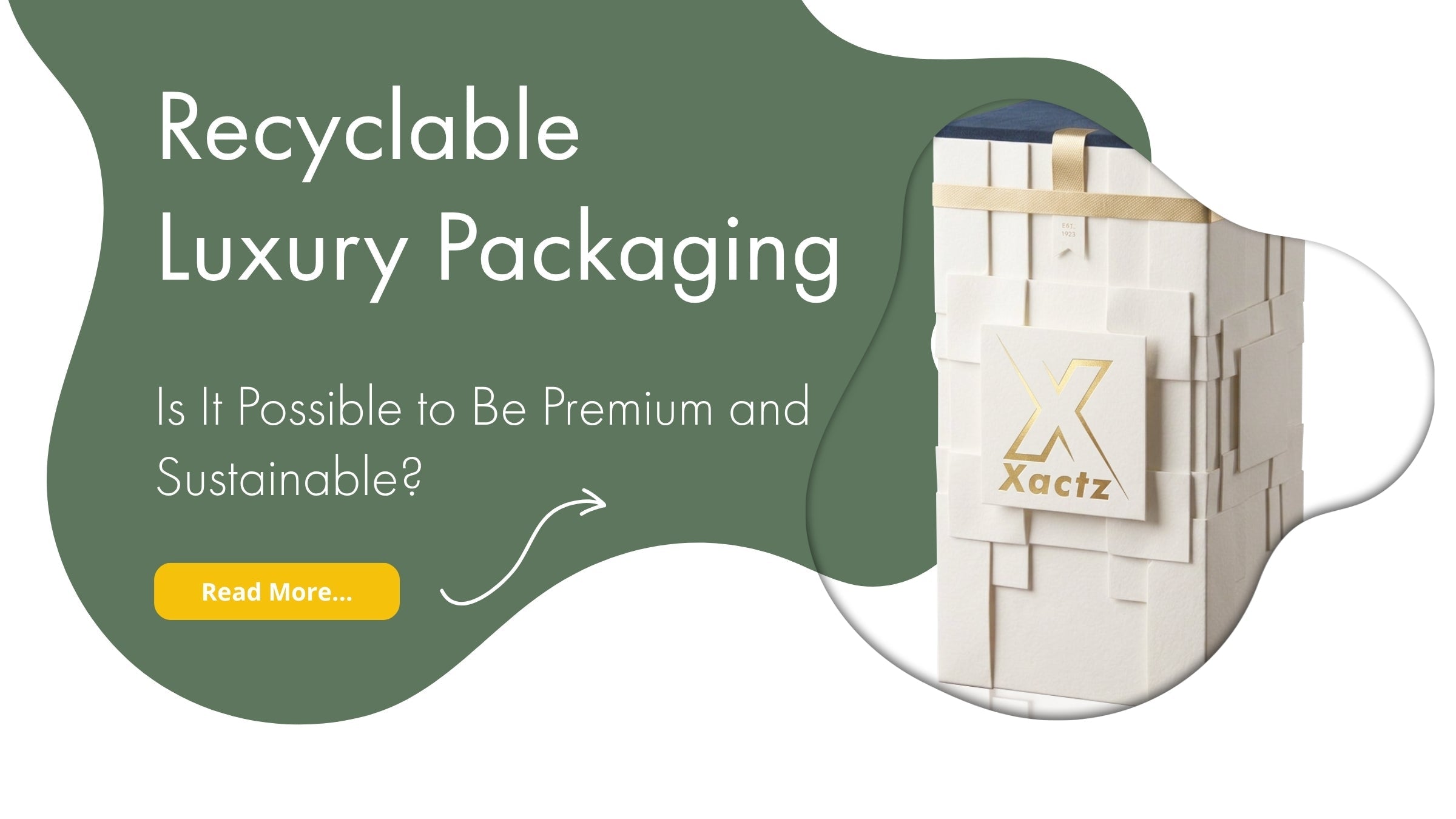
By Xactz Packaging
May 10, 2026
Add a comment
There is a question that comes up in almost every conversation we have with premium brands about sustainability. It is not a question about materials or certifications or carbon footprints. It is a more fundamental question, one that sits at the intersection of brand identity and commercial responsibility.
Can packaging be genuinely recyclable and still feel genuinely luxurious?
The honest answer is yes. But the longer answer is more important, because understanding how it is possible, and where the real trade-offs lie, is what separates brands that lead on sustainability from brands that merely claim it.
This guide covers the full picture: the consumer demand data, the material science, the finishing options that work, the ones that compromise recyclability, and how to brief a manufacturer to deliver packaging that is both premium and genuinely sustainable.
Sustainability is no longer a niche concern for a subset of eco-conscious consumers. It has become a mainstream commercial expectation, and the data is unambiguous.
According to McKinsey's 2025 global packaging survey, covering more than 11,000 respondents across 11 countries, recyclability is now viewed as the most critical sustainability trait globally. The majority of respondents across all surveyed countries indicated willingness to pay more for sustainable packaging, with younger and higher-income consumers showing the strongest preference.
Shorr's 2025 Sustainable Packaging Consumer Report, surveying 2,016 American consumers, found that 90% of consumers are more likely to purchase from a brand whose packaging is eco-friendly, and 54% reported deliberately choosing products with sustainable packaging in the past six months. Among Millennials and Gen Z, the primary growth demographic for premium DTC brands, those figures rise to 59% and 56% respectively.
Perhaps most commercially significant: 39% of consumers have already switched to a competing brand because it offered more sustainable packaging. And nearly three-quarters (73%) say they are open to making that switch.
For luxury and premium brands, this data reframes the sustainability question entirely. It is no longer a question of whether to invest in recyclable packaging. It is a question of how to do it without compromising the brand experience that justifies the premium price point.
The assumption that luxury and sustainability are in conflict comes from a specific place: the visual and tactile vocabulary of traditional luxury packaging. Heavy greyboard. Multi-layer lamination. Metallic foil across large surface areas. Velvet lining. Magnetic closures with embedded hardware. Plastic film overwrap.
Many of these elements, in their traditional specification, do compromise recyclability. Multi-layer lamination bonds dissimilar materials that cannot be separated in a standard recycling stream. Plastic film overwrap is rarely collected for recycling at scale. Velvet and fabric linings contaminate paper recycling.
But the assumption that luxury requires these elements, in their traditional form, is the assumption worth challenging. Because in almost every case, there is a specification that delivers the same sensory experience, the same structural integrity, and the same brand signal, using materials that are either fully recyclable, FSC-certified, or designed for disassembly.
The tension is real. But it is an engineering problem, not a brand identity problem.
Before specifying recyclable luxury packaging, it is important to understand what recyclability actually means in a packaging context, because the term is used loosely, and the difference between genuinely recyclable and technically recyclable matters.
The most recyclable packaging is made from a single material class, typically paper and board, with no bonded dissimilar materials that cannot be separated in a standard recycling stream. A rigid greyboard box wrapped in uncoated kraft paper with no lamination film is fully recyclable in most municipal paper recycling systems.
FSC (Forest Stewardship Council) certification ensures that the paper and board used in packaging comes from responsibly managed forests, maintaining the chain of custody from forest to finished product. FSC certification is the baseline sustainability credential for paper-based luxury packaging and is increasingly required by procurement teams at major retail and DTC brands.
These three terms are not interchangeable:
For luxury packaging, recyclable is the most commercially relevant credential, it aligns with existing consumer behaviour (83% of consumers believe recyclable packaging is important) and existing infrastructure.
Packaging that incorporates post-consumer recycled content closes the loop, using material that has already been through a consumer recycling cycle. PCR board and paper are now available at premium quality levels, indistinguishable in hand-feel and printability from virgin board.
This is where the practical engineering of recyclable luxury packaging happens. Not every finishing option is compatible with recyclability, but the options that are compatible cover the full range of premium brand expression.
| Finish | Recyclability | Luxury Credential |
|---|---|---|
| Uncoated kraft or art paper wrap | ✅ Fully recyclable | Natural, artisanal, premium |
| Water-based matte lamination | ✅ Recyclable (water-based adhesive) | Soft, tactile, premium DTC |
| Embossing / Debossing | ✅ Fully recyclable | Tactile brand mark, no added material |
| Blind deboss (no foil) | ✅ Fully recyclable | Tone-on-tone luxury, rewards inspection |
| Water-based spot varnish | ✅ Recyclable | Selective gloss contrast |
| FSC-certified paper with CMYK print | ✅ Recyclable | Full-colour brand expression |
| Soy-based or water-based inks | ✅ Recyclable | Full print range, no compromise |
| Paper ribbon pull tab | ✅ Fully recyclable | Tactile reveal, premium feel |
The structural foundation of a rigid luxury box, typically 1,500–2,000 gsm, is paper-based and fully recyclable when not bonded to non-paper materials. FSC-certified greyboard is available across all standard thicknesses and delivers identical structural performance to non-certified board.
The outer surface of the box, where brand identity is expressed through colour, texture, and finish. Recyclable wrap options include:
The interior is where recyclability is most often compromised in traditional luxury packaging. Sustainable alternatives that maintain premium presentation:
The category leading the transition to recyclable luxury packaging. The combination of uncoated textured wrap, blind debossed logo, water-based matte lamination, and paper pulp interior tray delivers a sensory experience that many consumers now associate more strongly with premium positioning than traditional plastic-laminated glossy boxes.
The shift is deliberate, brands in this category have recognised that the sustainability credential is itself a luxury signal. It communicates considered design, material intelligence, and brand values that resonate with the high-income, sustainability-conscious consumer who represents their core growth demographic.
Historically one of the most material-intensive luxury packaging categories, heavy glass, thick board, velvet lining, large-area foil. The transition to recyclable construction in this category requires the most careful engineering: replacing velvet with flocked paper lining, replacing plastic foam with paper pulp, retaining the foil credential through small-area stamping rather than full-surface coverage.
The jewellery category has historically relied on velvet and fabric lining as the primary interior material, a direct conflict with recyclability. The sustainable alternative, flocked paper lining, which delivers the same soft, textured surface feel as velvet using a paper substrate, is now widely available and increasingly specified by premium jewellery brands transitioning to recyclable construction.
The category with the highest volume throughput and therefore the highest sustainability leverage. A DTC brand shipping 10,000 units per month that transitions from plastic-laminated rigid boxes to water-based matte laminated, FSC-certified construction eliminates a significant volume of non-recyclable material from its supply chain, and communicates that transition directly to its consumer base through packaging that signals the change.
The commercial case for recyclable luxury packaging is compelling. The regulatory case is becoming mandatory.
The European Union's Packaging and Packaging Waste Regulation (PPWR) requires all packaging sold in EU markets to be either reusable or recyclable by 2030. Brands that do not comply will face significant penalties, and brands that sell into EU markets through DTC or retail channels are directly affected.
In the United States, Extended Producer Responsibility (EPR) laws, already enacted in California, Oregon, and Maine, place the cost and logistics of packaging recycling directly on manufacturers and brand owners. As these laws expand to additional states, the cost of non-recyclable packaging will increase materially.
In the UK, the Plastic Packaging Tax penalises packaging that contains less than 30% recycled content. Brands using virgin plastic components in their packaging, including plastic foam inserts, plastic film lamination, and plastic closure hardware, are directly affected.
For premium brands selling globally, the regulatory trajectory is clear: recyclable packaging is not a future aspiration. It is a near-term compliance requirement in the markets that matter most.
Not all sustainability claims are equal. The luxury packaging market has a greenwashing problem, brands and manufacturers making broad sustainability claims that are not supported by independently verified credentials. Here is what to look for:
| Credential | What It Means | How to Verify |
|---|---|---|
| FSC™ Chain-of-Custody | Paper and board sourced from responsibly managed forests, tracked from forest to finished product | Request the manufacturer's FSC certificate number and verify at info.fsc.org |
| ISO 9001:2015 | Quality management system — consistent production standards | Request the certificate and verify the issuing body |
| TÜV Rheinland Verified | Independent third-party audit of manufacturing and supply chain claims | Request the audit report |
| PCR Content Declaration | Percentage of post-consumer recycled content in board or paper | Request material data sheet from manufacturer |
| Water-Based Lamination Confirmation | Confirms lamination adhesive is water-based (recyclable) vs solvent-based (not recyclable) | Request technical specification from manufacturer |
Xactz holds FSC™ Chain-of-Custody certification (SGSHK-COC-332603, valid to 2030), ISO 9001:2015 quality management certification, and TÜV Rheinland Verified Supplier status, independently audited across both our Shenzhen and Huizhou facilities.
Getting recyclable luxury packaging right starts with a brief that specifies sustainability requirements with the same precision as aesthetic requirements. Here is what your manufacturer needs:
| Requirement | Detail to Provide |
|---|---|
| Recyclability target | Specify: fully recyclable, FSC-certified, PCR content percentage |
| Market compliance | Specify target markets, EU PPWR, UK Plastic Packaging Tax, US EPR states |
| Board specification | FSC-certified greyboard, confirm grade and thickness |
| Wrap material | Specify: uncoated kraft, textured art paper, recycled content paper |
| Lamination type | Specify: water-based matte (recyclable), confirm no solvent-based or BOPP film |
| Foil requirement | Specify: blind deboss preferred; if foil required, specify small-area only |
| Interior construction | Specify: paper pulp tray, FSC board insert, kraft tissue, no plastic foam |
| Closure mechanism | Specify: magnetic closure with paper-wrapped housing, no exposed plastic |
| Ink specification | Specify: soy-based or water-based inks only |
| Certification documentation | Request FSC certificate, ISO 9001 certificate, PCR content declaration |
| Quantity and MOQ | Specify order volume and annual forecast |
| Brand files | AI or PDF with bleed, fonts embedded, Pantone references |
| Good Recyclable Luxury Packaging | Great Recyclable Luxury Packaging |
|---|---|
| FSC-certified board | FSC-certified board with PCR content declaration |
| Recyclable wrap paper | Textured recycled-content wrap with blind debossed logo |
| Water-based lamination | Water-based soft-touch matte, tactile, premium, fully recyclable |
| No plastic foam insert | Paper pulp tray precision-moulded to product shape |
| Recyclable closure | Magnetic closure with paper-wrapped magnet housing |
| Sustainability claim on packaging | Verified FSC certificate number printed on packaging |
| Single recyclable material | Fully mono-material paper and board construction |
| Recyclable packaging | Recyclable packaging that communicates the credential to the consumer |
| Industry | Sustainability Driver | Common Recyclable Specification |
|---|---|---|
| Premium Skincare and Beauty | Consumer demand, brand values alignment | FSC board, textured wrap, paper pulp tray, water-based matte |
| Luxury Fragrance | EU PPWR compliance, retail buyer requirements | FSC board, kraft wrap, flocked paper lining, small-area foil |
| Jewellery and Watches | Consumer demand, sustainability positioning | FSC board, duplex wrap, flocked paper lining, blind deboss |
| Premium Confectionery | Retail sustainability requirements, consumer demand | FSC board, uncoated kraft, paper divider tray, soy-based inks |
| DTC and Subscription | Consumer demand, brand differentiation | FSC board, recycled-content wrap, paper pulp tray, water-based matte |
| Corporate Gifting | ESG procurement requirements | FSC board, textured wrap, paper insert, blind deboss |
| Premium Spirits and Food | EU PPWR, retail buyer requirements | FSC board, kraft wrap, paper pulp tray, water-based varnish |
| Fashion and Accessories | Brand values, consumer demand | FSC board, recycled-content wrap, kraft tissue, blind deboss |
At Xactz, we manufacture custom recyclable luxury packaging for premium brands, DTC labels, and global retailers across 60+ countries. Our sustainability capabilities include:
Every recyclable luxury box we manufacture passes through a dedicated QC process, checking material certification compliance, finish quality, structural integrity, interior insert precision, and closure mechanism function before it leaves our facility.
The question is not whether luxury packaging can be recyclable. It can. The question is whether your manufacturer understands the engineering required to make it so, without compromising the sensory experience, the structural integrity, or the brand signal that justifies the premium price point.
The consumer data is clear: recyclability is the most valued sustainability credential globally, and the brands that lead on it are earning measurable commercial advantage, higher purchase intent, stronger brand loyalty, and lower customer acquisition costs in the demographic segments that matter most to premium growth.
The regulatory trajectory is clear: recyclable packaging is a near-term compliance requirement in the EU, the UK, and an expanding number of US states. Brands that transition now avoid forced redesigns, compliance penalties, and the reputational cost of being seen to lag.
And the material science is clear: every element of the traditional luxury packaging vocabulary has a recyclable equivalent that delivers the same sensory experience, the same structural performance, and the same brand signal, when specified correctly and manufactured with precision.
Premium and sustainable are not opposites. They never were. They just require a manufacturer who understands both.
Ready to develop your custom recyclable luxury packaging? Contact the Xactz team for a no-obligation consultation and sample quote.
By Xactz Packaging
Aug 16, 2026
By Xactz Packaging
Aug 13, 2026
By Xactz Packaging
Aug 12, 2026
