Use less text on mobile!
EXACTLY WHAT YOU NEED
EVERYTHING CUSTOMIZABLE
Use less text on mobile!
FEEL THE LUXURY
CONTACT US TO GET A QUOTE AS YOU NEED
EXACTLY WHAT YOU NEED
EVERYTHING CUSTOMIZABLE
CONTACT US & GET YOUR QUOTE
FEEL THE LUXURY
By Xactz Packaging
Aug 5, 2026
Add a comment
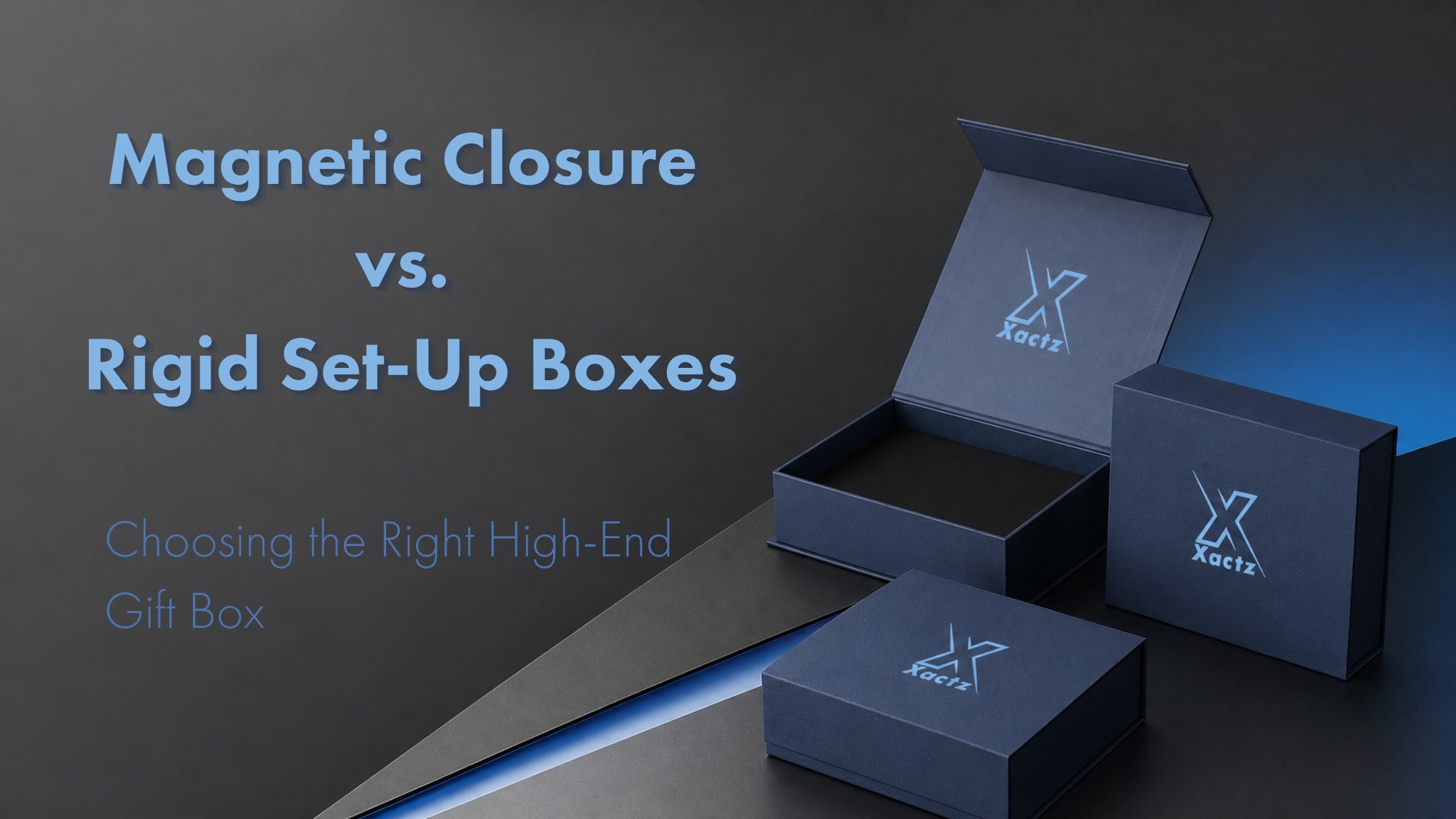
When it comes to luxury packaging, the box is never just a box. It is the first physical expression of your brand, the moment a customer decides whether the product inside is worth the premium they paid. For manufacturers in jewelry, cosmetics, high-end apparel, and gourmet food, the choice between magnetic closure gift boxes and rigid set-up boxes is one of the most consequential decisions in the entire product experience. Get it right and your packaging becomes a brand asset. Get it wrong and it becomes a liability.
This guide breaks down every dimension of that decision, from structural engineering to storage logistics, cost modeling to aesthetic positioning, so you can choose the format that serves your product, your customer, and your bottom line.
The luxury packaging market is not slowing down. Consumer expectations for premium unboxing experiences are rising year over year, and the physical packaging format you choose directly determines whether your brand meets or falls short of those expectations. In a market where 43% of consumers will pay more for sustainably and thoughtfully packaged products, and where unboxing content consistently drives social media engagement for premium brands, the structural format of your gift box is a strategic decision, not just an operational one.
For manufacturers supplying the jewelry, cosmetics, high-end apparel, and gourmet food sectors, two formats dominate the high-end gift box category: magnetic closure gift boxes and rigid set-up boxes. Both deliver a premium experience. Both support full custom branding. But they serve different use cases, different logistics models, and different brand positioning strategies. Understanding the differences in depth is the only way to make a choice you will not need to revisit.

A magnetic closure gift box, also referred to as a book-style box or a flap-lid box, is constructed from high-density chipboard wrapped in premium paper or fabric. The defining structural feature is a hinged lid that opens like a hardcover book, with small neodymium magnets embedded in the lid and the base that draw the closure shut automatically when the lid is pressed closed.
The hinge is a continuous bond along the spine of the box, typically reinforced with a fabric or paper hinge strip on the interior. This means the lid is permanently attached to the base, which eliminates the risk of a separated lid during shipping or retail display. The magnetic closure creates a satisfying, tactile snap that has become one of the most recognized signals of premium packaging in the modern luxury market.
Magnetic closure boxes are available in both rigid and collapsible formats. The rigid version is pre-assembled and ships in its final three-dimensional form. The collapsible version, discussed in detail in the storage section below, uses a scored and folded construction that allows the box to be shipped flat and assembled by the end user or fulfillment team.
Structurally, magnetic closure boxes support all premium finishing options: hot stamping, UV spot coating, embossing, debossing, soft-touch lamination, and full-color offset or digital printing. The exterior surface area of the lid provides a large, uninterrupted canvas for brand graphics, making this format particularly effective for brands whose visual identity is a core part of the product experience.

A rigid set-up box, also called a two-piece rigid box or a neck-and-shoulder box, is the oldest and most structurally traditional format in luxury packaging. It consists of two separate components: a base tray and a lid that sits over or inside the base. The two pieces are manufactured independently and do not fold or collapse. They are permanently set in their three-dimensional form from the moment they leave the production line, which is the origin of the name "set-up box."
The construction uses a wrapped chipboard system where a rigid greyboard core is wrapped in premium paper, fabric, or specialty material. The structural integrity of a rigid set-up box is exceptionally high. The four walls of both the base and the lid are fully solid, with no scored fold lines or hinge points that could become stress points over time. This makes the rigid set-up box the most durable format available in luxury packaging and the preferred choice for products that require maximum protection during transit and long-term storage.
The lid-to-base fit is engineered to a precise tolerance. A tight fit communicates craftsmanship and creates a deliberate, ceremonial opening experience. A looser fit allows for faster opening and is preferred in retail environments where customers open and close the box repeatedly. Both fit tolerances are available as a specification choice at the manufacturing stage.
Rigid set-up boxes support the full range of premium finishing options and are available in a wide variety of configurations including standard two-piece, neck-and-shoulder, telescope, and tray-and-lid formats. Interior fitments including die-cut foam, molded pulp, paper partitions, and fabric-lined trays are all compatible with the rigid set-up format.
Lid attachment: Magnetic closure boxes have a permanently attached hinged lid. Rigid set-up boxes have a fully separate lid.
Closure mechanism: Magnetic closure boxes use embedded neodymium magnets. Rigid set-up boxes use a friction fit between lid and base.
Opening experience: Magnetic closure boxes open like a book with a horizontal swing. Rigid set-up boxes open with a vertical lift.
Collapsibility: Magnetic closure boxes are available in collapsible flat-pack formats. Rigid set-up boxes are not collapsible and ship pre-assembled.
Structural rigidity: Both formats use chipboard construction. Rigid set-up boxes have a slight structural advantage due to the absence of hinge stress points.
Reuse appeal: Both formats are highly reusable. Magnetic closure boxes are slightly preferred for reuse due to the integrated lid.
Storage and logistics are where the choice between magnetic closure gift boxes and rigid set-up boxes has the most direct impact on operational cost. Understanding the practical implications of each format before placing a wholesale order is essential for manufacturers managing warehouse space, import freight, and fulfillment workflows.

Rigid set-up boxes are manufactured in their final three-dimensional form and cannot be collapsed or flattened. This means every unit occupies its full cubic volume from the moment it leaves the factory to the moment it is packed with product. For manufacturers ordering at wholesale volumes, this creates a significant storage footprint. A pallet of pre-assembled rigid set-up boxes contains a fraction of the unit count that the same pallet space would hold in flat-pack format.
The shipping cost implications are equally significant. Because rigid set-up boxes are essentially shipping air inside a structure, freight costs are calculated on dimensional weight rather than actual weight. For manufacturers importing from overseas factories, this can meaningfully increase the landed cost per unit compared to the factory unit price. Warehousing costs follow the same logic: more cubic space per unit means higher storage cost per unit at every point in the supply chain.
Despite these logistical challenges, rigid set-up boxes remain the preferred format for many luxury manufacturers because the pre-assembled format eliminates any assembly step at the fulfillment stage. For high-volume fulfillment operations where speed is a priority, receiving boxes that are ready to pack without any setup time has real operational value.

Collapsible magnetic closure boxes are engineered to fold flat along pre-scored lines, reducing their storage volume by up to 80% compared to their assembled dimensions. A pallet that holds 200 pre-assembled rigid boxes can hold 1,000 or more collapsible magnetic closure boxes at the same dimensions. For manufacturers managing limited warehouse space or importing large volumes, this difference is transformative.
The flat-pack format also dramatically reduces dimensional weight in freight calculations, which lowers shipping costs per unit on both inbound freight from the factory and outbound fulfillment to customers. For D2C brands shipping directly to consumers, this saving compounds across every order.
Assembly of collapsible magnetic closure boxes is straightforward. The scored fold lines guide the box into shape, and the magnetic closure locks the structure in place once assembled. Most fulfillment teams can assemble collapsible magnetic boxes at a rate that does not meaningfully impact throughput. For brands that pre-assemble boxes in advance of fulfillment runs, the process is even faster.
The practical recommendation for most manufacturers is this: if your warehouse space is limited, your freight budget is a priority, or you are importing at high volumes, collapsible magnetic closure boxes deliver a significant logistical advantage over pre-assembled rigid set-up boxes. If your fulfillment operation prioritizes zero assembly time and maximum structural protection, pre-assembled rigid set-up boxes are the more appropriate choice.
Cost is the dimension of this decision that generates the most questions from manufacturers, and also the one that is most frequently misunderstood. The unit price of a custom rigid box is not the total cost of that box. The total cost includes production, finishing, freight, storage, and any assembly labor. Understanding all of these components is the only way to make an accurate cost comparison between formats.
Custom rigid set-up boxes typically range from $3.00 to $15.00 or more per unit for standard to premium specifications at medium order volumes. The wide range reflects the significant impact of size, board weight, finishing options, interior fitments, and order quantity on unit cost. Hot stamping, embossing, soft-touch lamination, and custom interior trays each add to the base unit cost.
Magnetic closure gift boxes at wholesale volumes start significantly lower, with some suppliers offering pricing from $0.55 per unit at high volumes for standard specifications. Premium specifications with full finishing options will push the unit cost higher, but the production cost baseline for magnetic closure boxes is generally lower than for equivalent rigid set-up boxes due to the simpler two-component construction of the collapsible format.
Both formats support the same range of premium finishing options, and finishing costs are broadly comparable between the two. Hot stamping, UV spot coating, embossing, debossing, and soft-touch lamination are all available for both magnetic closure and rigid set-up formats. The cost differential in finishing is driven more by the surface area being finished than by the box format itself.
This is where the total cost comparison shifts most significantly. Pre-assembled rigid set-up boxes carry a substantial freight and storage cost premium due to their dimensional volume. For manufacturers importing from overseas factories, the dimensional weight surcharge on rigid set-up boxes can add $0.50 to $2.00 or more per unit to the landed cost, depending on shipping route and volume. Collapsible magnetic closure boxes, shipping flat, carry no dimensional weight surcharge and can reduce inbound freight cost per unit by 40% to 60% compared to pre-assembled rigid boxes at equivalent order volumes.
Both formats are available at wholesale with minimum order quantities that vary by supplier. Factory-direct suppliers like Xactz offer competitive MOQs for both magnetic closure gift boxes and custom rigid boxes, with pricing that scales favorably at higher volumes. For manufacturers placing large wholesale orders, factory-direct sourcing eliminates the distributor margin that inflates per-unit cost at retail packaging suppliers.
For manufacturers prioritizing the lowest total landed cost per unit, collapsible magnetic closure gift boxes typically deliver a lower total cost when freight and storage are included in the calculation. For manufacturers prioritizing maximum structural protection and zero assembly time, the higher total cost of pre-assembled rigid set-up boxes is justified by the operational benefits.
Beyond structure and logistics, the aesthetic and experiential qualities of each box format are the most important factors for luxury manufacturers whose packaging is a direct extension of their brand identity.
The magnetic closure gift box has become the defining aesthetic of modern luxury packaging. Its book-style opening, the smooth horizontal swing of the lid, and the satisfying magnetic snap closure create an unboxing experience that feels deliberate, ceremonial, and contemporary. For brands in the jewelry, cosmetics, and premium apparel sectors whose customers share unboxing moments on social media, the magnetic closure format is purpose-built for that context.
The exterior of a magnetic closure box offers a large, uninterrupted surface on both the lid and the base for brand graphics. The spine of the box, visible when the box is displayed on a shelf or retail fixture, provides an additional branding surface that rigid set-up boxes do not offer. The hinged lid means the box can be displayed open, showing the product inside alongside the brand graphics on the interior of the lid, which is a powerful retail presentation format.
Magnetic closure boxes are available in a wide range of exterior materials including premium coated paper, linen-texture paper, kraft paper, velvet fabric, and specialty materials. Interior options include ribbon pulls, die-cut foam inserts, paper partitions, fabric-lined trays, and molded pulp fitments. The format is particularly well suited to jewelry, cosmetics, premium candles, gourmet food gift sets, and high-end apparel accessories.
For brands whose identity is built on innovation, modernity, and a premium digital-native aesthetic, the magnetic closure gift box is the natural choice.
The rigid set-up box carries a different aesthetic language. It is the format of heritage luxury brands, fine jewelry houses, and prestige department store packaging. The separate lid, the deliberate vertical lift required to open it, and the solid structural walls communicate permanence, craftsmanship, and timelessness in a way that no other packaging format replicates.
For manufacturers in the fine jewelry sector, the rigid set-up box is the industry standard for a reason. The two-piece format allows the base to be displayed independently with the product inside while the lid is set aside, which is the standard presentation format for jewelry retail. The neck-and-shoulder construction, where a narrow inner tray sits inside a slightly larger outer lid, creates a tiered opening experience that feels genuinely ceremonial.
For gourmet food manufacturers, the rigid set-up box in a telescope or tray-and-lid format provides the structural protection required for fragile or heavy food products while delivering a presentation quality that justifies a premium price point. The interior of a rigid set-up box can be fitted with custom paper partitions, fabric-lined compartments, or molded pulp inserts that hold multiple products in precise positions, which is a configuration that magnetic closure boxes can replicate but that rigid set-up boxes execute with slightly greater structural stability.
For high-end apparel manufacturers, the rigid set-up box in a large flat format with a ribbon pull is the classic presentation for folded garments, scarves, and accessories. The format communicates the same heritage luxury aesthetic that the apparel itself is designed to project.
Magnetic closure gift boxes are best suited for: jewelry, cosmetics, premium candles, gourmet food gift sets, apparel accessories, D2C luxury brands, social-media-forward unboxing experiences, and modern premium retail.
Rigid set-up boxes are best suited for: fine jewelry retail, heritage luxury brands, prestige cosmetics, high-end apparel, gourmet food with multiple components, department store retail, and brands whose identity is built on timeless craftsmanship.
Both formats support: full custom branding, premium finishing options, custom interior fitments, FSC-certified sustainable materials, soy-based ink printing, and factory-direct wholesale pricing.
The choice between magnetic closure gift boxes and rigid set-up boxes is not a question of which format is better. It is a question of which format is better for your specific product, your specific customer, and your specific operational model.
If your brand is building a modern luxury identity, if your customers share unboxing moments online, if you are managing freight and storage costs carefully, and if you want a format that delivers a premium experience at a competitive total landed cost, magnetic closure gift boxes in a collapsible flat-pack format are the stronger choice for most use cases.
If your brand is positioned in the heritage luxury segment, if your retail environment requires a separate lid for product display, if maximum structural protection is a non-negotiable requirement, and if zero assembly time at the fulfillment stage is an operational priority, rigid set-up boxes are the appropriate choice.
For many manufacturers, the answer is not either-or. A jewelry brand might use rigid set-up boxes for its flagship retail line and magnetic closure gift boxes for its D2C e-commerce channel. A cosmetics manufacturer might use magnetic closure boxes for gift sets and rigid set-up boxes for single-product hero SKUs. The two formats are complementary, not competitive, and a packaging strategy that uses both in the right contexts is often the most commercially effective approach.
The most important step is to know your specifications before you source. Know your product dimensions. Know your order volume. Know your freight model. Know your customer's unboxing expectations. With those specifications in hand, a factory-direct quote from Xactz will give you the exact cost comparison you need to make the right decision with confidence.
Whether you are sourcing magnetic closure gift boxes, custom rigid boxes, or wholesale luxury boxes for jewelry, cosmetics, apparel, or gourmet food, Xactz manufactures directly with no distributor markup, full custom specification support, and competitive MOQs for both formats.
Know your specifications. Get your direct factory quote today.
By Xactz Packaging
Aug 16, 2026
By Xactz Packaging
Aug 13, 2026
By Xactz Packaging
Aug 12, 2026
