Use less text on mobile!
EXACTLY WHAT YOU NEED
EVERYTHING CUSTOMIZABLE
Use less text on mobile!
FEEL THE LUXURY
CONTACT US TO GET A QUOTE AS YOU NEED
EXACTLY WHAT YOU NEED
EVERYTHING CUSTOMIZABLE
CONTACT US & GET YOUR QUOTE
FEEL THE LUXURY
By Xactz Packaging
Apr 27, 2026
Add a comment
When you place a packaging order with a manufacturer, you are making a significant commitment, of budget, of time and of brand reputation. The packaging that arrives at your warehouse will represent your brand in the hands of every customer who receives it. If the quality is inconsistent, the finish is wrong or the structure fails in transit, the consequences fall on your brand, not your manufacturer.
ISO 9001 certification exists precisely to address this risk. It is the global standard for quality management systems, and for brands sourcing packaging from manufacturers anywhere in the world, it is one of the most important credentials a supplier can hold.
This guide explains what ISO 9001 is, what it means in the context of packaging manufacturing, and why working exclusively with ISO 9001 certified manufacturers is one of the most important sourcing decisions your brand can make.
ISO 9001 is an internationally recognised standard for Quality Management Systems (QMS), published and maintained by the International Organization for Standardization (ISO). It defines the requirements that an organisation's quality management system must meet in order to consistently deliver products and services that satisfy customer requirements and comply with applicable regulations.
The current version, ISO 9001:2015, is the most widely adopted management system standard in the world. Over one million organisations across 170+ countries hold ISO 9001 certification, spanning manufacturing, services, logistics and beyond.
ISO 9001 is not an industry-specific standard. It applies to any organisation, of any size, in any sector. What makes it universally relevant is its focus on the underlying systems and processes that determine whether an organisation can deliver consistent quality, regardless of what it produces.
ISO 9001:2015 is built around seven quality management principles that form the foundation of the standard:
The primary objective of quality management is to meet customer requirements and strive to exceed customer expectations. Every process in a certified organisation is evaluated against its contribution to customer satisfaction.
Top management must demonstrate commitment to the quality management system, not delegate it. Quality must be embedded at the leadership level, not managed as a separate function.
Competent, empowered people at every level of the organisation are essential to delivering consistent quality. ISO 9001 requires documented competency frameworks, training records and defined responsibilities.
Quality outcomes are the result of consistent processes — not individual effort. ISO 9001 requires organisations to define, document, monitor and continuously improve every process that affects product quality.
Certified organisations must demonstrate a systematic approach to identifying non-conformances, investigating root causes and implementing corrective actions. Quality is not static, it must be actively improved.
Decisions must be based on the analysis of data and information, not assumption or habit. ISO 9001 requires organisations to collect, analyse and act on quality data at every stage of production.
Quality extends beyond the organisation's own walls. ISO 9001 requires certified organisations to manage their supplier and partner relationships in a way that supports consistent quality outcomes throughout the supply chain.
In a packaging manufacturing context, ISO 9001 certification means that the manufacturer has implemented and maintains a documented quality management system that governs every stage of the production process, from raw material intake to finished product dispatch.
In practical terms, this means:
Every material that enters the production facility, paper, board, foil, laminate, adhesive, is inspected and verified against specification before it enters the production line. Non-conforming materials are quarantined and rejected. This eliminates the risk of quality failures caused by substandard input materials.
Every production process, printing, laminating, die-cutting, folding, gluing, finishing, is documented with defined parameters, tolerances and inspection points. Operators follow documented procedures, not informal practice. This ensures that the process that produced your first order is the same process that produces your tenth.
Quality checks are embedded at defined intervals throughout the production process, not just at the end. This means defects are identified and corrected at the point of origin, not discovered after an entire production run has been completed.
When a quality issue is identified, at any stage, it is formally recorded, investigated and resolved through a documented corrective action process. The root cause is identified and addressed to prevent recurrence. This is fundamentally different from simply replacing defective units.
Every finished order is inspected against specification before release. Dimensional accuracy, colour consistency, finish quality, structural integrity, all verified against the approved sample before the order leaves the facility.
Every production batch is traceable, from the raw materials used to the finished product shipped. In the event of a quality issue, the manufacturer can identify exactly which materials, processes and personnel were involved and take targeted corrective action.
The packaging industry, particularly in high-volume manufacturing markets, contains a significant number of manufacturers who operate without any formal quality management system. This does not mean they always produce poor quality. It means their quality is unpredictable, dependent on individual operators, informal practices and the absence of systematic controls.
For brands, this unpredictability creates several specific risks:
Without documented process controls, the quality of your second order may differ materially from your first, in colour, in finish, in structural precision. For brands with multiple SKUs or ongoing reorder programmes, this inconsistency is commercially damaging.
When a non-certified manufacturer produces a defective batch, the typical response is to replace the units. The underlying cause, a miscalibrated machine, a substandard material batch, an undertrained operator, is rarely identified or addressed. The same problem recurs.
If a quality dispute arises, a non-certified manufacturer has no documented quality records to reference. There is no inspection data, no material traceability, no corrective action history. Resolving the dispute becomes a matter of assertion rather than evidence.
Major retailers, brand owners and procurement teams increasingly require ISO 9001 certification as a baseline supplier qualification. Working with a non-certified manufacturer can disqualify your brand from retail listings, corporate procurement programmes and export markets that require documented quality assurance.
ISO 9001 certification is issued by accredited certification bodies, independent third-party organisations authorised to audit and certify compliance with the standard. Not all certification claims are legitimate. Before relying on a manufacturer's ISO 9001 claim, verify the following:
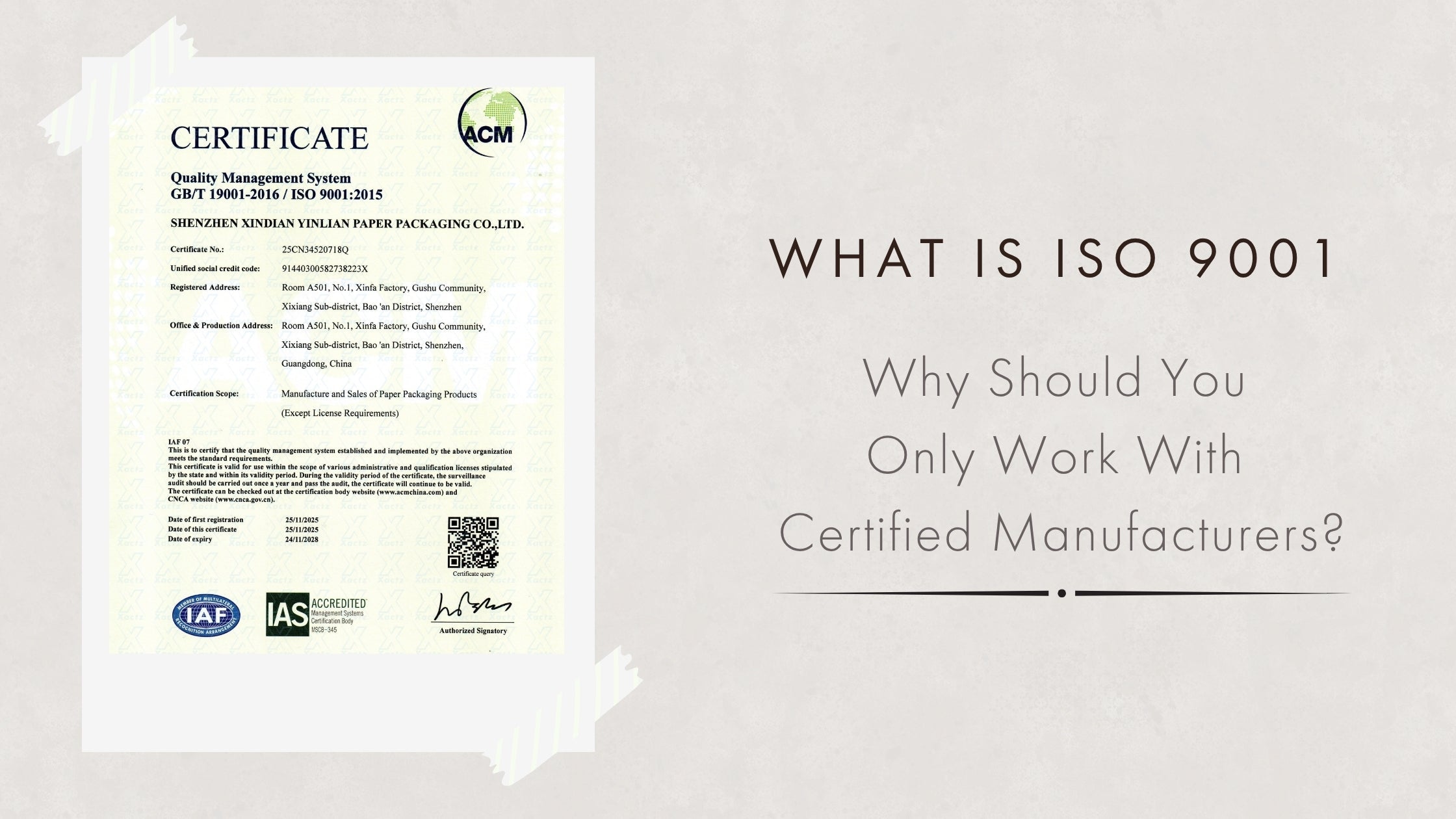
Legitimate ISO 9001 certificates are issued by accredited certification bodies, such as Bureau Veritas, SGS, Intertek, TÜV Rheinland, BSI or equivalent. A certificate issued by an unrecognised body may not represent a genuine third-party audit.
The certificate scope defines exactly which sites, processes and product categories are covered. A manufacturer may hold ISO 9001 certification for one facility but not another, or for some processes but not all. Confirm that your specific packaging type and production site fall within the certified scope.
ISO 9001 certificates are valid for three years and require annual surveillance audits to remain active. A certificate that has not been renewed is not a valid certification, it is evidence of a lapsed commitment.
A legitimate ISO 9001 certified manufacturer will provide their certificate immediately and without hesitation. Reluctance to share certification documentation is a significant red flag.
ISO 9001 certification is the quality foundation, but for brands sourcing premium packaging, it is most valuable when combined with complementary certifications that address sustainability, environmental responsibility and supplier verification.
The main certification stack for a premium packaging manufacturer should include:

Quality management system, consistent production quality

Responsible forest sourcing, paper and board traceability

Independent supplier assessment, operational credibility
Together, these three certifications address the three questions every quality-conscious brand should ask of their packaging manufacturer: Can you deliver consistent quality? Can you prove your materials are responsibly sourced? Has an independent third party verified your operation?
Xactz holds ISO 9001:2015 certification, valid until 24 November 2028, alongside FSC Chain-of-Custody certification and TÜV Rheinland Verified Supplier status for 2025–2026. These are not marketing claims. They are independently audited, third-party verified credentials that are available for review on request.
Operating across 40,000 sqm of fully automated manufacturing facilities spanning Shenzhen and Huizhou, Xactz is China's No.1 luxury custom packaging manufacturer, with 300+ specialists in printing, engineering, die-cutting and quality control, serving brands in 60+ countries since 2006.
Every order produced at Xactz is governed by a documented quality management system that covers raw material intake, in-process inspection, final release and full batch traceability. The ISO 9001 framework is not a certificate on the wall, it is the operating system of the entire production facility.
With 20+ finishing options, flexible order quantities from pilot runs to large-scale programmes, and a 10–18 day production timeline from design approval to dispatch, Xactz delivers the quality, consistency and certification credentials that premium brands require.
The packaging your customer receives is a direct reflection of your brand's commitment to quality. Every dent, every colour inconsistency, every misaligned finish tells your customer something about how much care went into their order.
ISO 9001 certification is the mechanism that ensures that care is systematic, documented and consistent, not dependent on luck, individual effort or informal practice.
Work only with manufacturers who can prove their quality commitment with independently verified certification. Your brand reputation depends on it.
Contact the Xactz team today to discuss your packaging requirements, request your ISO 9001 certificate, and receive your complimentary sample pack. Every enquiry is handled by a dedicated packaging specialist, not a sales script.
Xactz : China's Top 1 Luxury Custom Packaging Manufacturer. ISO 9001 Certified. FSC Certified. TÜV Rheinland Verified.
By Xactz Packaging
Aug 16, 2026
By Xactz Packaging
Aug 13, 2026
By Xactz Packaging
Aug 12, 2026
