Use less text on mobile!
EXACTLY WHAT YOU NEED
EVERYTHING CUSTOMIZABLE
Use less text on mobile!
FEEL THE LUXURY
CONTACT US TO GET A QUOTE AS YOU NEED
EXACTLY WHAT YOU NEED
EVERYTHING CUSTOMIZABLE
CONTACT US & GET YOUR QUOTE
FEEL THE LUXURY
By Xactz Packaging
May 24, 2026
Add a comment
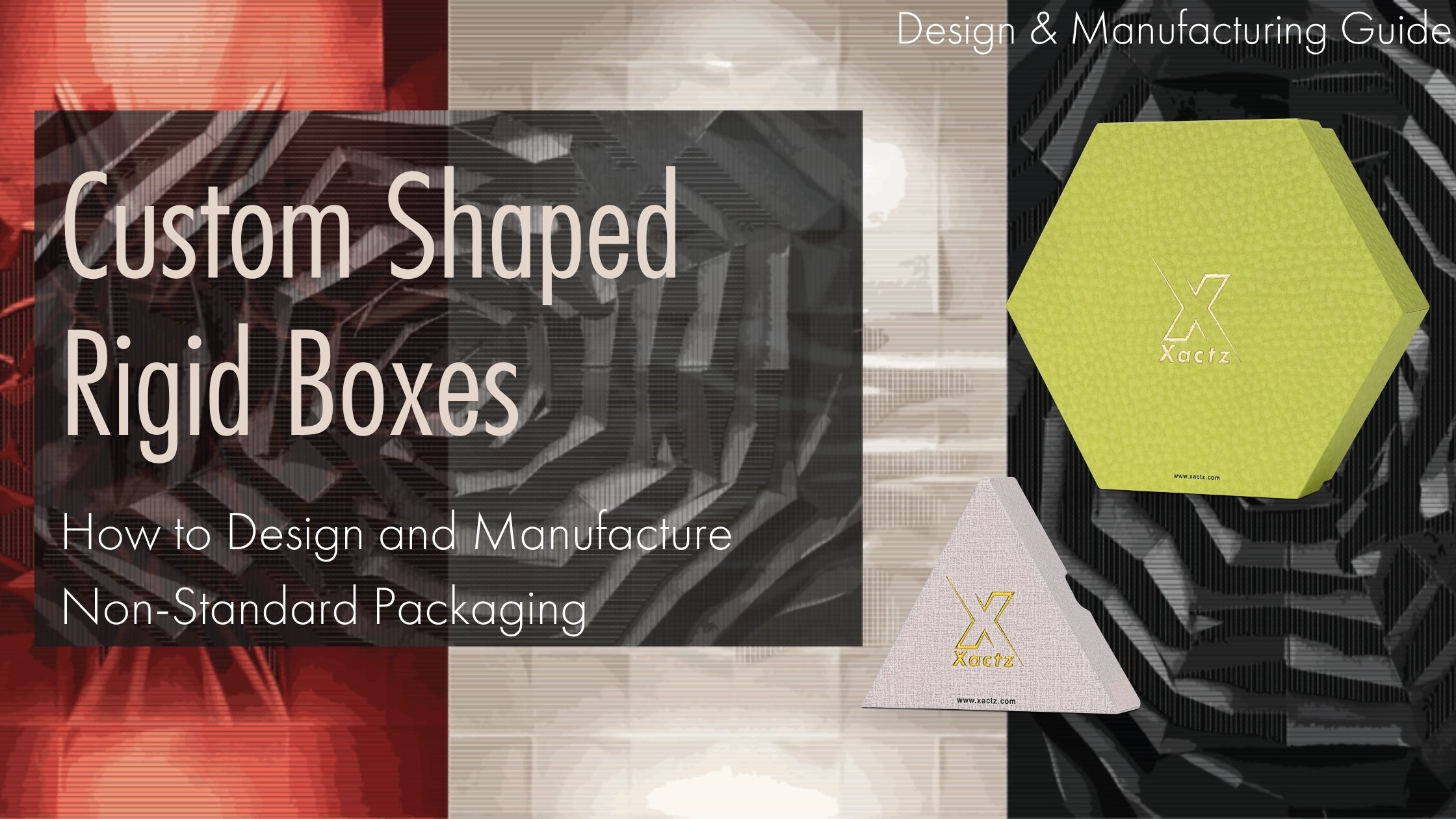
A custom shaped rigid box is a packaging structure that departs from the standard rectangular or square format, engineered to a specific geometry, contour, or architectural form that is unique to the brand or product it is built for.
Where a standard rigid box is defined by its four right-angle corners and flat parallel surfaces, a custom shaped rigid box can take almost any form. Hexagonal. Octagonal. Cylindrical. Triangular. Trapezoidal. Arch-topped. Curved-sided. Asymmetric. Or entirely proprietary, a shape that exists nowhere else in the market and belongs exclusively to the brand that commissioned it.
The rigid box construction itself, a chipboard core wrapped in paper, fabric, or specialist material, remains the same. What changes is the geometry of the structure, the engineering required to hold that geometry under load and in transit, and the manufacturing precision needed to produce it consistently at scale.
Custom shaped rigid boxes are used across the full spectrum of the luxury goods market, fragrance, cosmetics, spirits, jewellery, confectionery, electronics, fashion accessories, and premium gifting, wherever the packaging is expected to do more than contain a product. Wherever the box itself is part of the brand experience.
The decision to move from a standard rigid box to a custom shaped structure is rarely made lightly. It involves more complex engineering, longer development timelines, and higher tooling investment. Brands that make that decision do so because the standard format is no longer sufficient, and because the packaging needs to work harder.
There are several reasons brands arrive at that point.
Shelf differentiation. In a retail environment where dozens of luxury products compete for the same buyer's attention, a non-standard shape creates an immediate visual break from everything around it. The eye goes to what is different. A custom shaped rigid box is different by definition.
Brand identity. For some brands, the shape of the packaging is as much a part of the brand identity as the logo or the colour palette. The box is not a container, it is a brand asset. A proprietary shape that cannot be replicated by a competitor without direct imitation.
Product fit. Some products are not rectangular. A sculptural fragrance bottle, an irregularly shaped confection, a precision instrument, these products deserve packaging that is engineered around their specific geometry, not forced into a standard format that does not serve them.
Unboxing experience. The moment a customer opens a package is a brand moment. A custom shaped rigid box, with its specific geometry, its engineered opening mechanism, its interior construction, creates an unboxing experience that a standard box cannot replicate.
Premium positioning. The investment in a custom shaped rigid box signals something to the buyer before they have even opened it. It signals that the brand behind the packaging takes quality seriously at every level, including the level that most brands treat as an afterthought.
Designing a custom shaped rigid box begins with a brief, and the quality of the brief determines the quality of everything that follows. A strong brief answers four questions: what is the product, what does the packaging need to do, what does the brand need the packaging to say, and what are the constraints.
From the brief, the structural design process moves through several stages.
Concept development. The structural engineer translates the brief into initial geometry concepts, exploring the shape language, the opening mechanism, the interior construction, and the material implications of each option. At this stage, the goal is to identify the structural direction before committing to detailed engineering.
Structural drawing. Once the concept direction is confirmed, the structural engineer produces a full technical drawing, the dieline, that defines every dimension, every fold, every score line, and every tolerance of the finished structure. For custom shapes, this drawing is more complex than a standard box dieline and requires a higher level of engineering precision.
Digital mockup. Before any physical material is cut, a digital 3D render of the structure is produced, allowing the brand to visualise the finished box in context, check proportions, and confirm the design direction before the first physical sample is made.
Physical sample. The first physical sample is produced by hand, cut and constructed from the specified materials to the exact dimensions of the structural drawing. This is the critical validation stage. The sample is tested for structural integrity, opening mechanism function, product fit, and finishing compatibility before any production tooling is committed.
Refinement. Most custom shaped rigid box projects go through at least one round of sample refinement, adjusting dimensions, tolerances, or construction details based on the physical sample review. This is normal and expected. The goal of the sampling stage is to arrive at a confirmed structure that performs exactly as specified before production begins.
The material specification of a custom shaped rigid box has a direct impact on what shapes are achievable, how the finished structure performs, and what the box communicates to the person holding it.
Greyboard / chipboard core. The structural foundation of every rigid box, a dense, compressed board that provides the rigidity and weight that defines the premium feel of the format. For custom shapes, the thickness and grade of the greyboard is selected based on the structural demands of the specific geometry. Thicker board for larger structures. Higher-grade board for shapes with complex curves or acute angles.
Wrapping paper. The outer surface of the rigid box, the material that carries the brand's visual identity. Wrapping papers range from uncoated and textured stocks to metallics, soft-touch laminates, and specialist materials including fabric, leather, and suede. For custom shapes with curved surfaces, the wrapping material must have sufficient flexibility to conform to the geometry without creasing or lifting at the edges.
Interior lining. The interior of a custom shaped rigid box is typically lined with a separate material, chosen for its tactile quality, its visual contrast with the exterior, and its compatibility with the product it will hold. Velvet, foam, moulded pulp, vacuum-formed tray inserts, and custom-cut EVA foam are all common interior specifications for custom shaped structures.
Specialty materials. For the highest tier of custom shaped rigid box production, specialty materials including book-binding cloth, Japanese tissue, hand-marbled paper, and custom-woven fabric are available as wrapping materials, each adding a layer of material authenticity that reinforces the premium positioning of the finished structure.
Manufacturing a custom shaped rigid box requires a different production approach from a standard rectangular structure, and understanding that process helps brands set realistic expectations for tooling, sampling, and production timelines.
Tooling. Every custom shape requires a bespoke cutting die, a precision-engineered steel-rule tool that cuts the greyboard and wrapping materials to the exact geometry of the structural drawing. Tooling is a one-time investment per shape and is reused across all subsequent production runs of the same structure.
Greyboard cutting. The greyboard core panels are cut to the exact dimensions of the structural drawing using the bespoke cutting die. For complex shapes, multiple panels are cut and assembled, the greyboard construction of a non-standard shape requires more individual components than a standard rectangular box.
Assembly. The cut greyboard panels are assembled into the three-dimensional structure, joined with precision-applied adhesive and held under pressure until fully cured. For custom shapes, the assembly stage requires a higher level of manual skill than standard box production, the geometry must be held exactly true during the curing process.
Wrapping. The assembled greyboard structure is wrapped in the specified outer material, paper, fabric, or specialist material, with the wrapping cut to the exact profile of the shape and applied with consistent tension to ensure a smooth, crease-free surface across all faces and edges.
Finishing. Once wrapped, the box passes through the finishing stage, where foil stamping, embossing, debossing, UV spot coating, screen printing, or any other specified surface treatment is applied. For custom shapes, finishing registration requires additional precision, the finishing tools must be aligned to the specific geometry of the structure.
Quality control. Every production run passes through Xactz's 18-point in-house QC framework, checking structural integrity, dimensional accuracy, surface finish quality, opening mechanism function, and interior construction against the confirmed sample specification.
The finishing of a custom shaped rigid box is where the structural engineering meets the brand's visual identity, and where the packaging moves from impressive to extraordinary.
| Finishing Option | Effect | Best Used For |
|---|---|---|
| Foil stamping | Metallic or holographic surface application | Brand marks, logos, fine detail |
| Embossing | Raised surface relief without colour | Texture, logo, pattern |
| Debossing | Recessed surface impression | Understated brand marks, tactile detail |
| Soft-touch lamination | Velvet-like matte surface | Premium feel, full-surface application |
| UV spot coating | High-gloss selective surface coating | Contrast against matte, highlighting detail |
| Screen printing | Direct ink application to surface | Colour, pattern, illustration |
| Hot stamping | Heat-applied metallic or pigment foil | Fine lines, small text, intricate marks |
| Matte lamination | Flat, non-reflective surface finish | Clean, modern luxury aesthetic |
| Gloss lamination | High-reflectivity surface finish | Vibrant colour, high-impact visual |
| Aqueous coating | Water-based protective surface coating | Durability, subtle sheen |
Finishing combinations, for example, soft-touch lamination with UV spot coating and foil stamping, are standard practice in luxury rigid box production and are fully supported across all custom shaped structures at Xactz.
While every custom shaped rigid box project is unique, certain geometric departures from the standard rectangular format appear consistently across the luxury packaging market, each with its own structural logic and brand application.
Hexagonal boxes. Six-sided structures with a strong architectural presence, used widely in premium confectionery, cosmetics, and gifting. The hexagonal format stacks efficiently and presents well on shelf and in flat-lay photography.
Octagonal boxes. Eight-sided structures that combine the visual interest of a non-standard shape with a relatively straightforward manufacturing process, used in fragrance, jewellery, and premium food gifting.
Cylindrical boxes. Circular cross-section structures, either full cylinders or half-cylinders, used in fragrance, candle, and premium spirits packaging. Cylindrical rigid boxes require specialist wrapping techniques and are a strong indicator of manufacturing capability.
Arch-topped boxes. Rectangular base with a curved or arched lid, used in jewellery, watch, and premium accessory packaging. The arch creates a distinctive silhouette and a dramatic opening moment.
Triangular and trapezoidal boxes. Angular structures used in premium confectionery, cosmetics, and limited-edition gifting, particularly effective for products that are displayed in groups or multiples.
Book-style boxes. Hinged structures that open like a book, used across fragrance, cosmetics, electronics, and premium gifting. The book-style format creates a strong unboxing narrative and a high-perceived-value opening experience.
Fully bespoke geometries. Shapes that exist nowhere else, engineered from scratch to a brand's specific brief. These are the most complex and the most powerful custom shaped rigid box projects, and they are the projects that Xactz's structural engineering team is built for.
Custom shaped rigid boxes introduce structural engineering challenges that do not exist in standard rectangular production. Understanding these challenges helps brands brief more effectively and make better decisions during the design and sampling process.
Corner integrity. Acute angles, corners sharper than 90 degrees, place concentrated stress on the greyboard and wrapping material at the corner point. The greyboard grade, the wrapping material flexibility, and the adhesive specification all need to be calibrated to the specific angle to ensure the corner holds under repeated use and in transit.
Curve construction. Curved surfaces in rigid box construction require the greyboard to be scored, slotted, or laminated in multiple thin layers to achieve the curve without cracking. The wrapping material must have sufficient stretch and flexibility to conform to the curve without lifting or creasing at the edges.
Lid and base alignment. For custom shaped boxes with separate lids and bases, the dimensional tolerances between the two components must be engineered to a tighter specification than a standard rectangular box, because any deviation in a non-standard geometry is more visually apparent than in a standard format.
Load distribution. Custom shapes that depart significantly from the rectangular format may have uneven load distribution under stacking or transit conditions. The structural engineer must account for this in the greyboard specification and the interior construction to ensure the box protects the product under real-world conditions.
Interior construction. The interior of a custom shaped rigid box must be engineered to fit the specific geometry of the structure, a standard rectangular tray insert will not work in a hexagonal or cylindrical box. Custom interior constructions, moulded pulp, vacuum-formed trays, custom-cut foam, are the standard solution and add an additional layer of engineering complexity to the project.
One of the most common questions brands ask when approaching a custom shaped rigid box project for the first time is about minimum order quantities, sampling timelines, and production lead times. Here is what to expect.
| Stage | Example Timelines |
|---|---|
| Structural drawing from confirmed brief | 2–5 business days |
| Digital 3D render | 1–2 business days from confirmed drawing |
| First physical sample | 3–5 business days from confirmed drawing |
| Sample refinement round | 3–5 business days per round |
| Production tooling | Included in the production process |
| Production run | 10–18 days from confirmed sample |
MOQ for custom shaped rigid boxes: from 100 units.
Xactz operates a dedicated department for personalised small-order production, meaning the brand commissioning 100 custom shaped rigid boxes receives the same structural engineering precision, the same certified materials, and the same 18-point QC standard as the enterprise managing a 500,000-unit annual programme.
There is no minimum order that is too small to receive the full Xactz manufacturing standard. And there is no order that is too large for Xactz's 40,000+ sqm production capacity across Shenzhen and Huizhou to handle.
Not every rigid box manufacturer is equipped to produce custom shaped structures at a consistent quality level. When evaluating a custom shaped rigid box manufacturer, there are several capabilities that separate the manufacturers who can deliver from the manufacturers who will struggle.
In-house structural engineering. Custom shapes require structural engineers who can translate a brief into a technically sound dieline, not just adapt a standard template. Ask whether the manufacturer has in-house structural engineering capability or relies on external design agencies.
Sampling capability and speed. The sampling stage is where custom shaped rigid box projects succeed or fail. A manufacturer with fast, in-house sampling capability, ideally 3–5 days for a first physical sample, gives brands the iteration speed they need to develop complex shapes without losing months to slow sample turnarounds.
Material range. Custom shapes place specific demands on wrapping materials, flexibility, stretch, and edge-adhesion properties that standard rectangular box production does not require. A manufacturer with a wide material library is better equipped to find the right wrapping specification for a complex geometry.
Finishing registration precision. Applying foil stamping or embossing to a non-standard surface requires finishing tools that are engineered to the specific geometry of the box. Ask whether the manufacturer produces finishing tools in-house or outsources them, in-house tooling gives tighter registration control.
Quality control framework. A rigorous, documented QC process is essential for custom shaped production, where dimensional tolerances are tighter and structural consistency is harder to maintain than in standard rectangular production. Ask for the manufacturer's QC documentation and inspection criteria.
Certifications. ISO 9001:2015 certification is the baseline indicator of a documented quality management system. FSC™ certification confirms responsible material sourcing. TÜV Rheinland verification provides independent third-party confirmation of manufacturing process standards.
Xactz is a global leading manufacturer specialising in high-end packaging boxes, with 40,000+ sqm of fully automated and semi-automated production across Shenzhen and Huizhou, China, and a structural engineering capability built specifically for the complexity of custom shaped rigid box production.
Manufacturing capability:
| Capability | Detail |
|---|---|
| Total facility footprint | 40,000+ sqm across Shenzhen and Huizhou |
| Production lines | Fully automated + semi-automated |
| Quality control | 18-point in-house QC on every production run |
| Finishing options | 20+ premium finishing options |
| Sample turnaround | 1–3 business days from confirmed brief |
| Production turnaround | 10–18 days from sample approval |
| MOQ | From 100 units |
| Global Service | Served 60+ countries |
Certifications:
✅ ISO 9001:2015 : International quality management certification
✅ FSC™ Certified : Responsible and sustainable sourcing Certification Code: SGSHK-COC-332603
✅ TÜV Rheinland Verified Supplier : Independent third-party factory audit
✅ FDA Compliant : Safe for food-contact and consumer use
✅ EU 94/62/EC Qualified : Export qualified for European and global markets
International exhibition recognition:
Xactz has been ranked in the top 5% at three consecutive international packaging exhibitions, Paris Packaging Week 2026, Packaging Innovations & Empack 2026, and Packaging Première & PCD Milan 2026, recognised each time for innovation, quality, and craftsmanship.
Dedicated small-order production department:
As a global leading manufacturer specialising in high-end packaging boxes, Xactz has established a dedicated department for personalised small-order production, committed to supporting the growth of small companies and ensuring the seamless execution of micro-order solutions for large enterprises. The brand ordering 100 custom shaped boxes today and the enterprise managing multi-million-unit annual programmes tomorrow receive the same manufacturing precision, the same certified materials, and the same uncompromising quality standard.
Every custom shaped rigid box project begins with a conversation. Tell us about the product, the brand, the shape you have in mind, or the problem you are trying to solve, and our structural engineering team will take it from there.
By Xactz Packaging
Aug 16, 2026
By Xactz Packaging
Aug 13, 2026
By Xactz Packaging
Aug 12, 2026
